
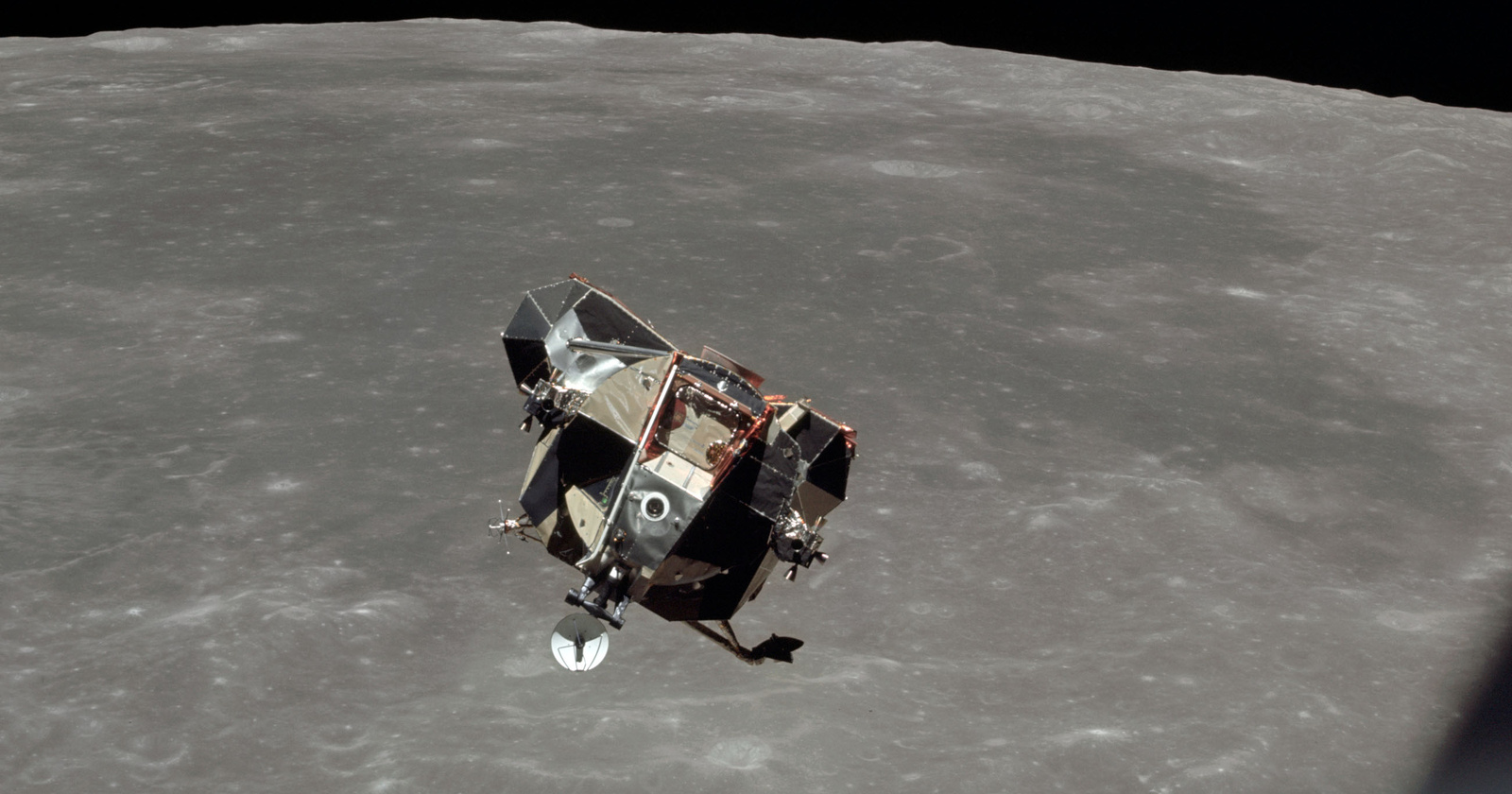
Sixty nautical miles above the Sea of Tranquility, Michael Collins put his eye to Columbia's sextant and tried to find two men on the Moon. Houston had given him the best coordinates it could, then different ones, drawn from a landing that had come down about four miles from the planned spot. The command module passed over the site too quickly to search it properly. He never spotted Eagle.
That was July 20, 1969, after Neil Armstrong and Buzz Aldrin had already landed. Collins's job was not to watch. It was to keep their ride home in orbit, and to be there when they came back up.
"You cats take it easy"
Earlier that afternoon, at 1:46 p.m. Eastern daylight time, Eagle had undocked and drifted away. Collins, his nose against the window, watched the ungainly lander turn in place. "You cats take it easy on the lunar surface," he told them, in an account he later wrote for NASA. A minute later: "You guys take care." Armstrong answered, "See you later."
Columbia then slipped behind the Moon. For the next stretch, no radio from Houston could reach him, and he could not reach Armstrong or Aldrin. A body of rock some 2,100 miles across sat between him and every other person alive.
Three billion plus two
He was alone in the command module for a little more than 27 hours, circling once every two hours, roughly 14 times in all. On each pass, about 48 minutes were spent on the far side, out of contact.
In his 1974 memoir, Carrying the Fire, Collins wrote down the arithmetic as he felt it. "I am alone now, truly alone, and absolutely isolated from any known life," he said. "I am it. If a count were taken, the score would be three billion plus two over on the other side of the moon, and one plus God only knows what on this side."
He did not describe that as loneliness. "I feel this powerfully—not as fear or loneliness—but as awareness, anticipation, satisfaction, confidence, almost exultation," he wrote, in a passage later quoted by National Geographic. "I like the feeling."
A happy little home
Columbia was, to him, a known ship. It had warm coffee and, if he wanted it, music. The cabin was quieter on the far side. "I was not lonely," he said at an Explorers Club event in New York in 2019. "I had a happy little home in the command module. Behind the moon it was very peaceful — no one in Mission Control is yakkin' at me and wanting me to do this, that, and the other." The remark is preserved by Space Center Houston.
There was still work. He ran checklists and watched the systems that would have to catch Eagle in orbit and, if needed, fly all three of them home. "Far from feeling lonely or abandoned, I feel very much a part of what's taking place on the lunar surface," he wrote. He did not pretend he had the best of the three Apollo 11 seats. He did say he was satisfied with the one he had.
The name that stuck
On the morning of July 21, at 9:44 a.m. Eastern time, after waking Collins, still circling the Moon, Mission Control offered a line that traveled farther than most of the flight's technical commentary.
"Not since Adam has any human known such solitude as Mike Collins is experiencing during this 47 minutes of each lunar revolution when he's behind the Moon with no one to talk to except his tape recorder aboard Columbia."
It was a NASA commentator speaking, not Collins. The official mission log records it as a remark from Mission Control.
When the crew came home, the press had a nickname ready. Collins later said, in an interview with The Atlantic, that news headlines had called him the loneliest man in history, and he would mimic a sorrowful announcer asking whether he had been terribly lonely behind the Moon. He thought the idea was ridiculous. In 2021, after his death, NASA's acting administrator, Steve Jurczyk, still had to nod at the phrase: "some called him 'the loneliest man in history.'"
The fear that was real
What did preoccupy him was not the quiet. It was the thought of going home alone.
The ascent engine on Eagle had never been fired from the lunar surface. If it failed, Armstrong and Aldrin would be stranded. Collins had been living with that possibility for months. Before launch, the three men had not been able to get affordable life insurance; they signed hundreds of envelopes to leave with their families. Collins's own private dread was more specific.
"My secret terror for the last six months has been leaving them on the Moon and returning to Earth alone; now I am within minutes of finding out the truth of the matter," he recorded at the time, a line later quoted in accounts of the mission. "I will be a marked man for life, and I know it."
Eagle coming back
At 1:54 p.m. on July 21, the ascent engine lit. Eagle rose from the descent stage it left behind in the Sea of Tranquility. A little more than three and a half hours later, at 5:35 p.m., the two spacecraft docked — on the far side of the Moon, out of sight of Earth.
From Columbia, Collins photographed the ascent stage on its way in: a small, angular machine hanging over the gray of Smyth's Sea, with Earth a blue-and-white crescent above the horizon. That picture is the one the world now knows. It is also the view from the seat he had been given: the ship coming back, and the home he had kept ready for it.