
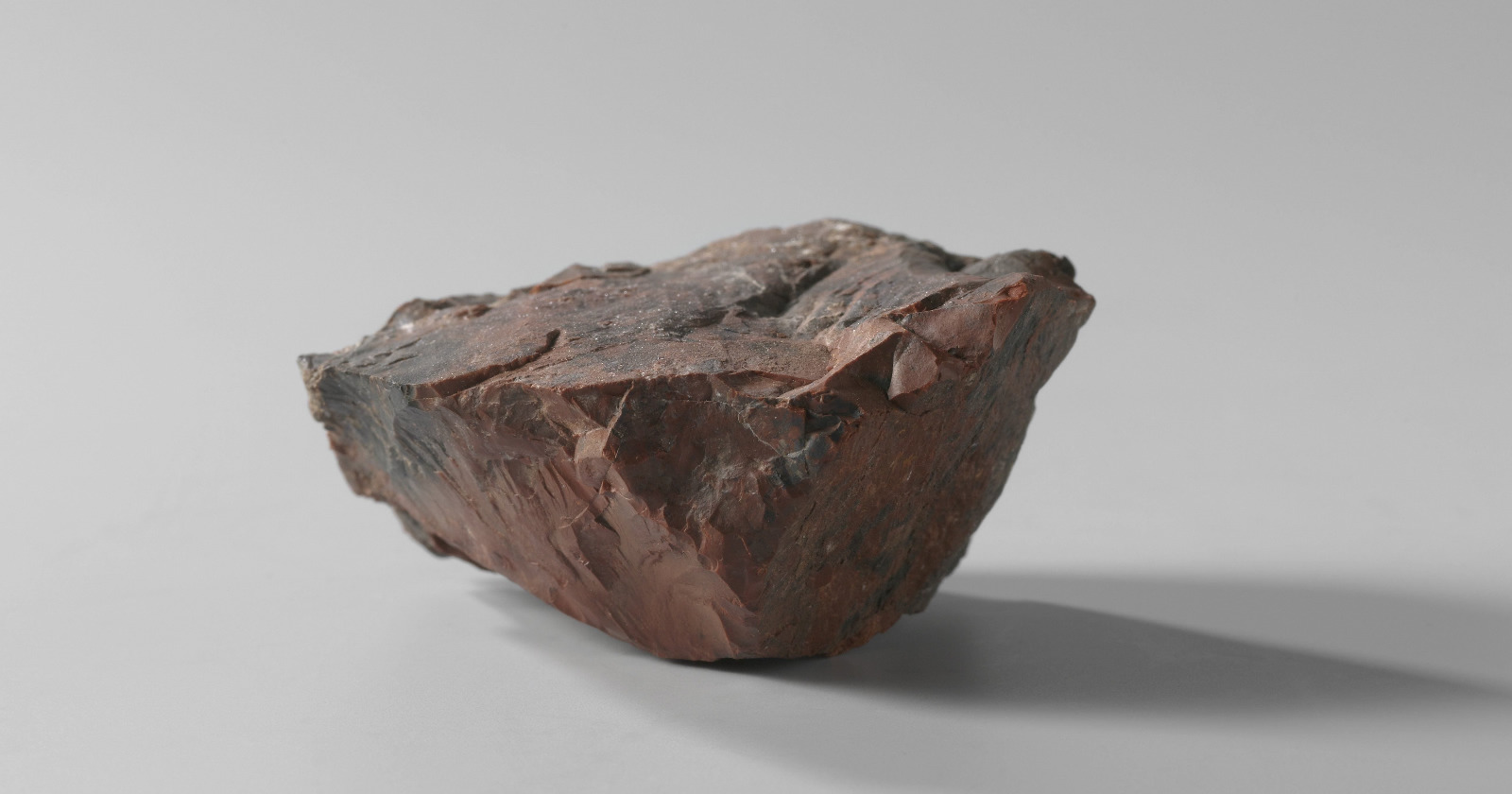
In October 2008, the Rijksmuseum in Amsterdam put what it billed as one of the oldest objects in its collection on public display: a rusty red-black lump about the size of a plum. The museum said it was a moon rock, brought back by Apollo 11 and given to the Netherlands that same year.
Visitors filed past it as part of an art project called Fly Me to the Moon. Among them was Arno Wielders, a physicist. The stone did not look right to him. He called a curator of lunar samples at NASA. The agency had no record of it.
A few months later, under a microscope, the "moon rock" still had the outlines of wood cells.
A gift on a world tour
On October 9, 1969, Neil Armstrong, Buzz Aldrin and Michael Collins were in Amsterdam, less than three months after Eagle had set down in the Sea of Tranquility. They were in the middle of a 38-day tour of 29 cities in 24 countries. That day they opened a space exhibition at the RAI convention center and were received by Queen Juliana.
At the same visit, the U.S. ambassador, J. William Middendorf II, presented a stone to Willem Drees, a former Dutch prime minister who had been out of office for 11 years. A brass plaque commemorated the astronauts' visit.
The Rijksmuseum still holds both objects. Its records once described the stone as a piece of Apollo 11 sample 10085, coarse soil from the landing site. The lump weighs 89.5 grams, nearly 2,000 times the 0.05 grams later placed in official goodwill displays.
NASA later said there was no way an ambassador would have been handed a piece that large, only months after the first landing. Armstrong and Aldrin had brought back about 21.5 kilograms (47 pounds) of rock and soil in total, and President Richard Nixon had not yet asked NASA to prepare official gifts.
Forty years as a piece of the Moon
For four decades after that October day, the stone was treated as lunar. It stayed with Drees until he died in May 1988, then passed to the Rijksmuseum, which received it formally as a gift from his family on February 13, 1991. Cataloged as object NG-1991-4-25, it was seldom shown.
After Wielders raised the alarm, curators asked geologists at Vrije Universiteit Amsterdam to take a look.
Frank Beunk later wrote that he could see, almost at a glance, that it was not from the Moon. Lunar surface rocks come in a short list of types: dark basalt from the maria, pale highland rocks, and the breccias and dust made when impacts smash those two together. This stone was rust-red to black jasper, a form of silica common on Earth.
What the microscope showed
The museum let the team chip off a sliver. In thin section, under a polarizing microscope and then a scanning electron microscope, a grid of wood cells appeared, stained brown with rust and filled in with quartz. It was petrified wood, silicified after the original timber had begun to rot.
Beunk, in a detailed account of the tests, guessed that the specimen might have come from Arizona's Petrified Forest, wood some 225 million years old. That was only a guess. The true source has never been established.
The museum had once insured the object for around $500,000. Beunk estimated it was worth maybe 50 euros.
"It's a good story, with some questions that are still unanswered," Xandra van Gelder, who oversaw the museum's inquiry, told reporters in August 2009. "We can laugh about it." The Rijksmuseum kept the stone as a curiosity.
The real Dutch moon rocks
The Drees stone was never one of the official goodwill displays. In late 1969, Nixon asked NASA to prepare plaques for 135 nations and the 50 U.S. states. Each Apollo 11 display held four tiny fragments of lunar dust, about 0.05 grams in all, sealed in an acrylic button and mounted with a flag that had flown to the Moon and back. Similar plaques, with chips from Apollo 17's "Goodwill Rock," sample 70017, went out in 1973.
Once the plaques left NASA, the agency stopped tracking them. Many later went missing. Joseph Gutheinz, a former special agent in NASA's Office of Inspector General, later set his students to hunting them down. Dozens of the Apollo 11 gifts are still unaccounted for.
The Netherlands' official gifts are accounted for. Queen Juliana received both the Apollo 11 and Apollo 17 displays and passed them to what is now Rijksmuseum Boerhaave, the national museum of the history of science in Leiden. The Apollo 11 plaque, registered there in 1996 after some years when it could not be found, is normally on display.
In 2024, a team that included Wim van Westrenen, one of the same Amsterdam scientists who helped expose the Drees stone, analyzed the Boerhaave display without taking it apart. X-ray scans found textures and chemistry consistent with Apollo 11 sample 10085, volcanic rock rich in titanium and iron, like the dark basalts from the Sea of Tranquility. The fragments, the authors concluded, were extremely likely to be genuine moon rock, and certainly not petrified wood.
Questions that are still open
Middendorf, asked about the fake years later, remembered that Drees had been very interested in the little piece of stone. As for its not being real, he said, he knew nothing about that. The people who might have known, he added, were already dead.
Why the ambassador gave the stone to a former prime minister, and how it came to be called a moon rock, remain unanswered. NASA has said it was not the source.
The Rijksmuseum still has the object, red-black, 89.5 grams, now correctly described as petrified wood. For forty years it was treated as a piece of another world. Under the microscope, it turned out to be a piece of this one, with the grain of an old tree still inside it.