
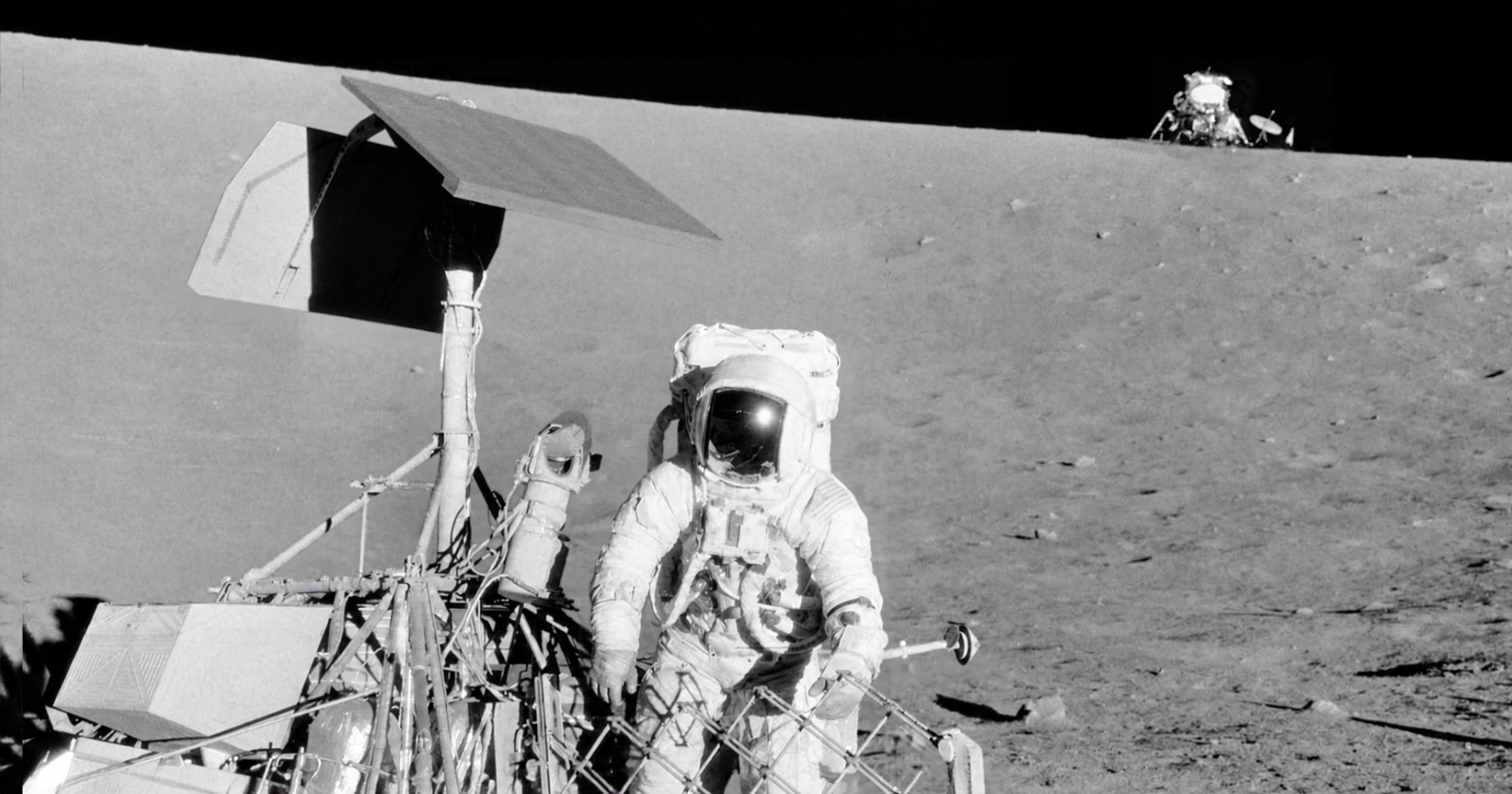
Alan Bean stands in a crater on the Ocean of Storms, one gloved hand on a spacecraft that is not his. The machine is low and spidery, brown where it had left Earth white. On the rim behind him, 163 meters (535 feet) away, the lunar module Intrepid sits against a black sky.
Pete Conrad took the picture on November 20, 1969, during Apollo 12's second moonwalk. The lander in the foreground is Surveyor 3. NASA had set it down in April 1967 and left it there. Now two men had walked over to cut off its television camera and take it home.
A walk across the crater
That short distance was the point of the mission. Apollo 12 was sent to prove that a crew could land on a chosen spot, not just somewhere in a wide, safe plain. NASA's account of the flight puts Intrepid's touchdown, on November 19, about 535 feet northwest of the old probe — roughly one and a half football fields, after a trip of about 400,000 kilometers (250,000 miles).
The next day, on their second excursion, Conrad and Bean worked their way down the inner slope of Surveyor Crater. They spent about 25 minutes at the silent lander, photographing it, snipping parts free, and talking the job through with Houston.
The lander that bounced
Surveyor 3 had not arrived gently. It launched from Cape Canaveral on April 17, 1967, and reached the Moon three days later, on April 20. In the last seconds of descent, highly reflective rocks confused its landing radar, and the engines failed to cut off at about 14 feet (4.3 meters) as planned.
The spacecraft hit, bounced about 10 meters (33 feet) up, hit again, and bounced a second time, this time about 3 meters (10 feet). A command from Earth finally shut the engines down. On the third touchdown, it settled on the inner slope of a crater in Oceanus Procellarum, the Ocean of Storms.
NASA's Surveyor 3 mission account records what the robot did next. Less than an hour after landing, it began sending the first of 6,326 television pictures. On command from Earth, its scoop dug four trenches, pressed on the soil, and knocked at the surface. The tests showed that lunar dirt had a consistency something like wet sand — firm enough, the engineers concluded, to hold an Apollo lander.
Last contact came on May 4, 1967, two days after the two-week lunar night began. The spacecraft went quiet. It stayed that way for 31 months.
A white machine gone brown
When Conrad and Bean reached it, the first surprise was the color. "You know, this one's brown, and I don't remember ours being brown there at the Cape," Bean said. Houston confirmed that the structure had been painted white. Up close, some surfaces were a light tan, others a dark brown.
Only near the end of the visit did they try rubbing a battery case. "We thought this thing had changed color, but I think it's just dust," Bean said. "Look. We rubbed into that battery, and it's good and shiny again."
Both observations had something to them. Later laboratory work found a film of lunar dust on the hardware, much of it blasted over when Intrepid's descent engine landed nearby. The same studies also found that sunlight and radiation had darkened the white paint itself. The brown was not one thing. It was dust and the Sun together, after 31 months outside.
"That's ours!"
They had come for pieces of a machine that had lived through vacuum, radiation, and the swing from lunar noon to the long, bitter night. Conrad used bolt cutters on the television camera, on lengths of cable and tubing, and on the scoop. The scoop still had dirt in it. "Outstanding! It's even got dirt in it!" Bean told Houston. "Bring back some of the original dirt!"
When the camera came free, Conrad called out, "That's ours!" Bean answered, "We got her!"
The camera, the scoop, and the other pieces went into a bag and then into Intrepid for the trip back to Earth, so engineers at NASA and at Hughes Aircraft, which had built the lander, could see what two and a half years on the Moon actually does to metal, paint, glass, and wiring.
The microbe that probably never left Earth
In 1971, a NASA report described something unexpected inside the returned camera: Streptococcus mitis, a common bacterium of the human mouth and throat. The suggestion was that a few dozen cells had survived launch, vacuum, radiation, and 31 months on the lunar surface, then grown again in a laboratory on Earth.
The claim never really made it through peer review, but it has lived on in retellings for decades.
In 2011, planetary protection researcher John Rummel and colleagues went back to the original handling records and even to 16-millimeter film of the camera being sampled. Their review, reported by Space.com, found a clean room that was not very clean. Workers leaned over the camera in short-sleeved scrubs, arms bare and shirt tails sitting above the workbench. The more convincing explanation, they argued, is that the bacteria got into the camera after it came home.
That reading is widely accepted, though it cannot be proved with certainty. The original samples are long gone, and no one can rerun the test.
A camera in Virginia
After the tests, NASA transferred the camera to the Smithsonian. The National Air and Space Museum now lists it as on display in the Space Science gallery at the Steven F. Udvar-Hazy Center in Chantilly, Virginia.
The rest of Surveyor 3 is still on that crater slope, a short walk from the descent stage of Intrepid. In Conrad's photograph, the two machines share the same frame: one that went and stayed, and one that came to take a piece of it home.