
Apollo 14 lifted off in the late afternoon of 31 January 1971, on what NASA's own account calls "our third trip to the lunar surface." Stowed in the command module, inside a small canvas pouch that counted as command module pilot Stuart Roosa's personal kit, was a metal canister packed with tree seeds.
The seeds were not a stunt. They were part of a joint NASA and US Forest Service project, and the agency's Moon Trees history page is the primary record of what was flown, what survived, and what happened afterward. That record is specific on two points that sit oddly together. It describes "hundreds of tree seeds" in Roosa's kit, and elsewhere states that he carried "possibly 2,000 or more seeds in the canister in his personal kit." It also states plainly that no list was ever kept, nor any systematic tracking made, of where all the resulting trees ended up.
A smoke jumper in lunar orbit
Roosa was born on 16 August 1933 in Durango, Colorado. He worked for the Forest Service in the early 1950s as a smoke jumper fighting fires, then joined the Air Force and became a test pilot. He was one of 19 people selected for the astronaut class of 1966 and served on the support crew for Apollo 9.
That forestry background is why the experiment exists at all. The project began after Roosa was named to the Apollo 14 crew. Ed Cliff, then Chief of the Forest Service, knew Roosa from his smoke-jumper days and contacted him about carrying seeds into space. Stan Krugman of the Forest Service was placed in charge of the effort and selected the species.
Five were chosen: loblolly pine, sycamore, sweetgum, redwood, and Douglas fir. The seeds were classified and sorted, then sealed in small plastic bags and stored in a metal canister. A matching set of control seeds stayed on the ground so that any later differences could be measured against them.
Five days after launch, Alan Shepard and Edgar Mitchell were walking on the lunar surface. NASA had earlier flown groups of future Apollo astronauts to the lava fields and volcanic craters of northern Iceland, and had them train inside Meteor Crater in Arizona, so they would know how to read the ground under their boots. Roosa remained overhead in the command module Kitty Hawk, and the canister of seeds orbited the Moon with him in February 1971. Only a few months earlier, in November 1970, the Soviet Union had landed a remote-controlled rover on the Moon that was still operating during Apollo 14’s flight.
Burst bags, Houston, and two Forest Service stations
The experiment nearly ended on the ground. During decontamination procedures after the return to Earth, the seed bags burst open. The seeds were scattered about the chamber and exposed to vacuum, and as NASA puts it, "it was thought they might not be viable."
Krugman collected what was left. An attempt at germinating some of the seeds in Houston proved surprisingly successful, but the resulting seedlings did not last long because the facilities there were inadequate for the job.
A year later the remaining seeds were split between two Forest Service stations according to climate. Sycamore, loblolly pine, and sweetgum went to the southern station at Gulfport, Mississippi. Redwood and Douglas fir went to the western station at Placerville, California. Many of the seeds, and later cuttings taken from them, were successful and grew into viable seedlings.
Some of those seedlings were planted alongside their Earth-bound counterparts so the comparison originally intended for the experiment could still be made. NASA records the outcome as an aside rather than a headline, noting that "as might be expected, after over forty years there is no discernable difference."
A bicentennial giveaway and an incomplete ledger
Most of the seedlings were given away in 1975 and 1976 to state forestry organizations for planting as part of the nation's bicentennial. Because the five species were southern and western types, not every state could receive one, and not every state did.
The known plantings range from the ceremonial to the local. A loblolly pine was planted at the White House. Trees went to Brazil and Switzerland, and one was presented to the Emperor of Japan. Others were planted in Washington Square in Philadelphia, at Valley Forge, in the International Forest of Friendship, and at various universities and NASA centers, reportedly in 40 different states. NASA describes the seedlings as having been planted throughout the United States, often tied to the 1976 bicentennial, and around the world.
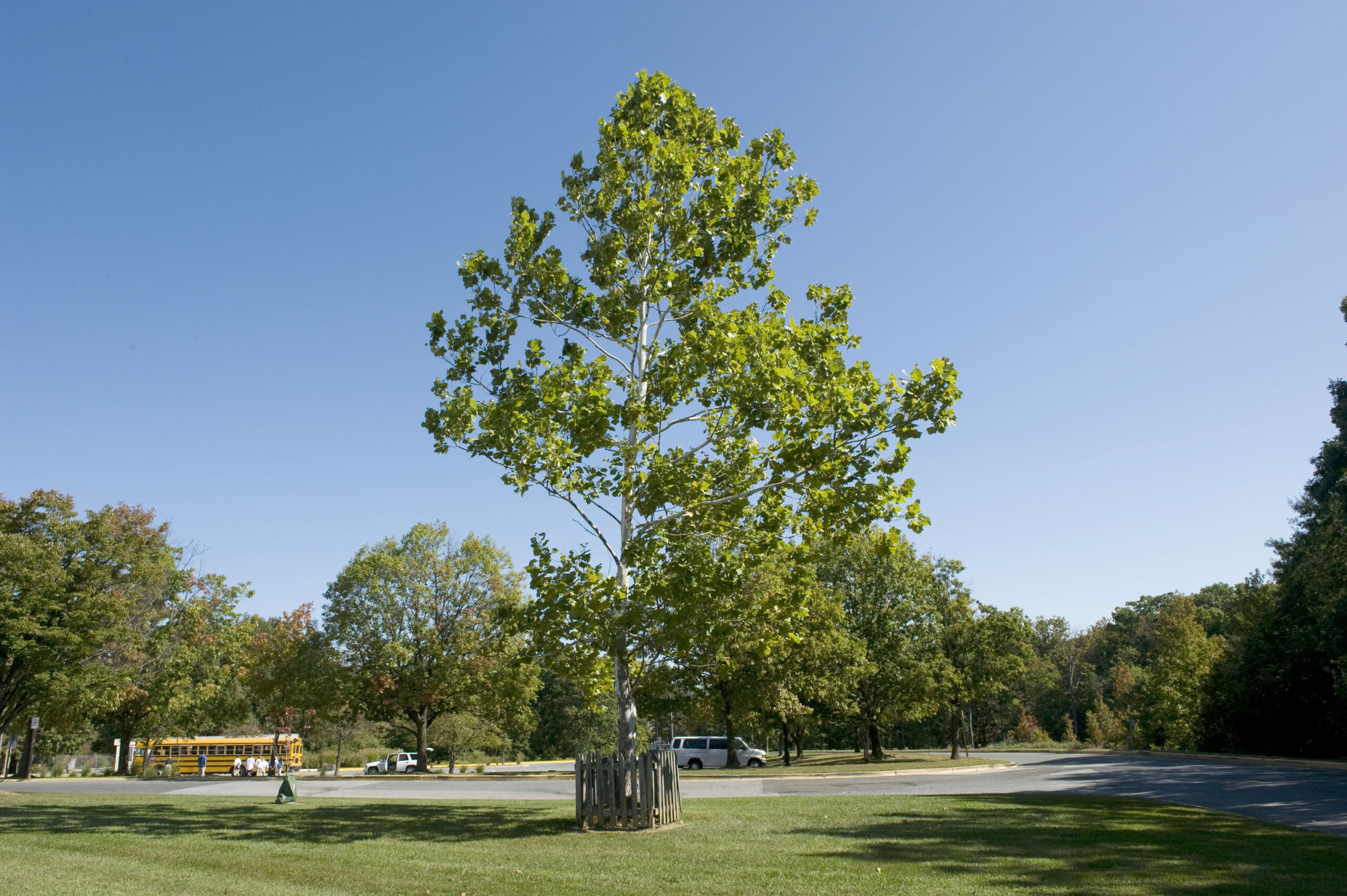
One of the easiest to visit stands in front of the Visitor Center at NASA's Goddard Space Flight Center in Greenbelt, Maryland. It is a sycamore, planted on 9 June 1977, grown from a seed that travelled to the Moon aboard Apollo 14.
What the agency never assembled was a master register. NASA lists believed locations for some of the original Moon Trees and then qualifies the list directly, stating that "no list was ever kept nor any systematic tracking made of the disposition of all the trees." The trees were handed out as civic gifts, not catalogued as hardware, and the paperwork followed accordingly.
The list that does exist was built after the fact, and from outside the agency's own records. It was initiated by Dr. David R. Williams, retired curator at NASA's National Space Science Data Center, after he received a request for more information from Joan Goble, a third grade teacher in Indiana, in 1996. Dozens of people have since contributed sightings and documentation of other Moon Trees, which is why the catalogue has grown rather than shrunk over the decades.
Roosa himself moved on quickly from the flight. He served as backup command module pilot for Apollo 16 and Apollo 17, then worked on the Space Shuttle program before retiring as a Colonel in the Air Force in 1976. He died in December 1994.
The idea did not end with him. NASA notes on the same history page that a new generation of tree seeds flew on Artemis I in 2022, continuing a line of flown forestry that began with a canvas pouch in a command module orbiting the Moon.