
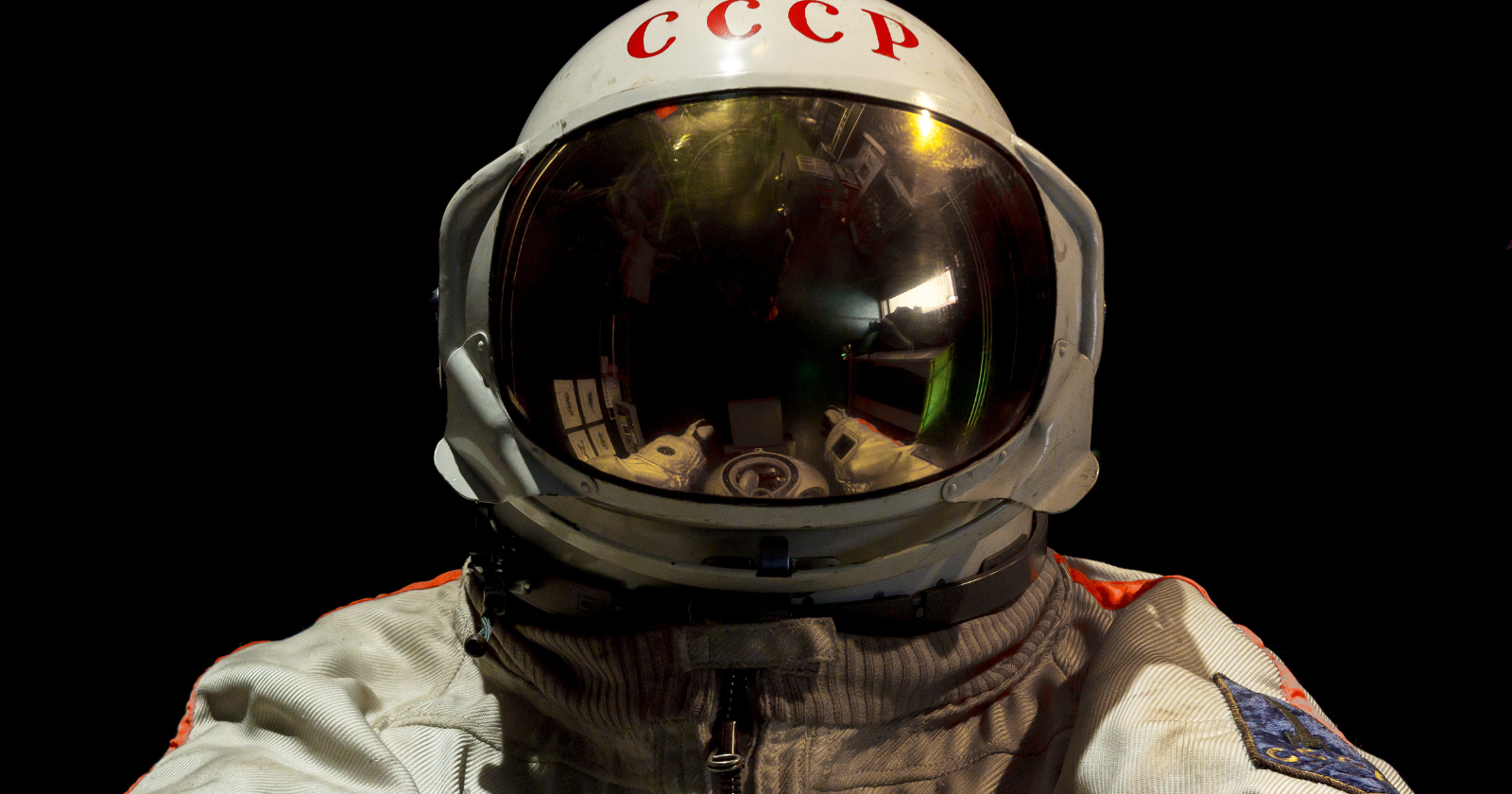
On 18 March 1965, a 30-year-old Soviet air force pilot pushed away from the rim of an inflatable tube on the side of his spacecraft and floated out into nothing.
Alexei Leonov stayed outside Voskhod 2 for 12 minutes and 9 seconds. Getting back in took nearly as much effort as everything that came before it.
A balloon for a door
Voskhod 2 was a converted single-seat Vostok capsule, crammed with two men in pressure suits. Rather than let all the air out of the cabin, Soviet engineers chose an inflatable airlock on the outside, so the ship itself could stay pressurised.
They called it Volga. It was a fabric tube about 2.5 metres long and 1.2 metres wide, and it was designed, built and tested in roughly nine months. An uncrewed test flight carrying a copy of the airlock, Kosmos-57, flew in February 1965 and ended in failure. The crewed mission went ahead a month later anyway.
Leonov's suit was called Berkut, or "golden eagle". It could be set to one of two pressures: about 0.4 atmospheres for normal work, or about 0.27 for emergencies.
The first steps into open space
Leonov and his commander, Pavel Belyayev, lifted off on the morning of 18 March. After the first orbit, Belyayev inflated the airlock and Leonov strapped on a life-support backpack. He sealed himself inside the tube, let the air out and opened the outer hatch.
Minutes later he was outside, tied to the ship by a tether about 5 metres long. His first job was to fix a film camera to the end of the airlock, and he managed it without trouble. Viewers in the Soviet Union and Europe watched live pictures of the first person floating freely in space.
"The Earth is round!" he reported. He had left the airlock over north-central Africa, and the ground slid past at nearly 8 kilometres a second.
When the suit fought back
About eight minutes in, the trouble started.
A spacesuit is a pressurised balloon shaped like a person. On Earth, that pressure barely matters. In a vacuum it pushes outwards on every seam. Leonov's suit swelled and stiffened until, as he described it later, his fingers no longer reached the tips of his gloves and his feet floated free inside his boots.
He could not reach the shutter switch for the still camera on his leg. More seriously, he no longer fitted the airlock.
Time was short. Voskhod 2 was heading towards orbital night, and Leonov later said he had about five minutes before the ship entered Earth's shadow and everything went dark.
Squeezing back inside
Leonov switched his suit to its lower pressure setting, bleeding oxygen out through a valve. That made the suit floppy enough to bend, but it raised the risk of decompression sickness, the "bends" that divers know. He felt pins and needles in his hands and legs.
In the version he told for decades, he gave up on the planned feet-first entry and dragged himself in head first. Then he had to curl up and turn around inside a tube little more than a metre across to close the outer hatch. The temperature inside his suit soared and he was soaked in sweat.
By the time he was back in the airlock, the ship was over eastern Siberia. Counting the time in the depressurised airlock, he had spent roughly 23 minutes in vacuum.
A calmer account, decades later
In 2020, historian Anatoly Zak examined Leonov's own post-flight report, written right after the mission and only recently made public. In it, Leonov said he had always intended to drop the suit pressure before going back in. Newly released film appeared to show him entering feet first, holding the camera, just as the report said.
The core facts are not in question. The suit ballooned, and Leonov vented oxygen to get back in. What is less certain is how close the moment came to disaster, and whether some of the most famous details grew with each retelling.
The long way home
Voskhod 2's troubles were far from over. The automatic landing system failed, so the crew had to fire the braking engine by hand, two orbits late. They came down on 19 March in snowy forest in the Perm region, far from the planned landing zone.
Rescuers spotted them within hours, but cutting a clearing for helicopters took time. The two men were finally flown out on 21 March.
Less than three months later, Ed White became the first American to walk in space, from Gemini 4. Leonov flew once more, commanding the Soviet half of the Apollo-Soyuz mission in 1975, and died in 2019 aged 85.
He was also an artist. During Voskhod 2 he took out coloured pencils and sketched an orbital sunrise, the first drawing ever made in space.