
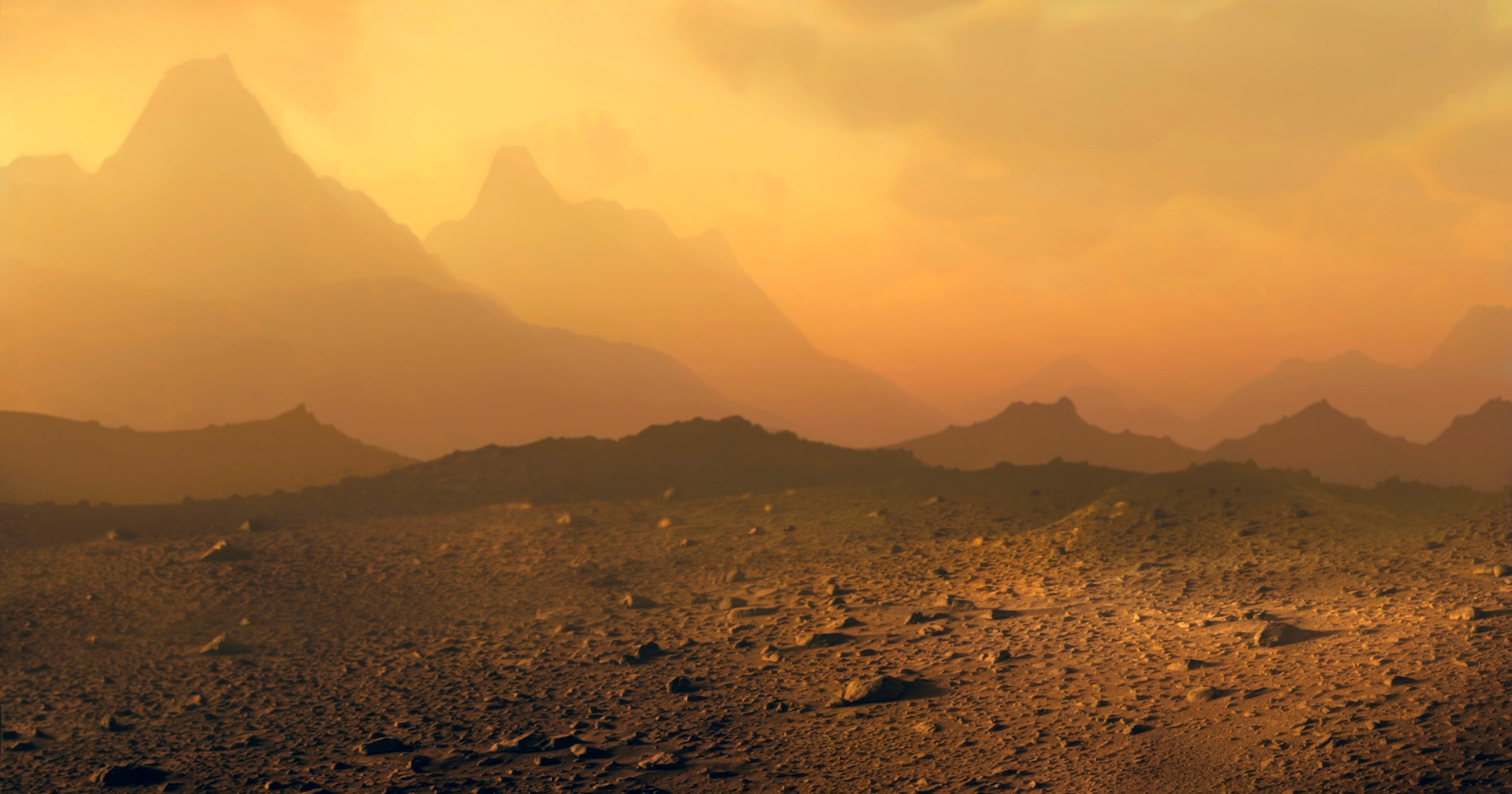
Thirty-two minutes. That was all the time Soviet engineers expected the Venera 13 lander to survive once it reached the surface of Venus. It touched down at 03:57 UT on 1 March 1982 and kept transmitting for at least 127 minutes. No spacecraft has lasted longer on the planet since.
A number like that gets retold a lot, and some details have slipped along the way. Here is what the lander actually did, and a few claims that don't stand up.
Myth: Venera 13 took the first pictures from the surface of Venus
Not quite. That record belongs to Venera 9, which sent back black-and-white images in October 1975. Venera 10 followed days later. Venera 11 and 12 reached the surface in 1978, but on both landers the lens caps stayed stuck, so their cameras saw nothing.
Venera 13's first was colour. Its cameras scanned the ground through colour filters, and the three exposures were combined on Earth into true-colour panoramas, as described in a 1983 paper on the Venera 13 and 14 results. Its twin, Venera 14, landed about 950 km away on 5 March and took colour views of its own. Together they are still the only colour pictures ever taken on the surface of Venus.
Fact: it landed in conditions that destroy most machines
The landing site sits at 7.5°S, 303°E, on rolling ground east of a highland region called Phoebe Regio. NASA's catalogue records a surface temperature of 457°C and a pressure of 89 Earth atmospheres. Lead melts at 327°C. That pressure is roughly what a submarine would feel nearly 900 metres down.
Sources differ slightly. Some NASA pages give 465°C and 89.5 atmospheres. Either way, nothing about the place is survivable for long.
The 760 kg lander was built like a sealed pressure vessel, not a Mars rover. Its electronics sat inside thick insulation, next to blocks of lithium nitrate, a salt that soaks up large amounts of heat as it melts. None of this could keep Venus out. It could only slow the heat down. Meanwhile, the spacecraft that had carried the lander flew past the planet at about 36,000 km, relaying its signal to Earth.
What can you do with 127 minutes on Venus?
Quite a lot, as it turned out.
A screw drill bored into the ground and fed a sample through to a sealed chamber held at about 30°C and one-twentieth of Earth's air pressure. Inside, an X-ray fluorescence spectrometer bombarded it with radiation from small plutonium-238 and iron-55 sources and counted the X-rays that came back.
The answer was a potassium-rich volcanic rock. Soviet geochemists compared it to leucite basalt, a rock type that is uncommon on Earth. It remains one of only a handful of direct chemical analyses of Venusian rock.
A spring-loaded arm pressed into the soil to test how firm it was. Microphones listened to the wind, and scientists used the noise to estimate wind speed at the surface. The recordings are often described as the first sounds captured on another planet.
Myth: the cameras photographed something alive
In 2012, Leonid Ksanfomality of Moscow's Space Research Institute reanalysed the Venera panoramas in a paper in Solar System Research. He pointed to objects 10 to 50 cm across that seemed to appear, change shape or vanish between frames, and asked whether they could be alive.
The idea attracted headlines but little support. One "disc" turned out to be one of the lander's own ejected lens caps. Other shapes were put down to artefacts of image processing that don't appear in the original data.
Is that really the colour of Venus?
The panoramas are famous for their rusty, orange cast. Some of that comes from the sky, not the rock. Venus's thick cloud deck absorbs much of the blue in sunlight, so the light reaching the ground is strongly tinted. Working out what the rocks would look like in white light is not straightforward, and processed versions of the images vary widely in colour.
Why hasn't anyone beaten the record?
Mostly because nobody has tried. The last spacecraft to land on Venus were the Soviet Vega 1 and Vega 2 landers in June 1985, dropped off on the way to Halley's Comet. They carried no cameras.
The next visitor is NASA's DAVINCI, now targeted for launch in December 2030. Its titanium probe is due to fall through the atmosphere in October 2032, photographing the rugged Alpha Regio highlands on the way down. It is built to study the descent, not to work on the ground, so any time it survives after landing is a bonus. NASA's VERITAS orbiter is set to follow in November 2032, with ESA's EnVision orbiter planned for the early 2030s.
That puts the 1982 record safe for a while yet. It was set by a machine asked to last 32 minutes that kept working for almost four times as long.
Further reading: Asif Siddiqi's NASA history Beyond Earth: A Chronicle of Deep Space Exploration and NASA's Venera 13 image catalogue.