
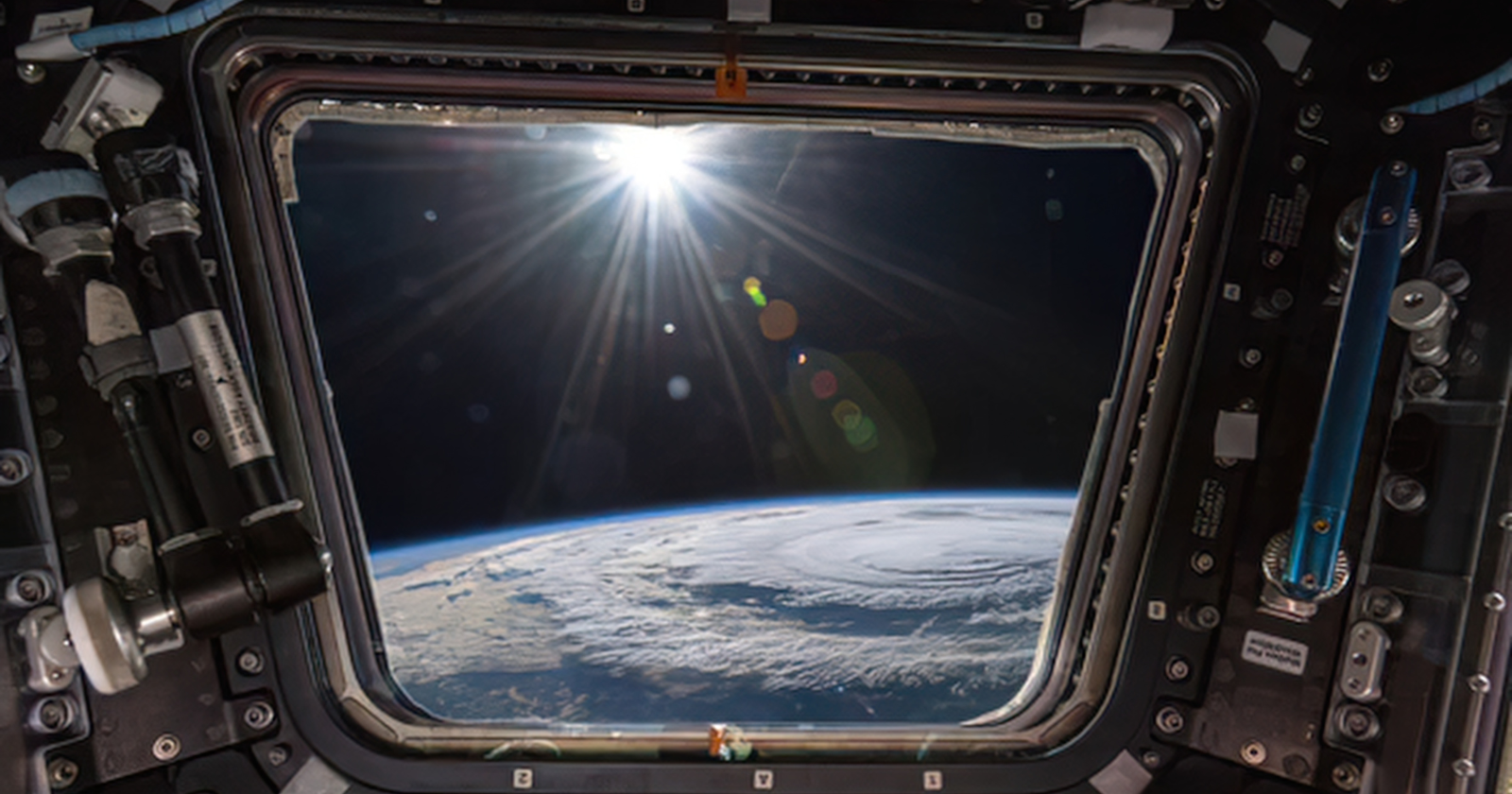
Buzz Aldrin was trying to get some sleep on the way to the Moon. The cabin lights of Apollo 11 were off, his eyes were closed, and something kept flickering.
"I observed what I thought were little flashes inside the cabin," he told NASA at his post-flight debriefing in July 1969. They came a couple of minutes apart. Sometimes he saw two at once, as if something had come in at one point and struck at another.
Nothing was flashing in the cabin. The light was being made inside his own eyes.
What were the astronauts actually seeing?
Once Aldrin mentioned it, other crews started paying attention. Neil Armstrong had seen the flashes too, and astronauts on Apollo 12 and 13 reported the same thing.
Later Apollo crews described three main types: a spot, a streak and a diffuse "cloud". Almost every flash was white or colourless. The exception came from Apollo 15 commander David Scott, who saw one that was "blue with a white cast, like a blue diamond".
The flashes were not rare. Once their eyes had adjusted to the dark, Apollo crews reported one on average every 2.9 minutes.
Why didn't anyone see them on Earth?
The leading suspect was cosmic radiation. Cosmic rays are atomic nuclei, stripped of their electrons and travelling at close to the speed of light, mostly from far beyond the solar system. On Earth, the atmosphere and the planet's magnetic field stop the most energetic of them long before they reach us.
On the way to the Moon there was no such shield, only the thin walls of the command module. The heaviest, most energetic cosmic rays could pass straight through the spacecraft, through an astronaut's skull and through the eye.
There was physical evidence that they were getting in. Helmets worn on Apollo 8 and Apollo 12 turned out to carry microscopic track marks in their plastic, left by high-energy particles passing through.
How did NASA test the idea?
On later Apollo flights, crews held dedicated observation sessions. They darkened the cabin, covered their eyes and reported each flash as it happened.
For Apollo 16 and 17, NASA went further. Physicists at the University of Houston and Johnson Space Center built the Apollo Light Flash Moving Emulsion Detector, or ALFMED. It was worn like a helmet and held sheets of photographic emulsion around the head. Any cosmic ray passing through would leave a track in them, and because the plates slowly shifted position, each track also carried a rough timestamp.
On Apollo 17, one astronaut wore it for an hour and reported 17 flashes. When the team had analysed a third of the plates, they found two clear matches between a reported flash and a heavy nucleus that had passed through one of his eyes at the same moment.
The team also noticed something odd in the wider data. Crews saw noticeably fewer flashes on the way home from the Moon than on the way out, and nobody could fully explain why.
Did anyone try it on the ground?
Yes, by firing particle beams into volunteers' eyes. At the Lawrence Berkeley laboratory in California, radiation biologist Cornelius Tobias put a light-proof hood over his head and exposed his own eyes to low-dose beams from a cyclotron. He saw the same kind of flashes the astronauts described.
Other laboratories, including Brookhaven in New York, did similar experiments with neutrons, protons and other particles. People still see flashes this way today: patients receiving proton or heavy-ion therapy for tumours near the eye have reported seeing them during treatment.
So is the mystery solved?
Partly. Few researchers now doubt that the flashes come from charged particles passing through the head. The harder question is how a particle becomes something you see.
One explanation is Cherenkov light. A particle moving faster than light can travel through the jelly-like fluid of the eyeball gives off a faint cone of blue light, a little like a sonic boom made of light, and the retina detects it. Another is that the particle triggers retinal cells or the nerves behind them directly, with no light involved at all.
Both may be true. In 2003, researchers using the SilEye-2 detector on the Mir space station reported two separate sources: one linked to heavy nuclei and one to protons. That suggested more than one mechanism might be at work.
The debate is still going. A computer study posted in August 2026, which has not yet been peer reviewed, modelled cosmic rays passing through a simulated eye. It found that Cherenkov light alone could account for the flash rates astronauts report in deep space and in most of low Earth orbit, but not in the South Atlantic Anomaly, a region of intense radiation over South America and the South Atlantic.
Are the flashes dangerous?
The flashes themselves appear harmless. What they signal is less comfortable: every one marks a heavy, fast particle that has just ploughed through living tissue.
That is why space agencies still study them. The ALTEA helmet on the International Space Station, first used by Swedish astronaut Christer Fuglesang in 2006, combined particle detectors with brain-activity recordings to follow what happens when a cosmic ray passes through an astronaut's head.
Station crews still see the flashes. NASA astronaut Don Pettit once compared them to "luminous dancing fairies" that appear as he drifts off to sleep.
In April 2026, the four Artemis II astronauts became the first people since 1972 to travel far beyond Earth's protective magnetic field. If people do head out to Mars, the flashes will likely keep them company the whole way, a faint sign of the radiation streaming through them.