
At 105 hours and 18 minutes into the flight of Apollo 13, with the crippled spacecraft still 175,000 miles from Earth, the astronauts lit the lunar module's descent propulsion system and let it run for 14.8 seconds. The firing was brief, the target was narrow, and the instrument that mattered most for pointing the vehicle was the window.
That duration, 14.8 seconds, is the figure logged in NASA's mission history account "Houston, We've Had a Problem" by John Uri. The same account establishes what sets the maneuver apart from the rest of the Apollo burn record. The lunar module guidance computer was not running for it.
The course corrections that came first
Apollo 13 lifted off in April 1970 with Commander James A. Lovell, Command Module Pilot John L. "Jack" Swigert and Lunar Module Pilot Fred W. Haise aboard. The command module was Odyssey. The lunar module was Aquarius.
At 55 hours, 55 minutes and 4 seconds into the flight, an oxygen tank accident disabled the Command and Service Module. The lunar landing was gone within hours. The crew moved into Aquarius and used it as a lifeboat.
The descent engine, built to lower Aquarius onto the Fra Mauro highlands, became the ship's main propulsion. At 61 hours and 30 minutes the crew fired it for 34 seconds to restore a free-return trajectory, the path that would carry the stack around the Moon and back toward Earth without further burns. About an hour and a half after passing the Moon they fired it again, this time for 4 minutes and 24 seconds, to shorten the trip home.
Those two burns set the broad geometry. The 14.8-second firing, logged later in the coast back toward Earth, was the trim. Its job was to fine tune the reentry path into Earth's atmosphere.
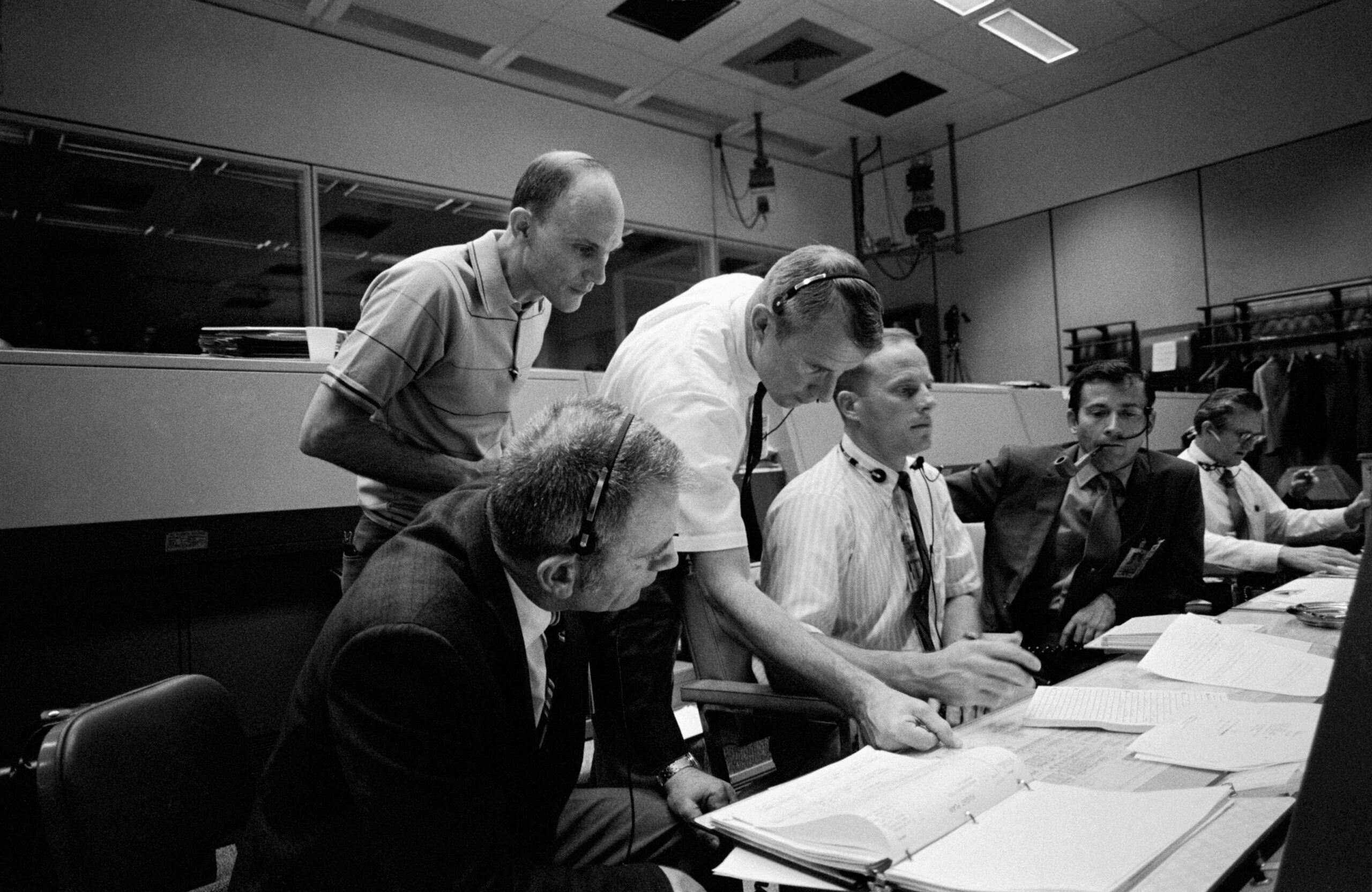
Capcom Jack Lousma had returned to the console in Mission Control to help the crew with the maneuver.
Flying by Earth and Sun
What made the burn remarkable was the resource picture inside Aquarius. Electrical power and cooling water were the two consumables the crew could not replace, and the lunar module's computer and its associated systems consumed both. Running the guidance system for a short trim burn meant spending margin that the return trip might need later.
So the crew flew the burn without it. The NASA history account describes the choice plainly:
using the LM's DPS engine but without using the LM's computer to conserve power and cooling water, they would have to maintain the spacecraft's attitude using visual sightings of the Earth and Sun out the windows
That is the official framing of the technique. Attitude, the direction the spacecraft was pointed, had to be established and then held by eye against two reference bodies, one of them a bright disc and the other the planet they were aiming at. Photographs of that planet from space go back further than Apollo: on 24 October 1946, a camera mounted on a captured German V-2 rocket took the first photograph of Earth from space, from about 105 km over New Mexico. Many astronauts later described a lasting shift in how they see Earth after coming home, even when they had been told to expect it.
A descent engine burn with no computer reference also meant the duration had to be controlled manually. Start the engine, run it, stop it, and the resulting velocity change follows from how long it ran.
The firing worked. NASA's account records that the burn had the desired effect of fine tuning the reentry path into Earth's atmosphere.
The watch in the crew's retelling
The detail that attached itself to this burn in later decades came from the astronauts rather than from the flight record. In a 2015 interview published by Hodinkee, Lovell described using "the Omega watch to time the 14 second burn of the Lunar Module engine". The official NASA duration for that firing is 14.8 seconds, not the rounded figure Lovell used in the later telling.
The same account has Lovell describing a gunsight, with the crosshairs aligned against the day and night shadow line on the Earth, the boundary known as the terminator. That is the origin of the image most often repeated about this maneuver, a commander holding a planet's edge steady in an optical sight while the engine burned behind him.
Omega's own chronicle of the flight, published as 1970 Lucky 13, likewise describes the crew timing "a 14-second burn" with Speedmaster watches. That is a company account rather than an official mission figure, and it carries the same rounding.
Later crew-account and watch-history reporting, including interviews retold by Hodinkee and Omega, says Swigert timed the burn with an Omega Speedmaster. NASA's history page does not name a wristwatch and does not describe the terminator alignment. It records the 14.8-second firing, the decision to leave the computer off, and the use of Earth and Sun sightings out the windows.
Both versions are compatible. One is the flight-record summary of what the spacecraft did. The other is what three men later said they were looking at and holding in their hands while it happened. Readers weighing the two should note which is which, and should treat the terminator and the Speedmaster as crew testimony rather than as logged mission data.
Apollo 13 splashed down on 17 April 1970. The descent engine that had been built to land on the Moon had instead performed a free-return correction, a speed-up burn and a reentry trim, the last of them for 14.8 seconds with the guidance computer dark and the crew navigating by what they could see.