
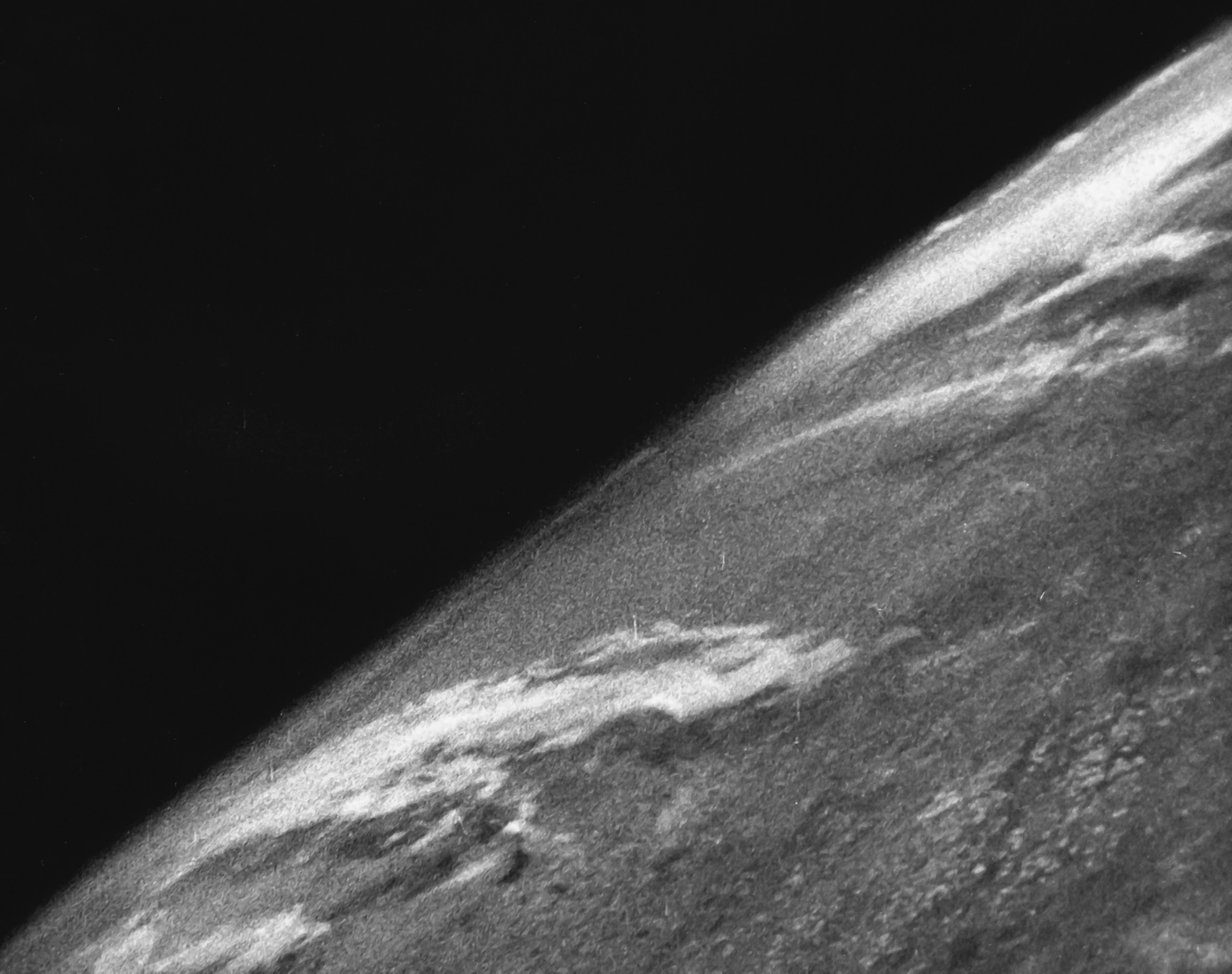
A captured German V-2 rocket launched from White Sands in New Mexico on 24 October 1946 carried a 35mm camera to about 65 miles, or roughly 105 km, and returned the first photographs of Earth taken from space.
The rocket was V-2 No. 13. The launch site was then known as the Army Ordnance Proving Ground, also called White Sands Proving Ground.
The camera was a DeVry 35mm motion picture camera loaded with 100 feet of film. Clyde Holliday, an engineer at the Johns Hopkins University Applied Physics Laboratory, mounted it on the rocket in a specially designed case.
The camera exposed a frame every one and a half seconds during the flight. The 100 km mark, about 62 miles, is commonly treated as the edge of space.
Minutes after launch the rocket fell back and struck the ground at about 500 feet per second. The camera was smashed. The film survived inside a steel cassette.
Before the flight, the highest photographs of Earth had been taken from the Explorer II balloon, which reached 13.7 miles in 1935. The V-2 pictures came from almost five times that height.
Holliday worked at the laboratory alongside James Van Allen. In National Geographic in 1950, Holliday wrote that the photographs showed "how our Earth would look to visitors from another planet coming in on a space ship."
Engineers needed to know the orientation of the rocket in flight. Scientists wanted to know the directions from which cosmic rays arrived.
S. Fred Singer analysed the photographs to work out the orientation of the rocket. "We considered clouds to be a nuisance," Singer said.
Further V-2 flights followed. Between 1946 and 1950 cameras on the rockets returned more than 1,000 pictures of Earth from altitudes as high as 100 miles.
Sputnik 1 was launched on 4 October 1957, 11 years after the White Sands flight.
The first photograph of Earth from orbit was taken by Explorer 6 on 14 August 1959. TIROS-1 returned the first of 23,000 television images of Earth from 1 April 1960.