
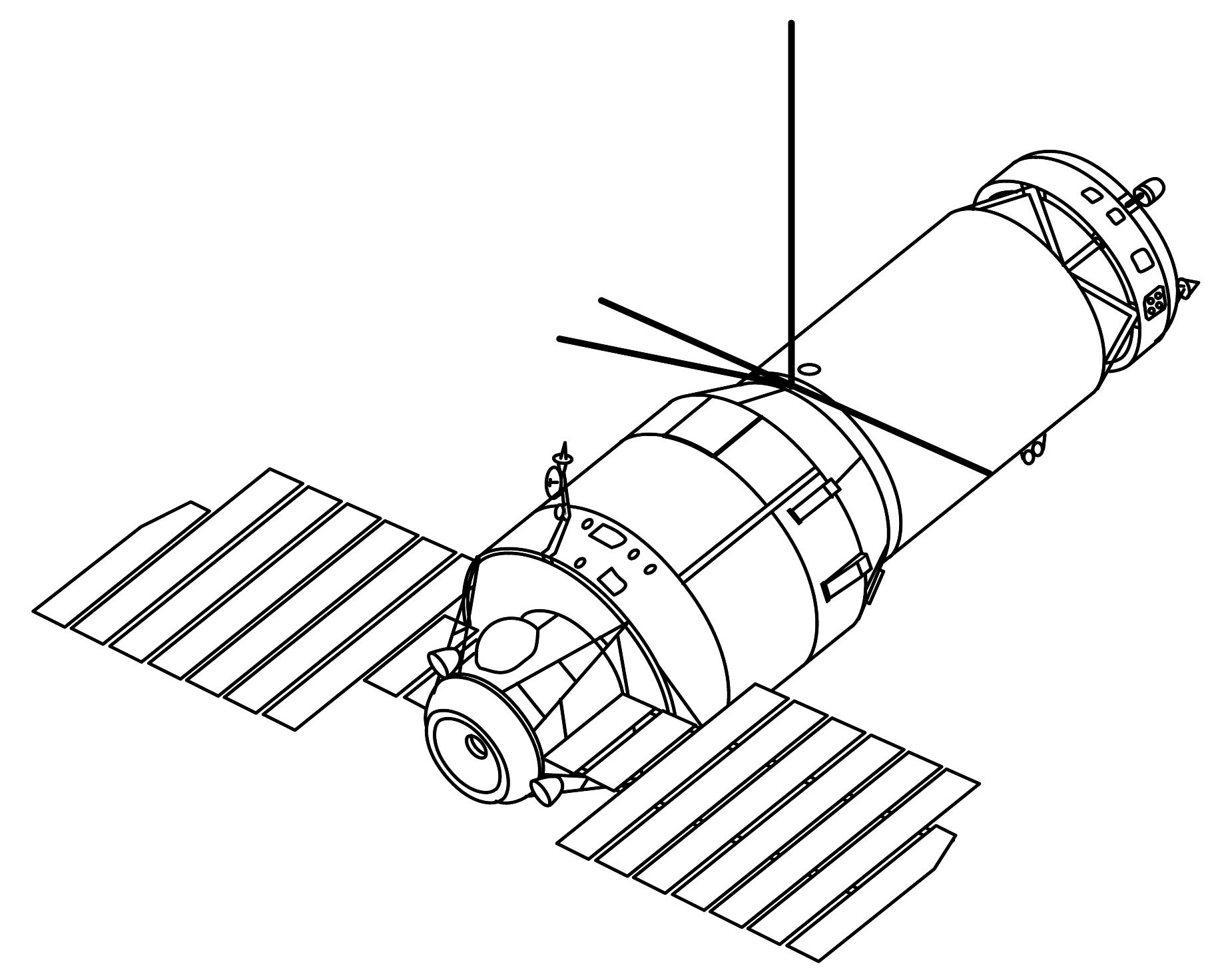
The spacecraft that reached orbit at 01:38 Moscow Decree Time on 25 June 1974 was introduced to the world as Salyut-3, another entry in the Soviet Union's civilian space station series. It was nothing of the kind. As Anatoly Zak documents on RussianSpaceWeb, the vehicle was the second military Almaz laboratory, OPS-2, carried on the books as OPS No. 0101-2 and dressed in a Salyut name for public consumption.
Seven months later, with its only crew long since back on the steppe, controllers on the ground sent a command that the Soviet Union would not acknowledge for decades. They told the station to open fire.
Only after the Cold War, Zak notes, was it revealed that Salyut-3 had carried a self-defense gun, and that the weapon had actually been fired in orbit.
A reconnaissance platform wearing a civilian name
Almaz was a military program, and OPS-2 was built to look down rather than outward. Cosmonaut Pavel Popovich later recalled that the station carried 14 different cameras.
Popovich knew the interior firsthand. He commanded Soyuz-14 with flight engineer Yuri Artyukhin, lifting off from Tyuratam Site 1 at 21:51:08 Moscow Time on 3 July 1974. They were the only crew ever to board the station.
Their Descent Module touched down as planned at 15:21 Moscow Time on 19 July 1974, roughly 140 kilometers southeast of Dzhezkazgan in Kazakhstan, with the official landing logged at 15:21:36 and the mission clocked at 15 days, 17 hours, 30 minutes and 28 seconds.
A second crew never got inside. Soyuz-15, with commander Gennady Sarafanov and flight engineer Lev Demin, failed to dock with the station, a failure also noted in Sean Gallagher's 17 November 2015 account for Ars Technica.
The Soyuz ferry that carried both crews proved durable enough to outlive the program it served, and decades later it would become the vehicle that NASA astronauts trained for months in Russian in order to fly.
Zak's tabulated figures give the station a total flight of 213 days, of which only 15 were piloted.
A weapon built into the front of the station
The gun came from a design bureau led by Nudelman, and it was installed in the front section of the station. There was no turret and no independent aiming mechanism worth the name. To point the weapon, the crew had to change the attitude of the entire station.
Ground testing left little doubt about its power. During a test firing on the ground, the gun was able to split a metal container in half. The firing also caused considerable shaking, enough that in-orbit tests during manned operations were ruled out.
The weapon's exact identity remains muddled in the public record. Writing for Popular Mechanics in an article first published in November 2015 and updated on 24 October 2022, Zak describes the R-23M Kartech as derived from a powerful aircraft weapon, crediting Aron Rikhter with the original 23-millimeter cannon designed for the Tupolev Tu-22 Blinder. The same account separately states that Nudelman's team developed a 14.5-millimeter rapid-fire cannon. Ars Technica reported 23 mm. Those figures do not reconcile, and no single caliber or designation should be treated as settled.
Rate of fire is equally slippery. In the words of the Popular Mechanics piece, "Depending who you ask, the 37-pound weapon could fire from 950 to 5,000 shots per minute."
Firing backward, hours before the fall
The test came on 24 January 1975. Officials scheduled it, Zak writes, just hours before the planned de-orbiting of the station and long after the departure of the crew on 19 July 1974.
Two engineering details stand out. The station ignited its jet thrusters simultaneously with firing the cannon to counteract the weapon's powerful recoil. And the shots were aimed deliberately backward, in the direction opposite the station's velocity vector, specifically to shorten the orbital life of the shells.
How many shots is contested. On the OPS-2 page Zak states flatly:
A total of three firings were conducted during the OPS-2 mission.
His Popular Mechanics account is looser, saying that according to various sources the cannon fired from one to three blasts, reportedly releasing around 20 shells in all that would burn up in the atmosphere. Ars Technica reported three bursts and about 20 rounds. Writing for Prokosmos on 25 June 2024, Igor Afanasyev describes two bursts and says the shells entered the atmosphere and burned up before the station did.
What the gunners learned is not public. The results of the tests, Popular Mechanics notes, still remain classified.
The station's own end is dated inconsistently even within a single source. Zak's narrative says the station was deorbited on 24 January 1975 over the Pacific Ocean, while his accompanying table lists 25 January 1975. The firing preceded the reentry by only hours, and Zak does not place the debris more precisely. A formal disposal corridor came later, when agencies began steering dead stations toward the most remote stretch of the South Pacific, a routine that postdates this 1975 reentry.
Zak describes the episode as the only cannon that actually fired in space, a claim best read as the only known gun firing from a space station and attributed to him. The deception around it was systematic. Until 1982 the USSR orbited seven stations under the Salyut name, and three of them were Almaz military craft.
The contrast with what followed is stark. The International Space Station has been continuously inhabited since 2 November 2000, an openly declared laboratory whose purpose is published rather than hidden, unlike the Almaz stations the Soviet Union flew under a borrowed civilian name.