
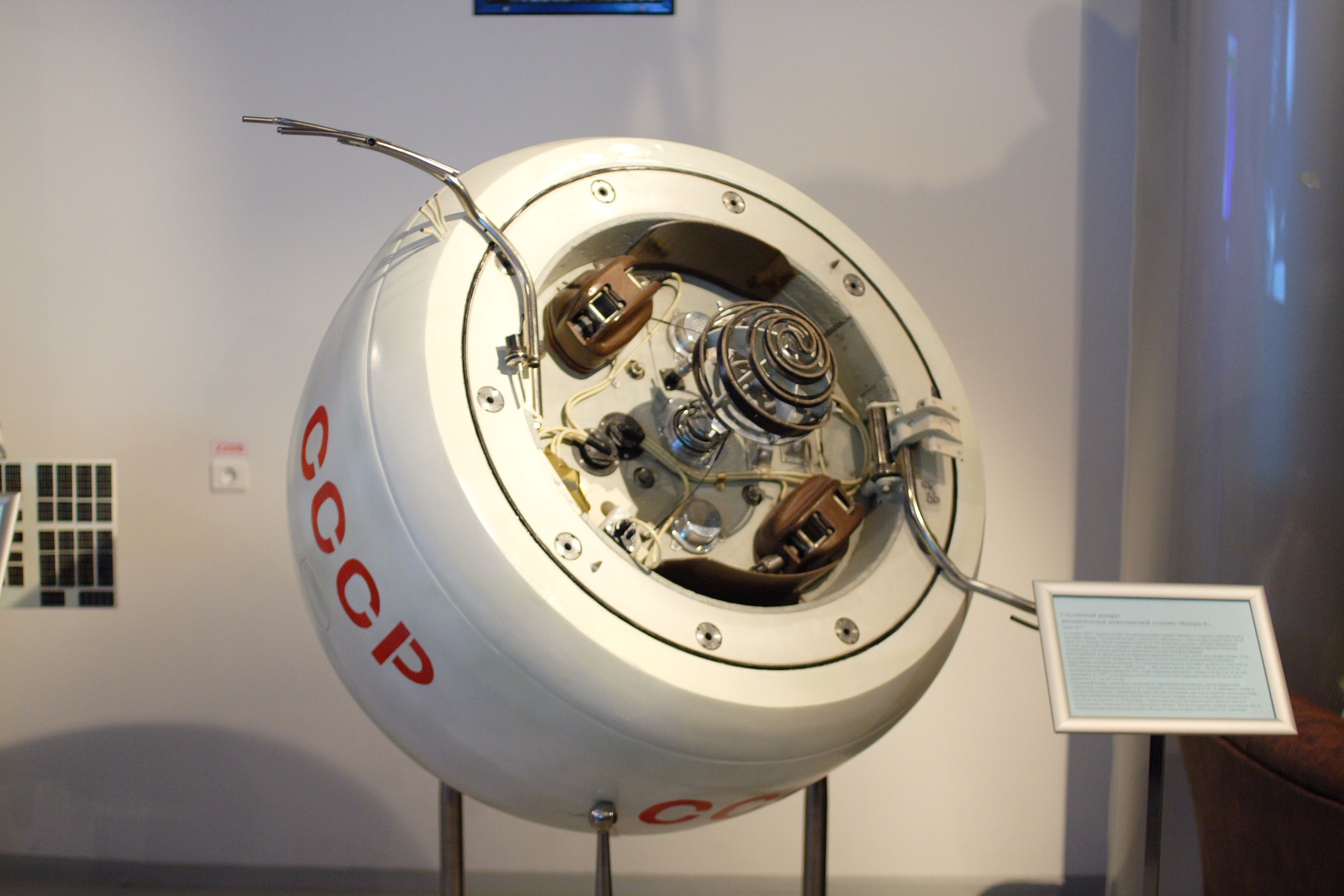
At 04:02 GMT on 31 March 1972, a Molniya 8K78M rocket lifted off from Baikonur with a Soviet Venus probe, carrying a lander, on top. Its twin, Venera 8, had left the same site four days earlier. The new probe reached a low parking orbit, but its escape stage stopped firing about halfway through the burn that should have sent it to Venus. The spacecraft stayed in Earth orbit. The tracking catalogue went on to list a main object and a second object that analysts believe is the descent craft. The object catalogued as 1972-023A, taken to be the main bus, decayed on 5 May 1981. ESA and Roscosmos report that the object believed to be the descent craft came down on 10 May 2025.
The Astronautix Venera entry records Venera 8 at 04:15 GMT on 27 March 1972 and Cosmos 482 at 04:02 GMT on 31 March, both on the Molniya 8K78M. It lists the Cosmos 482 payload as a 3V (V-72) spacecraft, serial number 671, with a mass of 1,180 kg and the COSPAR designation 1972-023A.
A Block L burn cut short
Jonathan McDowell, in notes dated April 2025, later updated around 7 May, describes the three lower stages placing the stack in a 196 by 215 km parking orbit.
The Block L upper stage then took over. McDowell, who calls that stage the Blok-NVL, writes that its BOZ ullage motor unit fired and separated, and the main engine ignited. It shut down early, about 2 minutes into a planned 4 minute burn. That left the stack in a 206 by 9,800 km orbit around Earth. Astronautix gives the orbit as about 204 by 9,806 km, inclined at 52 degrees.
The Astronautix entry gives a specific cause for the shutdown:
The escape stage Block L's engine cut off 125 seconds after ignition due to timer failure.
A collectSPACE report from May 2025 gives a more general description and says only that the stranding was "believed to have been an engine failure".
Since the craft never left Earth orbit, it was catalogued as Kosmos 482. McDowell writes that the USSR had planned to name a successful mission Venera 9, then announced the stranded probe as Kosmos 482. The 1975 Venera 9 was a separate mission.
collectSPACE lists these instruments for the craft: sensors for the temperature, pressure and density of the Venus atmosphere, along with an accelerometer, radio altimeter, anemometer, gamma-ray spectrometer, gas analyzer, visible photometers and radio transmitters. The instruments ran on batteries, with an expected life of about 30 minutes on the surface.
Venera 8 exceeded that figure and returned data for 50 minutes after landing. In 1982, Venera 13 reached the surface and lasted 127 minutes against an expected 32, while the object believed to be the Kosmos 482 lander was still circling Earth.
Catalogue entries 1972-023A and 1972-023E
US tracking catalogued several objects from the launch. Marco Langbroek, writing in The Space Review on 16 May 2022, sets out how the payload itself became two objects. One kept the designation 1972-023A and is believed to be the main bus. The other, 1972-023E, catalogue number 6073, is believed to be the descent craft.
Langbroek, in 2022, dated the split from the orbital elements and placed the separation in mid-June 1972, roughly 80 to 85 days after launch, around 21 June. That date was his reading of the tracking data. In the 2025 follow-up, Langbroek and Dirkx note later documentary evidence, unearthed by Anatoly Zak: a declassified Russian military memo indicating that the lander was deliberately released from the main bus after the failure to leave Earth orbit.
The objects then came down at different times. In Langbroek's table, 1972-023A reentered on 5 May 1981, and the Block L stage, listed as 1972-023D, reentered on 20 February 1983.
The Astronautix Venera listing gives a decay date of 5 May 1981 for Cosmos 482. That date belongs to 1972-023A, the object taken to be the main bus. It does not apply to object 6073, which is believed to be the descent craft.
The link between object 6073 and the descent sphere is an inference. McDowell says he began labelling 23E as the Venera descent sphere in September 2000, and the NORAD catalogue began using that label in June 2002. He describes himself as "moderately confident" that 6073 is the entry capsule. The May 2025 coverage reported no debris recovery that would confirm it.
If object 6073 is the descent craft, collectSPACE puts it at about 495 kg and about 1 metre across. Langbroek's 2022 article uses the same one-metre figure and a mass of 495 kilograms.
ESA and Roscosmos times for 10 May 2025
Object 6073 decayed in 2025. The ESA Space Debris Office, in a reentry prediction post updated on 13 May 2025, reported that an uncontrolled reentry of the Cosmos-482 descent craft took place on 10 May 2025.
ESA inferred a time window from radar. The Fraunhofer FHR radar in Germany last saw the object at about 06:04 UTC (08:04 CEST). ESA says the radar did not see it on the expected 07:32 UTC pass, so it assumed the reentry occurred between those two times. Separately, ESA gave a nominal estimate of 06:16 UTC, plus or minus 0.36 hours.
ESA did not claim a precise answer. The office said it had not identified an exact time or place, and that it had received no reports of direct visual observation or of ground impact.
Roscosmos issued its own statement on 10 May 2025, quoted by collectSPACE. It said the spacecraft "launched in 1972, ceased to exist, leaving orbit and falling into the Indian Ocean." By the Roscosmos account, the craft entered the dense atmosphere at 09:24 Moscow time (06:24 UTC), 560 km west of Middle Andaman Island, and fell into the Indian Ocean west of Jakarta.
Langbroek and Dirkx examined the question in The Space Review on 27 May 2025. They said the Roscosmos figure looks like a model result and not an exact determination. Their own judgement placed the reentry most likely between about 06:15 and 06:45 UTC, over southwest Asia or the Indian Ocean.
The time and place of the final descent therefore rest on different estimates from different sources. The date does not. ESA and Roscosmos both give 10 May 2025.
Featured image: A Venera 4 descent capsule, or a model of one, at the Memorial Museum of Cosmonautics in Moscow. Venera 4 was an earlier probe in the series, not the Kosmos 482 lander. Photo by Rave / Wikimedia Commons, CC BY-SA 3.0.