
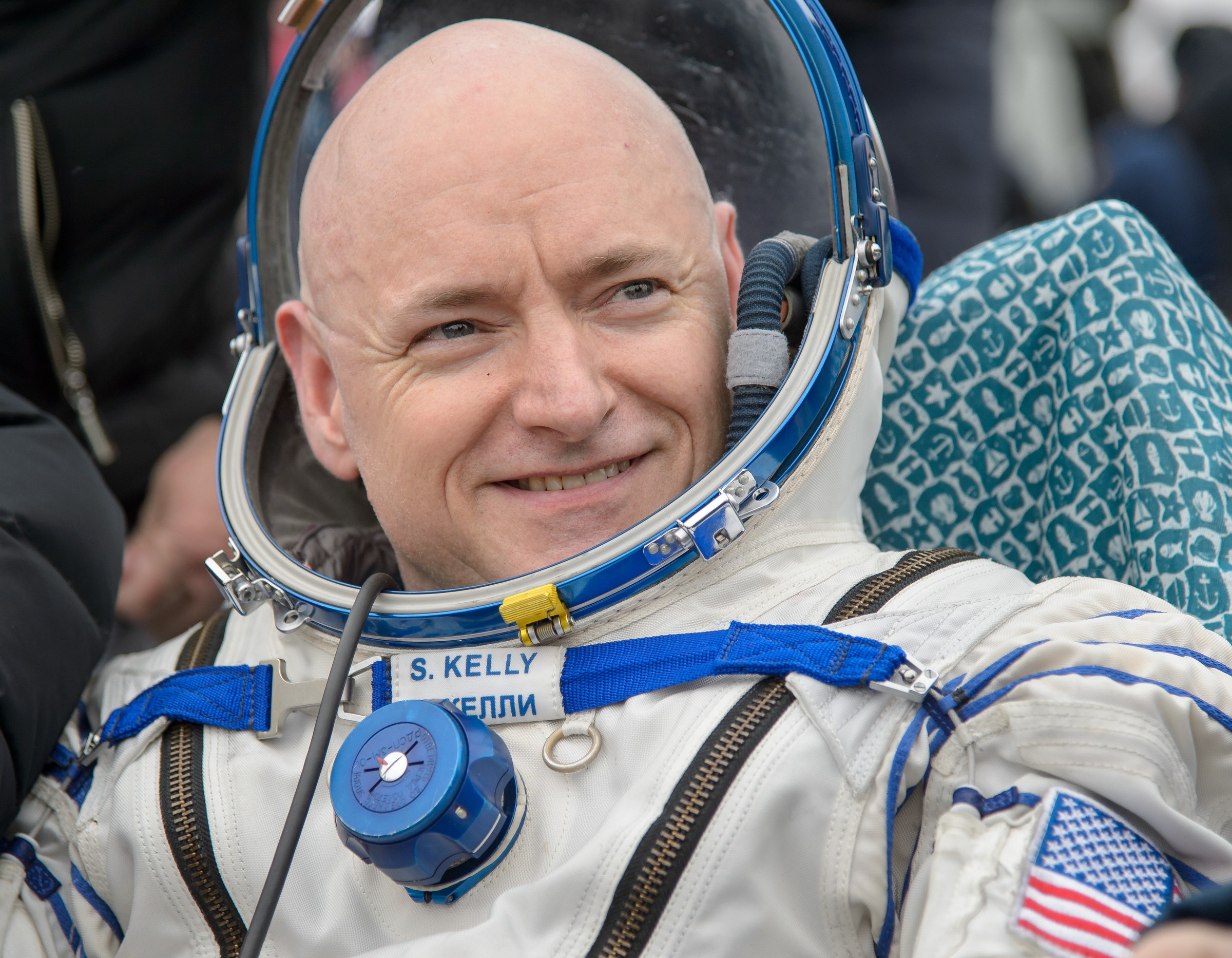
On 1 July 2020, the journal Aerospace Medicine and Human Performance published a case report on the skin of an astronaut who had spent 340 days in space. The journal lists that date as the online publication date. The patient was also the third author. The paper, indexed on PubMed, is credited to J. Law, S. Gilmore and Scott Kelly. It describes redness and skin sensitivity that appeared about 10 hours after Kelly's Soyuz landed in Kazakhstan and persisted for six days.
The authors offer a cause, but only as a hypothesis. They propose that a prolonged lack of skin stimulation over the year-long mission led to the rash and the sensitivity. In the same passage they state that vascular, allergic and immunologic causes cannot be ruled out.
A medical paper with the patient on the byline
The full citation is Law J, Gilmore S, Kelly S, "Postflight Rash and Skin Sensitivity Following a Year-Long Spaceflight Mission," Aerospace Medicine and Human Performance, 2020, volume 91, issue 7, pages 604 to 607, DOI 10.3357/amhp.5580.2020. The abstract identifies its subject as "NASA's first year-long crewmember." It does not name the patient. The 340-day mission it describes is Kelly's, and Kelly is the third author.
That mission began on 27 March 2015, when Kelly and Mikhail Kornienko launched to the International Space Station. The two returned with Sergey Volkov aboard Soyuz TMA-18M. A NASA photo caption places the landing near Zhezkazgan, Kazakhstan, on 2 March 2016 local time, which Spaceflight Now reported as late Tuesday U.S. time. NASA describes Kelly as the first American astronaut to spend a year in space. His Astronautix entry lists 520 cumulative days in space across four spaceflights: STS-103 in 1999, STS-118, Soyuz TMA-01M and Soyuz TMA-16M.
The same flight anchored the NASA Twins Study, which compared data from Scott Kelly with data gathered on the ground from his twin brother, Mark Kelly. Spaceflight Now reported that data collection on Kelly and Kornienko began before launch and continued during the flight, with more planned after landing. John Charles of NASA's Human Research Program said the aim was to compare two people who "at least at birth, were fairly identical genetically." The results appeared in Science in April 2019. That paper's abstract covers cardiovascular, telomere, gene-expression, microbiome, ocular and cognitive findings. It does not list the rash.
About ten hours after touchdown, in the gravity-dependent areas
The case report sets Kelly's experience against a known pattern. Skin conditions are commonly reported during flight on the ISS, the authors note. After landing, though, skin complaints had generally been limited to sensitivity in the soles of the feet once crew members began bearing weight on them again.
Kelly's in-flight course is described as unremarkable, with two exceptions. He used medication for congestion, which the authors consider likely secondary to the fluid shift of microgravity and elevated carbon dioxide aboard the station. He also had one episode of contact dermatitis from electrodes used in an experiment.
The landing was nominal. During his direct return to Houston, about 10 hours after the Soyuz came down, he developed erythema, or redness, along with skin sensitivity in gravity-dependent areas of the body.
The findings persisted for six days. The report says they were treated successfully with nonsteroidal anti-inflammatory drugs, gabapentin, hydrotherapy and massage.
The support for the skin-stimulation hypothesis is indirect. Earlier studies had shown altered feedback from skin receptors in the sole of the foot during spaceflight. From that, the authors argue it is plausible that skin elsewhere on the body also changes when it is not stimulated as it would be on Earth. They call for more work to understand the phenomenon and to test possible mitigations.
The report describes a single case, and it leaves vascular, allergic and immunologic explanations open as possibilities.
Six days in the journal, about two weeks in the memoir
Kelly described the problem in public four years before the paper appeared. He spoke to reporters at Johnson Space Center on 4 March 2016. William Harwood wrote the story for CBS News, and Spaceflight Now republished it with permission. Kelly said:
"I also have an issue with my skin. Because it hadn't touched anything for so long, had any significant contact, it's very, very sensitive. It's almost like a burning feeling where I sit or lie or walk."
That explanation, offered days after landing, is close to the one the case report would put forward as a hypothesis four years later.
At the same briefing he said he had gone 340 days without running water. On the night he got home, he jumped into his pool fully clothed.
His memoir, Endurance, gives a longer account. In an excerpt published by Smithsonian Magazine in September 2017, Kelly describes a strange rash across his back, the backs of his legs, and the back of his head and neck, "everywhere I was in contact with the bed." His partner at the time said it looked like an allergic rash, "like hives." That night, she brought him ibuprofen and water.
In the book, Kelly writes that the swelling in his legs went away after about two weeks, around the same time as the rashes, and that the rashes "were caused by the fact that my skin wasn't really subjected to pressure for a whole year." The memoir states that explanation as fact. The paper he co-signed presents a similar idea as a hypothesis.
The two sources also give different durations. The case report records skin findings that persisted for six days. The memoir gives about two weeks for the rashes, with the leg swelling clearing around the same time. The two sources give different durations, and both figures are recorded here as each source gives them.
Featured image: Expedition 46 Commander Scott Kelly outside Soyuz TMA-18M after landing near Zhezkazgan, Kazakhstan, on 2 March 2016 (Kazakh time). Photo by NASA/Bill Ingalls.