
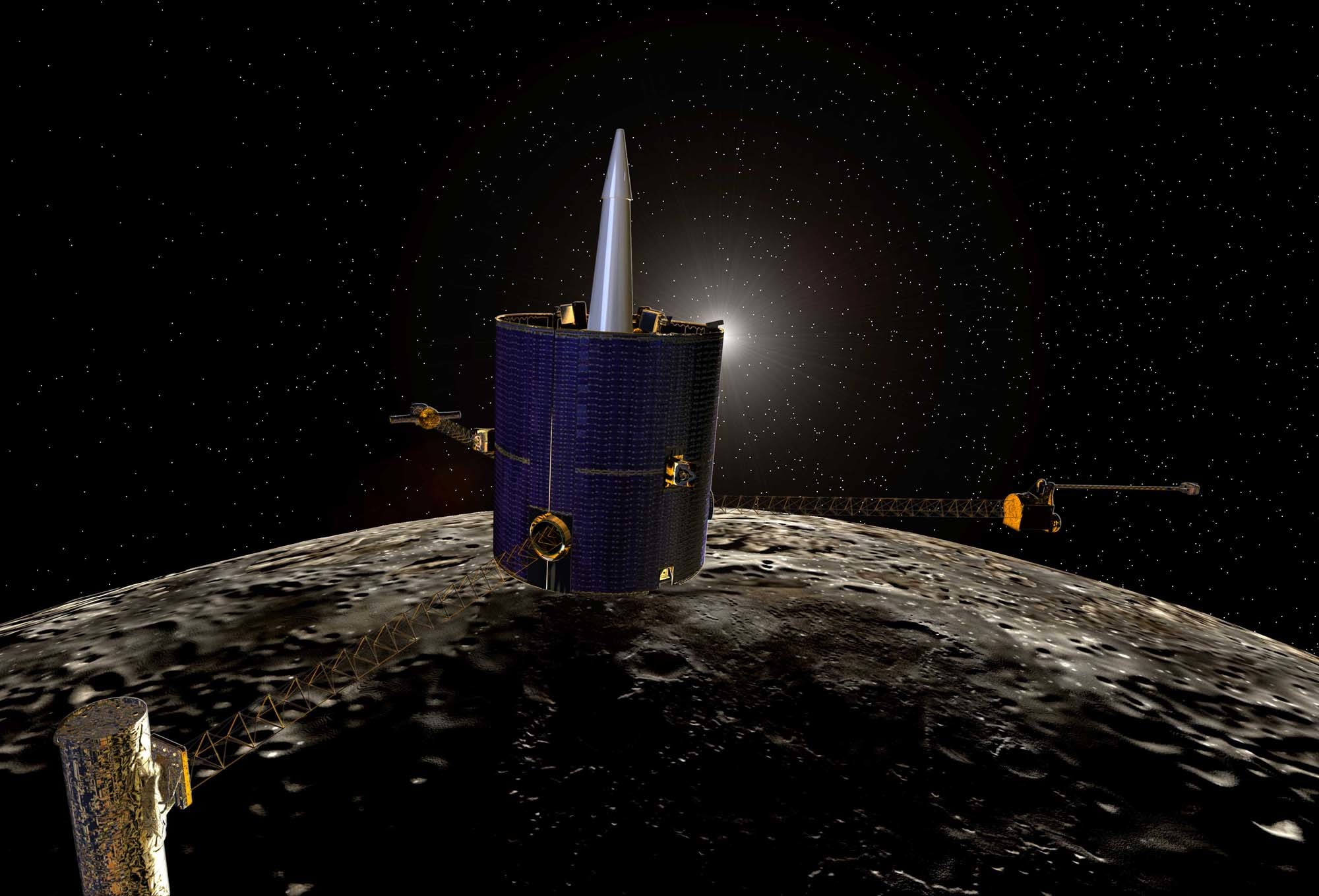
The end of Lunar Prospector's mission was scheduled, aimed and commanded. At 09:52:02 UT on 31 July 1999, the spacecraft was driven into a permanently shadowed area of a crater near the Moon's south pole, in a region that now carries the name Shoemaker crater. NASA's own mission page records the event plainly, stating that the vehicle was deliberately impacted onto the shadowed crater.
Mounted deep inside the structure, in a vacuum-sealed and flight-tested aluminum sleeve, was a small polycarbonate vial. It held one ounce of the cremated remains of Eugene Shoemaker, a geologist who helped train Apollo astronauts to read lunar geology.
A target chosen in the dark
Lunar Prospector had lifted off from Space Launch Complex 46 at Cape Canaveral Air Force Station on an Athena-2, on the evening of 6 January 1998 US Eastern time, which was 02:28:44 UT on 7 January 1998. The NASA Ames finding aid for the project records the same split, listing the launch as January 7, 1998 UT (January 6 EST). Liftoff that night had been set for 9:28 p.m. EST.
The final maneuver was an experiment as well as a disposal. By steering the spent spacecraft into permanent shadow, where water ice might survive, controllers hoped the impact would throw up a plume that Earth-based observers could examine. The result was negative. In NASA's wording, "Observations of the resulting dust cloud by Earth-based telescopes showed no spectral signature characteristic of water vapor."
The Ames records guide leaves no ambiguity about intent, describing how on 31 July 1999 UT the team "purposely slammed the craft into a permanently shadowed area of a crater near the south pole". Nothing about the ending was a mishap.
One ounce, wrapped in brass
The capsule itself was modest. A University of Arizona release written by Lori Stiles and dated 6 January 1998 described a polycarbonate container one and three quarters inches long and seven tenths of an inch in diameter, sealed inside the aluminum sleeve and fixed deep within the spacecraft.
Around the capsule went a sheet of brass foil, laser-engraved by Universal Laser Systems in Phoenix. It carried a CCD image of Comet Hale-Bopp taken on 14 April 1997 by Steve Larson, a photograph of Meteor Crater in northern Arizona by David Roddy and Karl Zeller of the United States Geological Survey, chosen at Carolyn Shoemaker's suggestion as her husband's favorite view of the crater, and a passage from Shakespeare's Romeo and Juliet.
And, when he shall die, Take him and cut him out in little stars, And he will make the face of heaven so fine That all the world will be in love with night, And pay no worship to the garish sun.
The tribute was proposed and produced by Carolyn C. Porco, then a planetary scientist at The University of Arizona and a former student of Shoemaker's at Caltech. She said the idea came to her on 19 July 1997, the day after he died.
NASA's Astronomy Picture of the Day for 15 January 1998 told readers that the tribute had been conceived by a former student, without naming her, and noted that the ashes were by then aboard the spacecraft in polar mapping orbit around the Moon.
Shoemaker was killed on 18 July 1997 in a car accident at Alice Springs, Australia, during field research on impact crater geology. Carolyn Shoemaker was injured in the same crash.
Her reaction to the flight, as quoted in the Arizona release, was direct. "I don't think Gene ever dreamed his ashes would go to the moon. He would be thrilled," she said, adding: "This is so important to us. It brings a little closure, in a way, to our feelings. We will always know when we look at the moon, that Gene is there."
The hammer that never reached the Moon
A health problem had kept Shoemaker from becoming the first geologist to walk on the Moon. Porco quoted him on the loss: "Not going to the moon and banging on it with my own hammer has been the biggest disappointment in life."
What he did instead shaped the Apollo science return. Shoemaker helped select the astronauts and train them in lunar geology and impact cratering, work that took crews to field sites chosen for their resemblance to the Moon, including the shattered rock of Meteor Crater in Arizona. The wider training program reached further afield, sending future Apollo crews to the ash-covered lava fields of northern Iceland. A USGS photograph from the mid-1960s shows Shoemaker at Meteor Crater, the same landmark later etched onto the brass foil.
The Ames project records guide makes a strong claim for what happened at impact, stating that "Shoemaker's ashes were embedded in the lunar surface with the spacecraft, for the first ever space burial of a human being on a celestial body." That is the archive's wording, and it is worth reporting as such rather than as settled fact.
The flight was not universally welcomed. Navajo Nation President Albert Hale objected in January 1998, and NASA apologized, saying it had not intended any disrespect.
The Moon keeps what is left on it. Hardware from the 1960s and 1970s still sits on the surface, including Lunokhod 1's laser reflector. Somewhere in the dark near the south pole, where telescopes searched the impact plume in vain for water, lies one ounce of a geologist who spent his career explaining what happens when something hits a planet.