
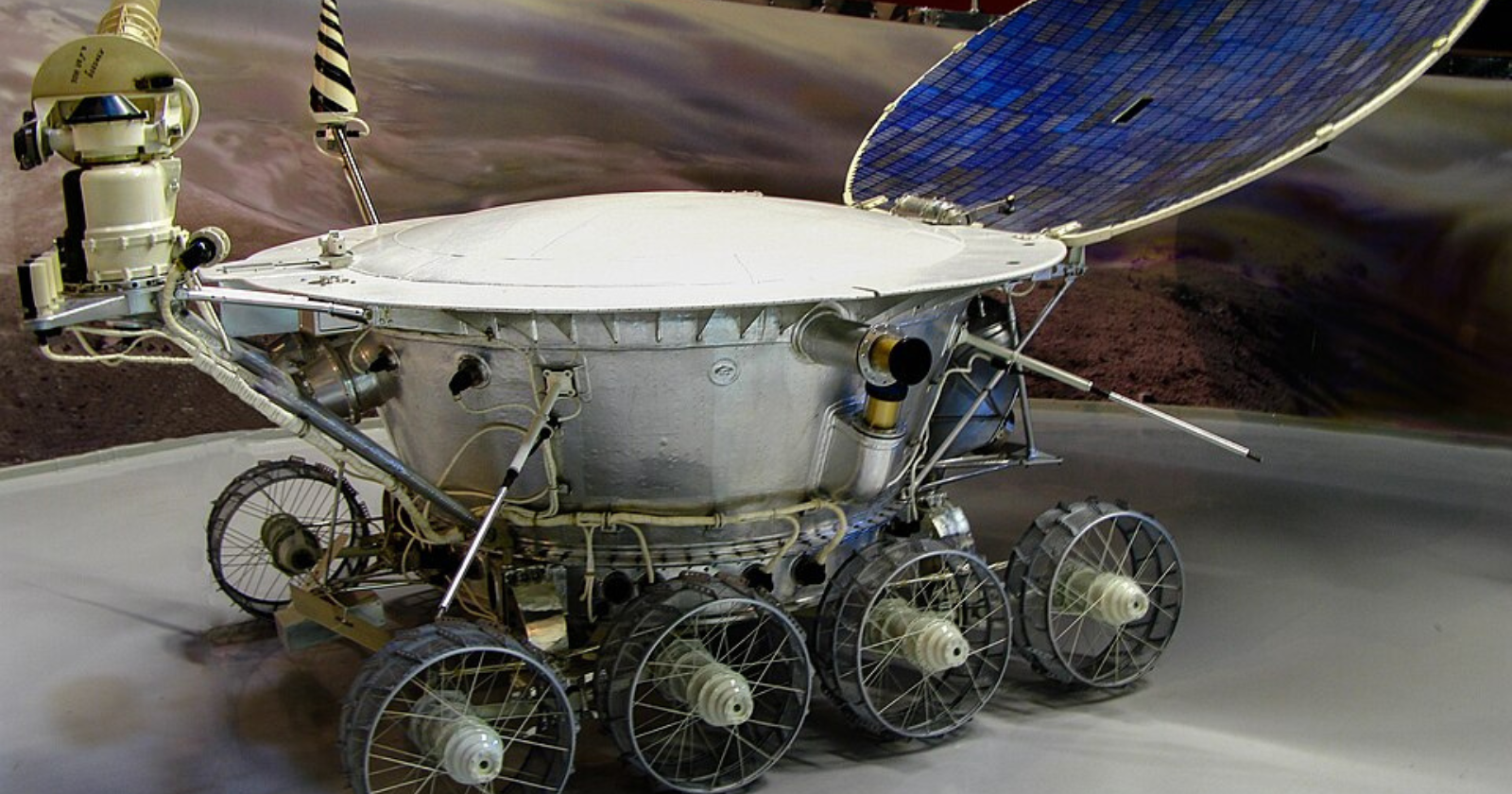
On 17 November 1970, a Soviet spacecraft called Luna 17 touched down on a plain known as the Sea of Rains. Ramps folded down, and a strange machine rolled onto the Moon. It looked like a bathtub on eight wheels, topped with a lid.
This was Lunokhod 1, the first remote-controlled rover ever to drive on another world. For almost a year it explored the Moon. Then it fell silent and, for nearly four decades, nobody knew exactly where it was.
The first rover on another world
Lunokhod 1 was about 2.3 metres long and was driven by a team of operators in the Soviet Union, who steered it using television images sent back from the Moon. Because of the delay in sending signals to and from the Moon, every move had to be planned with care.
The rover was a remarkable success. Over about 10 months, it travelled roughly 10 kilometres, sent back thousands of pictures and panoramas, and tested the lunar soil at hundreds of locations. It was powered by solar panels in its lid, and a small radioactive heater kept it warm through the freezing lunar nights.
A mirror for lasers
Lunokhod 1 also carried a French-built laser reflector, a device made of special prisms that bounces light straight back to where it came from. Scientists on Earth could fire a laser at it and time how long the light took to return, measuring the distance to the Moon with great precision.
Apollo astronauts left three similar reflectors at their landing sites, and a second Soviet rover, Lunokhod 2, carried another when it landed in 1973. Together, these reflectors are the only Apollo-era science experiment still in use today.
Silence and a lost rover
Controllers last heard from Lunokhod 1 on 14 September 1971. After that, the rover stopped responding, and the mission was officially ended a few weeks later.
Scientists at McDonald Observatory in Texas tried to bounce lasers off its reflector in the early 1970s but had, at most, one possible detection on 31 December 1970. They didn’t know the rover’s exact position, and over time they gave up. Many assumed it had fallen into a crater or parked with its reflector facing away from Earth.
Found from orbit
The breakthrough came in March 2010. NASA’s Lunar Reconnaissance Orbiter, which was photographing the Moon in high detail, spotted the Luna 17 lander and the rover’s tracks. Its camera team, led by Mark Robinson of Arizona State University, worked out the rover’s position to within about 100 metres.
Physicist Tom Murphy of the University of California, San Diego, led a project called APOLLO, which bounced lasers off the Moon from a 3.5-metre telescope at Apache Point Observatory in New Mexico. His team’s earlier best guess for the rover’s location turned out to be miles off.
A surprisingly bright signal
On 22 April 2010, Murphy’s team aimed their laser at the new coordinates. They found the reflector almost immediately and received about 2,000 photons, individual particles of light, on their first attempt.
The signal was so strong that Murphy first wondered if his equipment was faulty. It was at least five times brighter than the signal usually received from Lunokhod 2. It also showed that the rover had stopped on level ground with its reflector facing Earth. Why the long-lost reflector was performing better than its twin remains something of a mystery.
Why it matters
Each reflector adds a fixed point on the Moon’s surface. With more reflectors spread across the Moon, scientists can measure not only its distance but also how it wobbles, tilts and stretches under Earth’s gravity. This helps reveal what lies beneath the surface, including clues about the Moon’s core.
The measurements are also used to test Einstein’s theory of general relativity with extremely high precision. Adding Lunokhod 1 gave researchers a valuable new point on the Moon, nearly 40 years after the rover went quiet. More than half a century after it landed, the little Soviet rover is still helping scientists understand the Moon.