
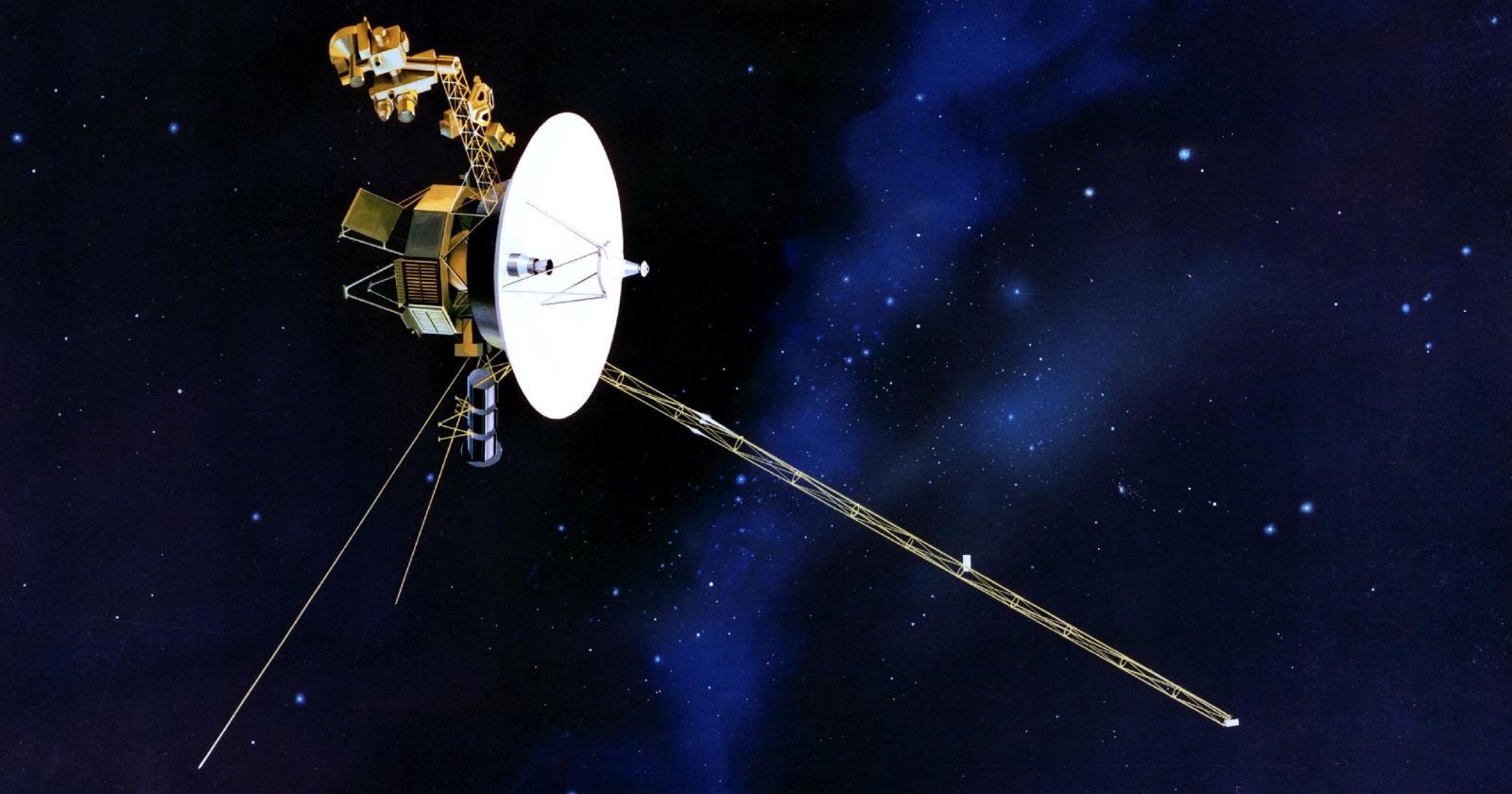
In September 1977, most homes had a phone fixed to the wall, with a curly cord and a rotary dial. Personal computers were a novelty for hobbyists, and the internet didn’t exist for ordinary people. That month, a rocket lifted off from Florida carrying a spacecraft called Voyager 1.
Nearly half a century later, Voyager 1 is still working. On 18 November 2026, it becomes the first human-made object to reach one light-day from Earth, a distance so great that its radio signal takes a full 24 hours to reach us.
What a light-day means
A light-day is the distance light travels in one day, about 25.9 billion kilometres. Radio waves travel at the speed of light, so from this week, a message from Earth will take a day to reach Voyager 1, and its reply will take another day to come back.
It has taken Voyager 1 just over 49 years to cover that distance, travelling at about 61,000 kilometres per hour. For comparison, the nearest star beyond the Sun is more than 1,500 light-days away. Voyager has crossed the first one.
Computers from another era
Voyager 1 is still running on the computers it launched with. It has three main computer systems: one to receive commands and control the spacecraft, one to keep it pointed in the right direction, and one to collect and package science data.
Their memory is tiny by modern standards, measured in thousands of words rather than billions. A single photo on a modern smartphone takes up far more space. The software is written in low-level code designed for custom processors from the 1970s, and few engineers today are trained to work with it.
Keeping old hardware alive
The hardware hasn’t changed, but the instructions have. Engineers have reprogrammed Voyager many times since launch, uploading new software to make the spacecraft more independent after its planetary encounters ended and to work around faults as parts have aged.
That has meant some remarkable repairs. In 2023, a memory chip in one of Voyager 1’s computers failed, and the spacecraft began sending back gibberish. Working with a 1970s design and a two-day round trip for every command, the team spent months finding the fault and moving the affected code to other parts of memory. In 2025, they revived backup thrusters that hadn’t been used since 2004.
A whisper across the solar system
Voyager 1’s radio transmitter has about the power of a refrigerator light bulb. By the time its signal reaches Earth, it is billions of times weaker than the power of a watch battery. NASA picks it up using the giant 70-metre dishes of its Deep Space Network in California, Spain and Australia.
The data trickles in at around 160 bits per second, far slower than a 1990s dial-up modem. Even so, the spacecraft is still sending back measurements from interstellar space, the region beyond the Sun’s influence that it entered in 2012.
The people who keep it going
The engineers who built Voyager have mostly retired, and many of today’s small team joined decades after launch. Some weren’t even born when it left Earth. They have had to learn the spacecraft from old manuals, scattered documents and advice from retired colleagues.
Every decision is made with care, because the spacecraft is running low on power. Its nuclear power source loses about 4 watts a year, and the team has switched off heaters and instruments one by one to keep it alive. In April 2026, they powered down another science instrument, leaving just a few still working.
The road ahead
NASA expects Voyager 1 to run out of power for its science instruments in the early 2030s. After that, it will fall silent, but it will keep travelling, carrying its Golden Record of sounds and images from Earth.
The world it left behind has changed beyond recognition. Wall phones gave way to mobiles, then smartphones with more computing power than every system NASA used in 1977. Through all of it, a machine built with that 1970s technology has kept working, and from this week, its messages will spend a full day travelling home.