
On Earth, people have dreamed of flying like birds for thousands of years, and almost every attempt to do it with strapped-on wings has ended in failure. Human muscles simply aren’t strong enough to lift our bodies through Earth’s thin air.
But about 1.2 billion kilometres away, on Saturn’s largest moon, the numbers change. On Titan, scientists say a person wearing wings could, in principle, take off by running a few steps and flapping their arms.
A moon with a thick atmosphere
Titan is larger than the planet Mercury and is the only moon in the solar system with a thick atmosphere. Like Earth’s, it is mostly nitrogen.
The air pressure at Titan’s surface is about one and a half times that at sea level on Earth, similar to what you’d feel about 5 metres underwater. And because Titan is so cold, around minus 179°C, its air is far denser than ours, about four to four and a half times as dense.
Why low gravity matters
Titan is also small. Its gravity is about 14% of Earth’s, or around one-seventh, slightly less than the Moon’s. A person who weighs 70 kilograms on Earth would feel like they weighed about 10 kilograms there.
Put these two facts together and flying becomes far easier. Thick air gives wings more lift, and weak gravity means there’s far less weight to lift. Engineers who studied a robotic Titan aircraft concept estimated that flight there is about 28 times easier than on Earth, meaning the same wing at the same speed could carry about 28 times as much.
Strapping on wings
The idea of human-powered flight on Titan was popularised in the 1990s by aerospace engineer Robert Zubrin. He suggested that people with wings attached to their arms could fly through Titan’s thick atmosphere.
Physics students at the University of Leicester later tested the idea with calculations and concluded that an average-sized person could fly using wings of a manageable size. On Earth, the take-off speed needed with arm-sized wings is far beyond what human legs can produce. On Titan, it drops to roughly a jogging pace.
The catch
Flying on Titan wouldn’t be as simple as stepping outside. The air contains no oxygen, and it is so cold that an unprotected person would freeze almost instantly. Any flyer would need a heated, pressurised suit and its own air supply.
Keeping warm would be the biggest challenge. Because Titan’s air is so thick, it would draw heat away from a suit much faster than the near-vacuum of space. The wings would also need to work in extreme cold, which makes many materials brittle.
What we know about Titan
Much of what we know comes from the Cassini mission, which orbited Saturn from 2004 to 2017. In January 2005, its European-built Huygens probe parachuted through Titan’s atmosphere and landed on the surface, the most distant landing ever made.
Cassini revealed a world that looks surprisingly like Earth, with clouds, rain, rivers, lakes and seas. But on Titan, the liquid is methane and ethane, not water, and the “rocks” are made of ice as hard as stone.
The next flyer: Dragonfly
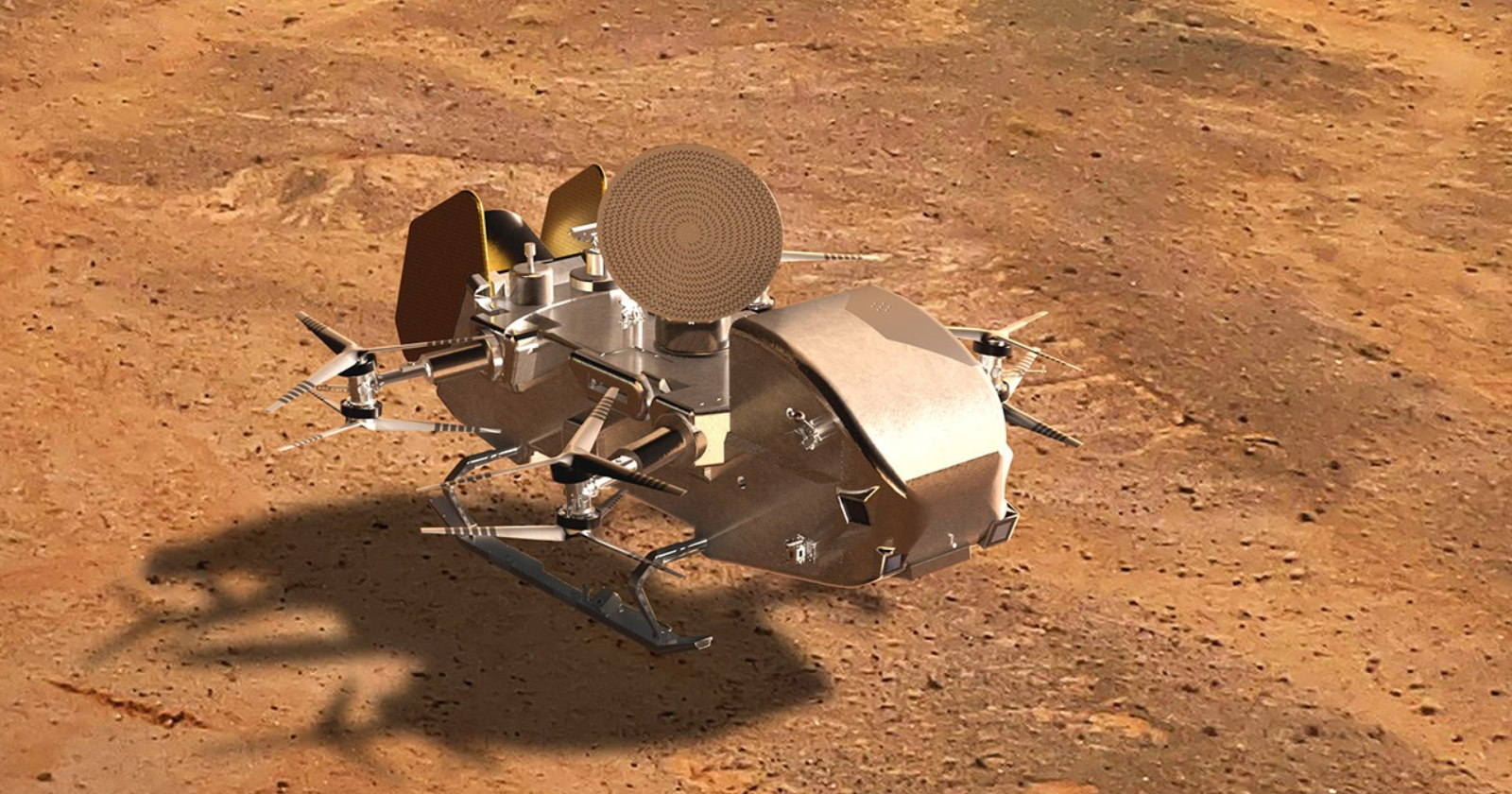
Humans won’t be flying on Titan any time soon, but a machine will. NASA’s Dragonfly mission is a car-sized, nuclear-powered rotorcraft, a kind of large drone with eight rotors. It is due to launch on a SpaceX Falcon Heavy rocket in July 2028 and arrive at Titan in 2034.
Dragonfly will fly from place to place, studying the moon’s chemistry and looking for clues about how the ingredients for life might come together. If it succeeds, it will show just how well Titan’s thick air and low gravity can support flight, and perhaps bring the dream of flying there one step closer.