
When Neil Armstrong stepped onto the Moon on 20 July 1969, the only thing between him and the vacuum was a garment made in Dover, Delaware, by women who had spent their careers making bras and girdles.
Its official name was the A7L. "A" stood for Apollo, "7" for the seventh generation of design, and "L" for latex, the specialty of the International Latex Corporation. Most people knew that company by its consumer brand: Playtex.
An underdog in a room of giants
NASA began looking for an Apollo spacesuit in the early 1960s, and the obvious candidates were defence contractors. Hamilton Standard, a division of United Aircraft, built aircraft systems. David Clark Company had made pressure suits for military pilots and Mercury astronauts.
NASA's first arrangement put Hamilton Standard in charge, with ILC, Playtex's industrial division, as the subcontractor making the suit itself. It went badly. The two companies worked in completely different ways, and early ILC designs failed to meet NASA's requirements.
By 1965, Hamilton Standard had pushed ILC out. NASA then ran a fresh competition between suits from Hamilton Standard, David Clark and ILC, which paid its own way to take part.
ILC won in July 1965. Its suit let testers bend, walk and move far more freely than its rivals, which historians describe as stiffer, armour-like designs built from interlocking parts.
The trick borrowed from a girdle
The hardest part of any spacesuit is the joints. Pressurise a fabric suit and it swells like a balloon, fighting every attempt to bend an elbow or knee.
ILC's answer came from its own factory floor. The company built its joints from "convolutes", ridged rubber bellows that folded and unfolded like an accordion as the wearer moved. They used the same kind of rubber that went into Playtex girdle moulds, with nylon tricot and webbing from its brassiere production lines.
The result held pure oxygen at about 3.75 pounds per square inch, roughly a quarter of sea-level air pressure, while still letting an astronaut kneel, climb a ladder and pick up rocks.
Twenty-one layers, from the skin out
The finished lunar suit had about 21 layers. Inside sat a comfort liner, and then a rubber-coated nylon bladder that held the air in. Over that went a restraint layer that stopped the bladder ballooning out of shape.
Then came the outer garment, which protected against heat, cold and tiny high-speed particles called micrometeoroids. It alone was made of 17 layers, many of them whisper-thin films of aluminised Mylar and Kapton separated by fabrics like Dacron. The outermost skin was Beta cloth, a Teflon-coated fibreglass fabric that would not burn.
That fireproofing became essential after January 1967, when three astronauts died in the Apollo 1 cabin fire. NASA then demanded far more fire resistance from every part of the suit.
Every A7L was custom-made for one astronaut, and every alteration meant a new fitting. When crews complained about rough surfaces inside, ILC added a layer of soft girdle lining.
Sewing to a sixty-fourth of an inch
According to architect and historian Nicholas de Monchaux, who wrote the definitive account of the suit's creation, NASA's tolerance for seams was less than 1/64 of an inch. That is about 0.4 millimetres, finer than the eye of the needle doing the sewing.
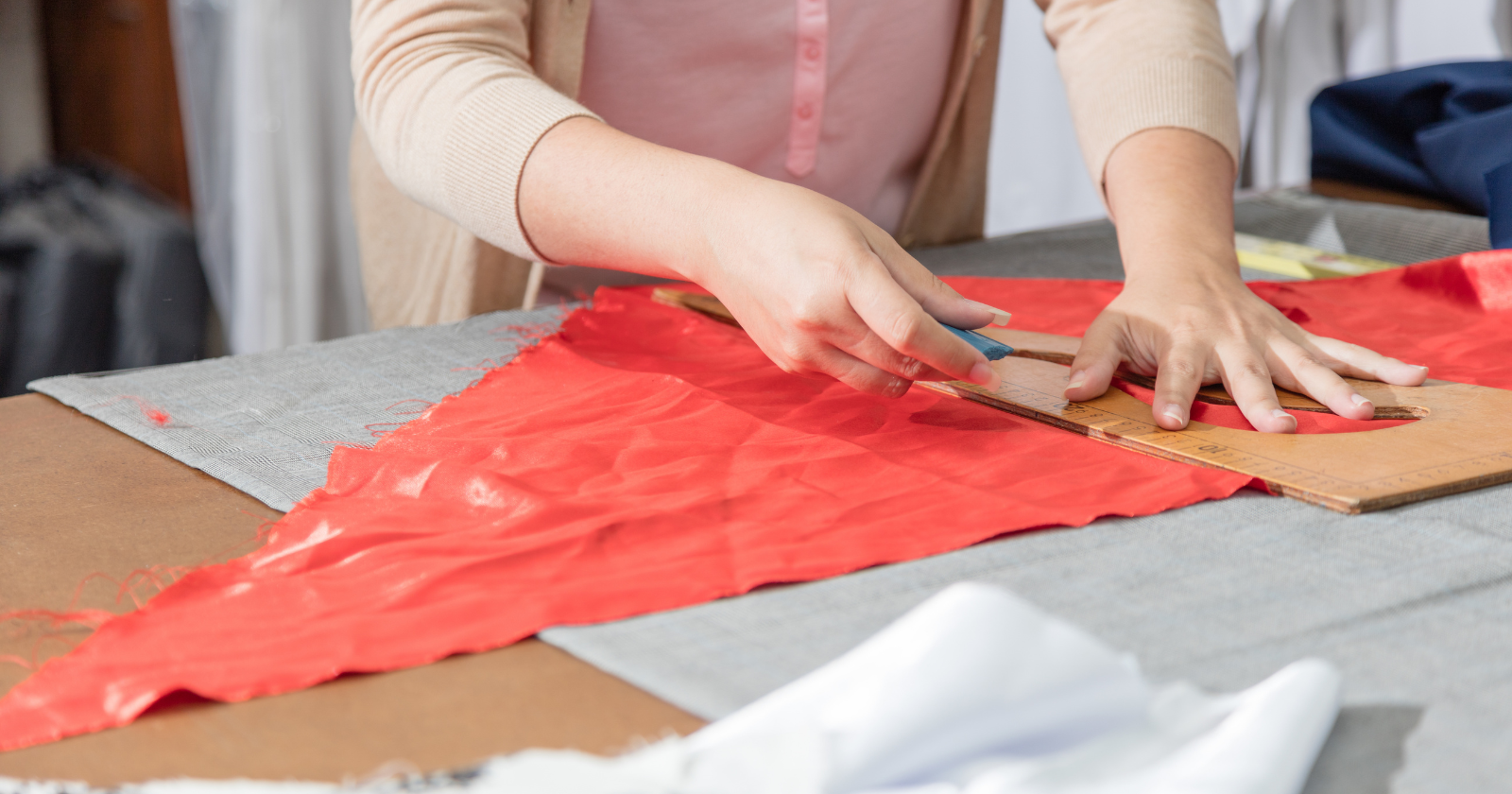
The seamstresses used ordinary industrial sewing machines, but guided every seam by hand. Many worked a modified treadle that fired a single stitch with each press of the foot. Pins, the basic tool of any dressmaker, were banned. A stray pin could puncture the pressure bladder.
In 1967, after one pin was found between the layers of a prototype, ILC installed an X-ray machine on the shop floor to check suits for anything left inside.
Roberta Pilkenton was one of the most valued workers. She could assemble the outer garment's 17 layers, with hundreds of metres of seams, using nothing but her fingers to guide the material. Another, Eleanor Foraker, often sewed late into the night to meet NASA's deadlines.
The suit in the museum
ILC suits flew on every Apollo landing, as well as on Skylab and the Apollo-Soyuz mission. The life-support backpack, the part that supplied oxygen and cooling, came from Hamilton Standard.
Armstrong's own suit, serial number 056, is now in the Smithsonian's National Air and Space Museum. Its rubber has aged, and conservators have worked hard to keep it from breaking down.
It is still marked with grey stains from the dust of the Sea of Tranquillity, picked up in roughly two and a half hours of walking on the Moon.