
On 21 August 2017, millions of Americans stepped outside to watch the Moon slide across the Sun. In Staten Island, New York, about 72% of the Sun's disc was covered. Nia Payne, 26, had no eclipse glasses, so she looked up anyway, several times, for about six seconds at a go.
Later she borrowed a pair of glasses from a stranger and looked again for 15 to 20 seconds. Nobody knew where the glasses came from or whether they were safe.
About four hours later, her vision began to blur.
A shadow that would not go away
At first, colours looked wrong and straight lines appeared wavy. Two days after the eclipse, a black spot settled into the centre of her sight, and it had a shape: a crescent, like the partly covered Sun she had looked at.
She went to a hospital emergency room and was referred to specialists at the New York Eye and Ear Infirmary of Mount Sinai. When doctors asked her to draw what she saw, she sketched a dark crescent. One of them, retina surgeon Avnish Deobhakta, later said it looked a bit like Pac-Man.
Both eyes were affected. The damage was much worse in her left eye, her dominant one.
A crescent in the photoreceptors
The team had access to equipment few hospitals have. Adaptive optics, the same technique astronomers use to sharpen telescope images, let them photograph individual light-sensing cells at the back of her eye. They combined it with detailed scans of the retina's layers.
What they found matched her drawing. A crescent-shaped band of damaged photoreceptors sat at the very centre of her retina, in the spot responsible for sharp, detailed vision.
Deobhakta said the team was surprised at how "precisely concordant" the damage was with the shape of the eclipse. The case was published in JAMA Ophthalmology in December 2017. It was the first time this kind of eclipse damage had been imaged at the level of individual cells.
Six weeks after the eclipse, the damage was still visible on her scans, and her symptoms had not gone away.
How sunlight writes on the retina
The lens of your eye works like a magnifying glass. It focuses incoming light into a small, sharp image on the retina. Look straight at the Sun and that image is a tiny, intensely bright copy of the Sun itself.
During a partial eclipse, that copy is a crescent. Whatever shape the visible Sun has, that is the shape of the light concentrated on the back of the eye.
Most of the harm is chemical rather than a literal burn. Intense visible light sets off reactions in the light-sensitive cells that produce damaging, highly reactive molecules. With longer or repeated exposure, the tissue can also be heated, and that heat injury adds to the damage.
Two features make it especially dangerous. The retina has no pain receptors, so you feel nothing while it happens. And the symptoms often take hours to appear, long after the looking has stopped.
Why a partial eclipse fools people
On an ordinary day, the Sun is too bright to stare at, and you look away by reflex. During a partial eclipse, the sky dims and that reflex weakens. But the uncovered sliver of Sun is just as bright as the whole Sun is, area for area.
That is why eye-safety experts warn that even a thin crescent can cause injury. Ralph Chou, an optometrist at the University of Waterloo in Canada and a longtime adviser on eclipse safety, has described patients turning up with crescents on the back of their eyes that show almost exactly when they looked.
There is no proven treatment for solar retinopathy, as the injury is called. Some people improve over months. Others are left with a permanent blind spot. Payne has described the black crescent as something she still sees when she closes her eyes.
Watching safely next time
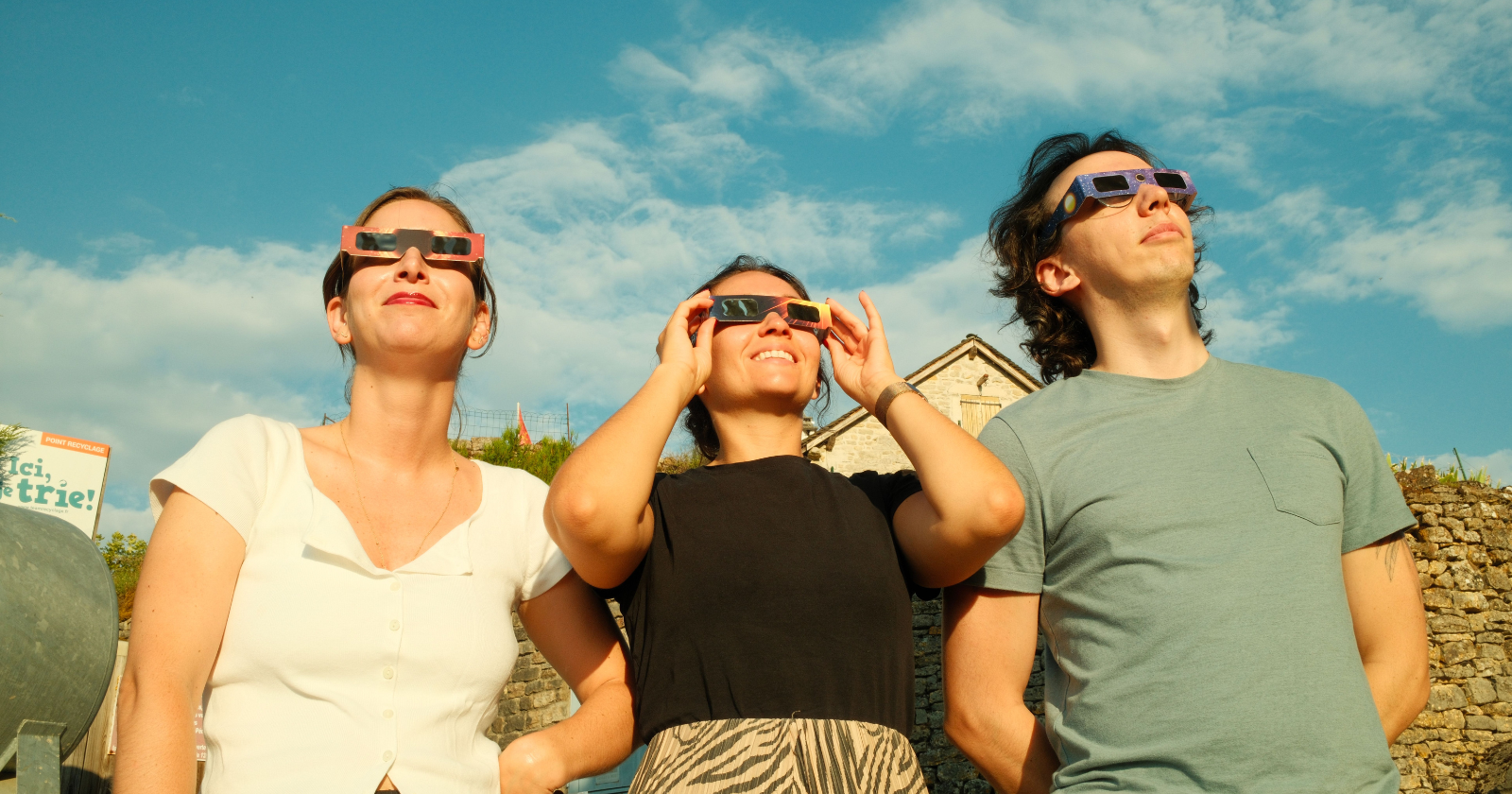
The only safe way to look directly at a partially eclipsed Sun is through a proper solar filter. Eclipse glasses should meet the international standard ISO 12312-2 and come from a reputable supplier, with no scratches or holes. Ordinary sunglasses, however dark, are nowhere near strong enough.
A pinhole projector is even simpler. A small hole in a piece of card throws an image of the Sun onto the ground or a sheet of paper, so you never look up at all.
The one exception is totality, the brief moment when the Moon covers the Sun completely. Only then is it safe to look with the naked eye, and the glasses must go back on the moment the first bright bead of sunlight reappears.
The next total solar eclipse, on 2 August 2027, will cross Spain, North Africa and the Middle East. Millions of people will be looking up. With the right glasses, none of them should go home with a crescent in their eye.