
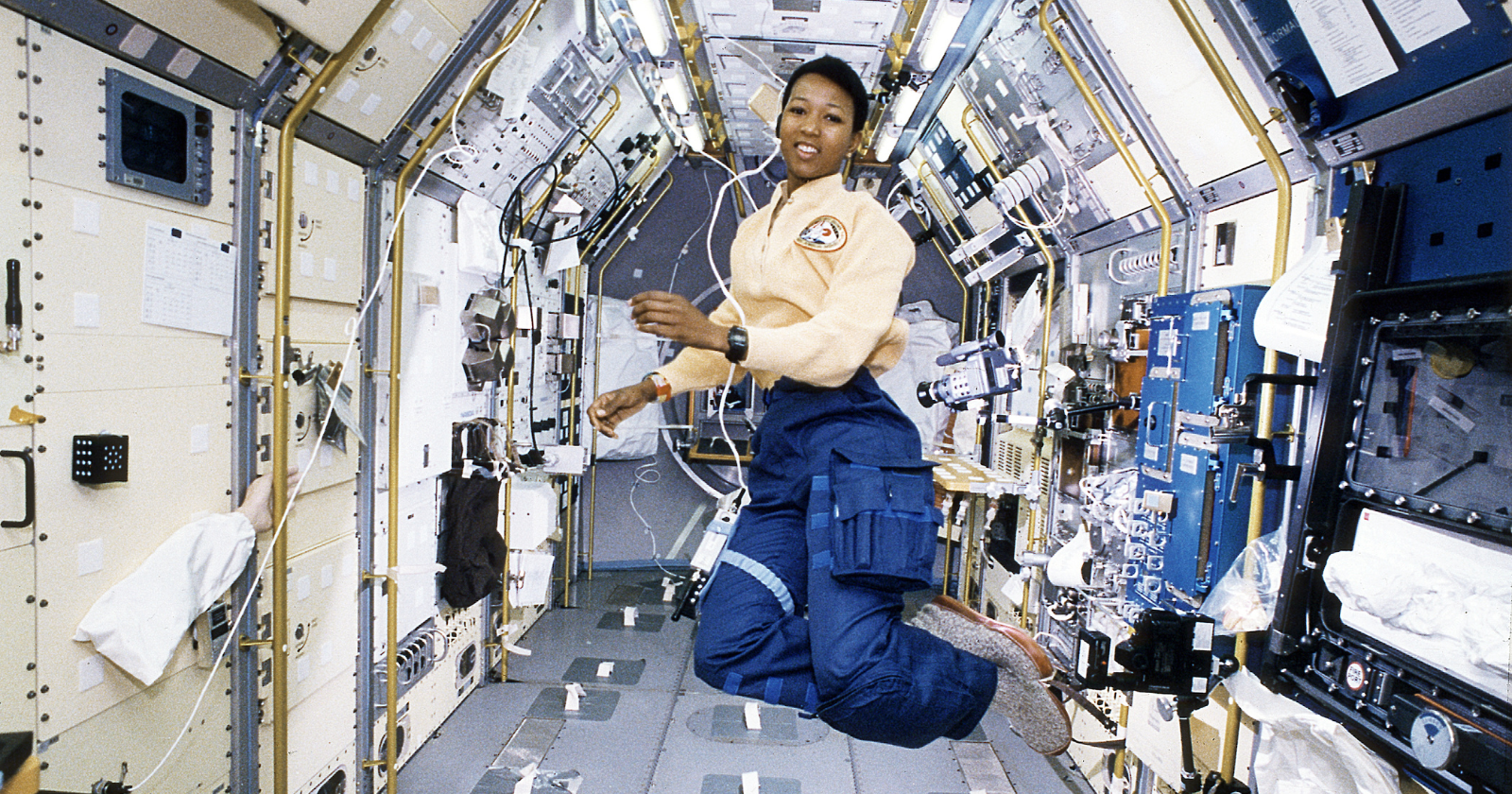
Tom Hanks is floating inside a replica Apollo spacecraft, roughly nine kilometres above the Gulf of Mexico. The camera rolls. Somewhere up front, the pilot is easing the nose of a Boeing jet over the top of a long arc. In about 23 seconds the floating will stop, and everyone on board will be pressed into the padded floor at nearly twice their normal weight.
That was how the weightless scenes in Apollo 13 were made in late 1994: not with wires, but by falling.
How do you make an aircraft feel like space?
You let it fall, and everything inside falls with it.
Astronauts on the International Space Station are not beyond the reach of Earth's gravity. They float because the station and everyone in it are in continuous free fall around the planet. A jet can copy that for a short while. If the aircraft follows the exact curved path a thrown ball would take, the passengers fall at the same rate as the cabin around them, and nothing presses them against the floor.
NASA's version was a modified KC-135, a military cousin of the Boeing 707 originally built as an air-to-air refuelling tanker. It flew from Ellington Field near Johnson Space Center in Houston, out over the Gulf.
The parabola, step by step
Each manoeuvre began in level flight at about 24,000 feet and 350 knots. The pilot pulled up steadily until the nose pointed 45 to 50 degrees above the horizon, loading everyone on board with about 1.8 g.
Then the pilot pushed the nose over, matching the curve of a free-falling object. The jet climbed to its peak at around 34,000 feet, tipped over and dived. Inside, passengers floated free for roughly 25 seconds.
As the nose reached about 45 degrees down, the pilot pulled out, the heavy g came back, and the cycle began again. A typical two-to-three-hour research flight packed in around 40 of these arcs.
Why it earned its nickname
The name came long before the KC-135. Project Mercury astronauts were already calling an earlier propeller aircraft, a C-131 Samaritan, the "vomit comet" in 1959.
Alternating between floating and double weight confuses the inner ear, and roughly two thirds of first-time fliers get airsick. NASA preferred a politer name, the "Weightless Wonder".
Filming Apollo 13 in 23-second takes
Director Ron Howard has described how he first heard about the aircraft through Steven Spielberg. When he asked Jim Lovell, the real Apollo 13 commander, Lovell knew it at once by its nickname.
NASA agreed to let the production build sections of its command module and lunar module sets inside a KC-135, the aircraft numbered NASA 930. Howard later recalled 13 days of filming, often with two flights a day and 80 to 100 parabolas between them. Each one gave him about 23 seconds of real weightlessness, so scenes were broken into fragments short enough to fit.
By the end, the cast and crew had flown more than 600 parabolas, adding up to roughly four hours of weightlessness. Not everything was shot in the air, though. Many close-ups were filmed on the ground, with the actors gently bobbing on see-saw-style rigs.
Where the Vomit Comet went
NASA 930 had flown more than 58,000 parabolas since NASA acquired it in 1973. It retired in 1995 and now stands on display at the entrance to Ellington Field.
Its sister ship, NASA 931, made the programme's last KC-135 flight on 29 October 2004 and went to the Pima Air & Space Museum in Arizona. A former Navy C-9 took over until NASA ended its own Reduced Gravity Program in 2014.
Since then, NASA has bought weightlessness rather than flying it. Zero Gravity Corporation carries NASA experiments on a modified Boeing 727 called G-Force One under the agency's Flight Opportunities programme. In February 2026, NASA's Armstrong Flight Research Center asked industry for ideas on who could supply parabolic flights and other reduced-gravity time in future.
So the Vomit Comet survives as a job description more than an aircraft. Twenty-five seconds at a time, someone is still falling on purpose so that experiments and people can float.