
An Atlas Agena D rocket lifted off from Cape Canaveral, Florida, at 14:22:01 UT on 28 November 1964 with Mariner 4 aboard. The spacecraft weighed 260.8 kilograms (575 pounds) and was bound for Mars.
About seven and a half months later, Mariner 4 flew past Mars and returned the first close-up images of another planet. The NASA Science Mariner 4 mission page also lists it as the first successful mission to Mars and the first spacecraft to fly by the planet.
Mariner 4 returned 21 complete images and part of a 22nd, all grainy black-and-white frames.
A failed twin and an all-metal shroud
Mariner 4 was the second of two twin spacecraft. The first, Mariner 3, launched on 5 November 1964, 23 days earlier.
On Mariner 3 the payload shroud failed to jettison, and the spacecraft's solar panels could not deploy. Mariner 3 became an inert spacecraft in solar orbit.
Mariner 4 flew with a new all-metal shroud. After the Atlas stage, the Agena D upper stage boosted the spacecraft towards Mars.
Mariner 4 made a single course correction on 5 December 1964, a week after launch.
A flyby at 9,846 kilometres
The flyby came 228 calendar days after launch, about seven and a half months later. That count runs from 28 November 1964 to 14 July 1965.
Closest approach came on 14 July 1965 in US Eastern time, and on 15 July 1965 in Universal Time. Mariner 4 passed the planet at a range of 9,846 kilometres (6,118 miles).
The television camera took images during the flyby. Its pictures reached Earth as data. It shot through red and green filters, but the returned pictures were black and white.
By the end of the run the camera had taken 21 complete images, plus 22 lines of a 22nd.
Mariner 4 was a flyby and did not land.
Paper strips, hand colouring and a White House release
Getting the pictures to Earth took far longer than taking them. NASA's account of the flyby, Triumph of Mariner 4, says each image needed about eight hours to arrive.
Transmitting the data for all 21 complete images and the partial one, and converting it into black-and-white pictures, took 10 days.
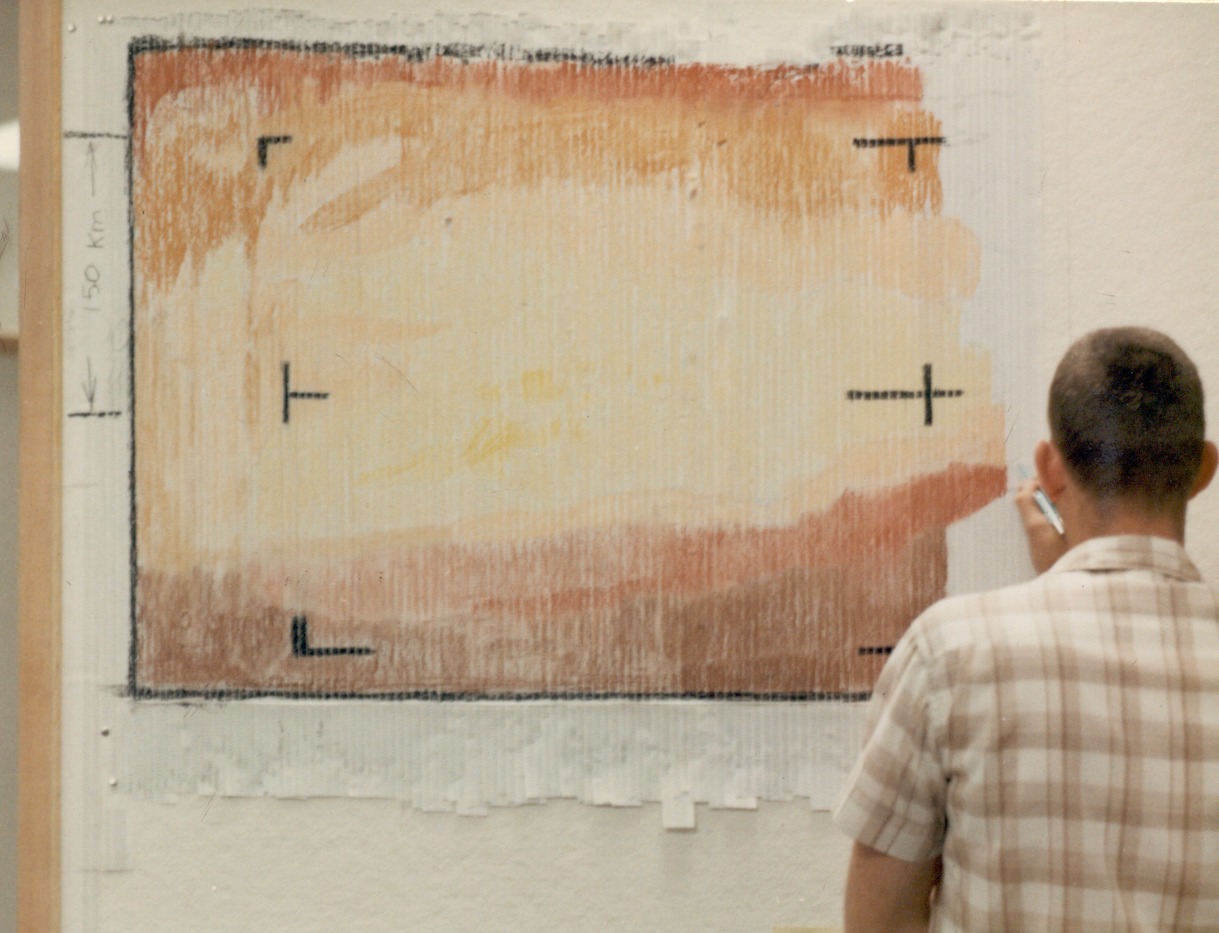
The first picture showed the edge of Mars against the blackness of space. Team members were too eager to wait for the computers. They printed the data, cut the printout into strips and coloured the paper by hand.
The team finished the hand-coloured image before the computer finished reconstructing the frame. NASA's account describes that handmade picture as the first digital image from space.
By the time the 10-day playback and processing were done, only the first three images had been made public. The remainder were released at a White House ceremony on 29 July 1965.
The pictures showed a cratered Mars that looked much like the Moon.
Their reach was limited. NASA notes that the 21 full images covered only 1 percent of the planet's surface. That figure refers to the 21 full images, not the partial 22nd. Most of Mars went unseen at close range on this flight.
Contact with Mariner 4 did not end with the flyby. NASA was in contact with Mariner 4 as late as December 1967.
NASA lists the encounter as a closest approach on 14 July 1965, with a range of 9,846 kilometres, or 6,118 miles. The camera took 21 complete images plus 22 lines of a 22nd.
The launch anniversary falls on 28 November 2026, 62 years on from the Atlas Agena D flight that started the mission.
Astronautix has also covered the first photograph taken on the surface of another planet sent home by the Soviet Venera 9 lander in 1975, why the surface of Mars looks closer to butterscotch than red, and the breathable oxygen produced on Mars by the MOXIE experiment carried by NASA's Perseverance rover.