
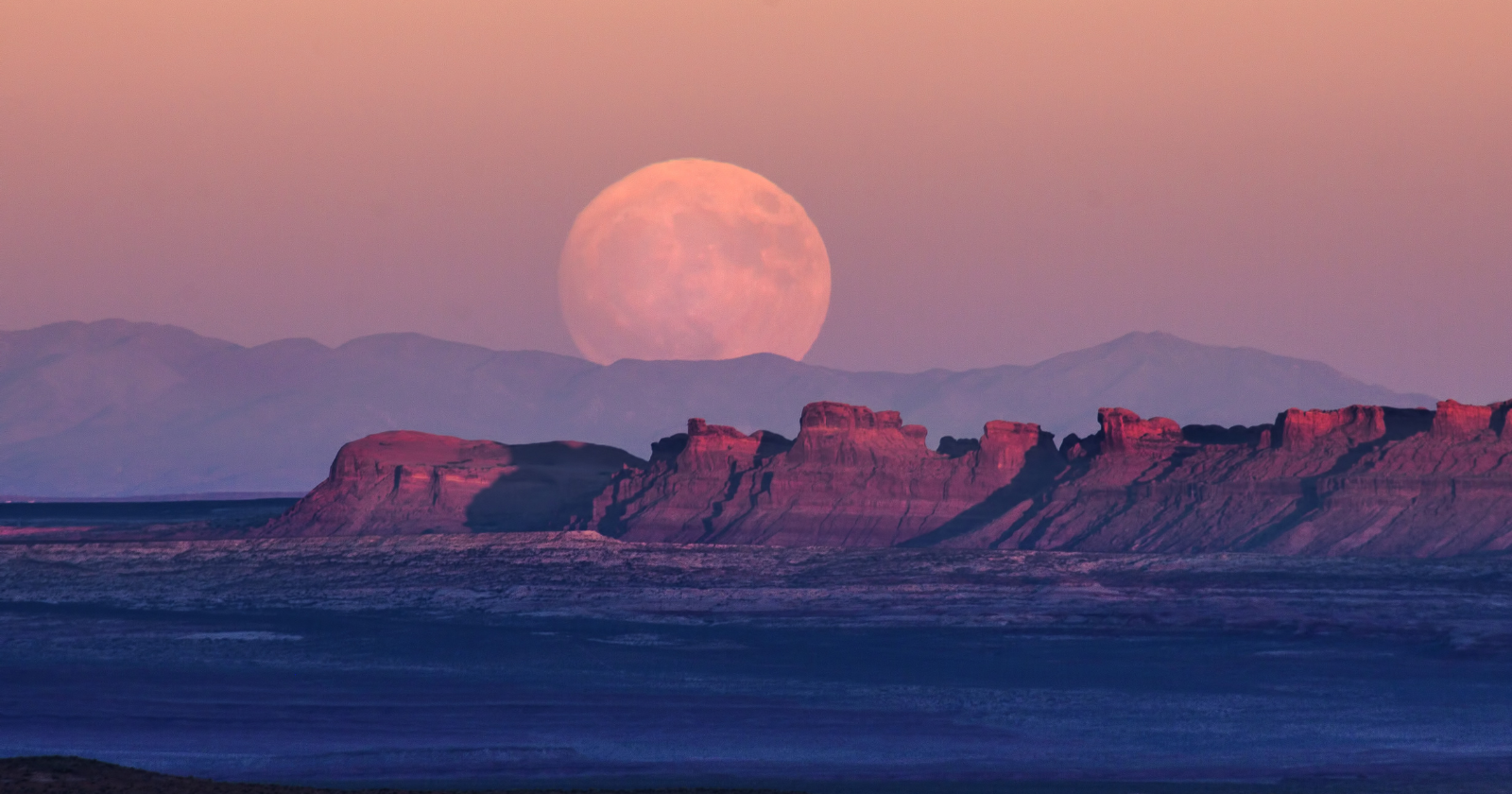
Have you ever watched a full Moon rise and felt it was almost too big to be real? It hangs over the rooftops or the trees like a huge copper plate. A few hours later, high in the sky, it looks like an ordinary small white disc.
Nothing about the Moon changed in between. If anything, the giant Moon on the horizon was slightly smaller.
The Moon is farther away when it rises
The Moon orbits about 384,000 kilometres from the centre of the Earth. But you are not standing at the centre. You are on the surface, about 6,400 kilometres out.
When the Moon is directly overhead, you are on the side of the Earth facing it, so you are roughly one Earth radius closer to it than the planet's centre is. When the Moon sits on the horizon, it is off to your side, and that advantage disappears.
The result is that the rising Moon is about 1.5% farther away than the Moon overhead, as a NASA scientist explains here. From farther away it covers a slightly smaller patch of sky. The difference is far too small to notice with the naked eye, but it points the opposite way to what we feel.
The air squashes it, too
There is one real physical change at the horizon, and it doesn't make the Moon bigger either.
Near the horizon, moonlight passes through much more of Earth's atmosphere. The air bends light slightly, and it bends light from the Moon's lower edge more than light from its upper edge. That squashes the Moon vertically, so a rising Moon is a little shorter than it is wide.
The long path through the air also scatters away more blue light, which is why a rising Moon so often looks yellow, orange or even red. The colour is real. The size is not.
Test it yourself
You do not need a telescope to prove the Moon illusion. Next time a full Moon rises, try one of these.
Hold your arm out straight and cover the Moon with your little fingernail. Do the same a few hours later when it is high in the sky. It will be covered just as neatly both times.
Or roll a sheet of paper into a narrow tube and look at the rising Moon through it, so you can't see the horizon. The Moon will seem to shrink instantly.
The strangest test is to turn your back to the Moon, bend over and look at it upside down between your legs. Many people find the illusion weakens or vanishes.
A camera settles it. NASA suggests photographing the Moon as it rises and again later the same night, with the same lens and zoom. Line the two pictures up and the width is the same. The only difference is that slight squashing at the horizon.
Those spectacular photos of a giant Moon behind a lighthouse or a city skyline are not capturing the illusion. They are taken with long telephoto lenses from far away, which magnify the Moon and the distant buildings together.
So what is going on in your head?
This is where the science gets messy. The illusion has been discussed for more than 2,000 years; Aristotle mentioned it. Ptolemy tried to explain it in the second century, and in his Book of Optics, written between 1011 and 1022, the scholar Ibn al-Haytham argued that the landscape stretching out between us and the horizon makes the Moon there seem farther away. By the 17th century, scholars broadly accepted that the effect happens in the mind, not in the sky, a history traced in research by Helen Ross and George Ross and later by Ross and Cornelis Plug. Yet researchers still don't agree on exactly how the brain produces it.
The oldest and best-known idea is the apparent distance theory. Our brains don't treat the sky as infinitely far away. We tend to see it as a flattened dome, with the horizon seeming farther off than the point overhead. If the brain thinks the horizon Moon is farther away, but its image on the retina is the same size, it concludes the Moon must be bigger.
In a 2000 study in PNAS, psychologist Lloyd Kaufman and his son, physicist James Kaufman, used carefully controlled experiments with artificial moons to test this. They found that perceived distance plays a major part in the illusion.
There's a catch, though. When people are asked, most say the horizon Moon looks both bigger and closer, not farther away. Researchers call this the size-distance paradox. Some supporters of the apparent distance theory argue that the brain's judgement of distance happens below conscious awareness, and the sense of the Moon being "close" comes afterwards, because it looks so big.
Other researchers point to related effects. One is the Ponzo illusion, where an object looks bigger when it is placed among lines or features that suggest depth. Another is that objects look larger next to small, detailed things, such as distant trees or buildings, and smaller against a vast empty sky.
A puzzle with no final answer
The illusion is not just about the Moon. The Sun looks larger when it sets, and constellations seem to spread out when they are low in the sky. Studies suggest that, on average, people see the horizon Moon as about 50% wider than it really is.
That's an enormous error for a brain that handles distances and sizes so well most of the time. It may be a side effect of how we judge the size of things on the ground, applied to an object that is far too distant for those rules to work.
Next time a full Moon rises, it will look just as huge, even if you know better. That's what makes it such a good illusion.