
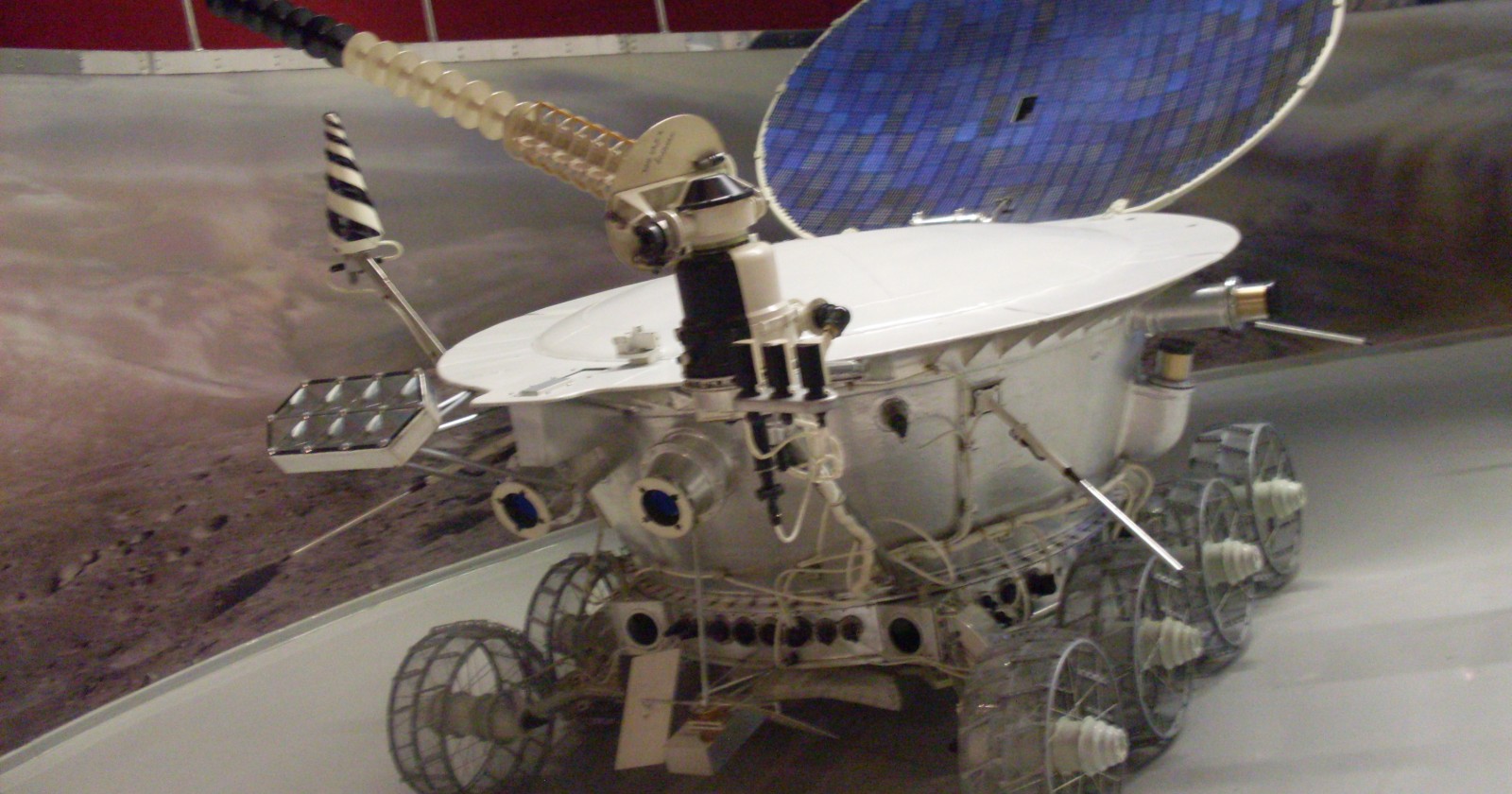
On 17 November 1970, in a control room in Crimea, a Soviet military officer named Gabdulkhay Latypov took hold of a control stick and drove a vehicle down a ramp. The vehicle was about 384,000 kilometres away, on the Moon.
It was called Lunokhod 1, Russian for "Moonwalker 1", and it was the first rover to drive on another world. Nobody rode in it. For the next 10 months it was steered from Earth by men who could only see where it had been a few seconds earlier.
A crew that never left the ground
Lunokhod 1 arrived on a lander called Luna 17, which set down on a lava plain known as the Sea of Rains. The rover weighed 756 kilograms and rolled on eight wire-mesh wheels, each with its own electric motor.
Its crew stayed behind near the city of Simferopol. Each crew had five seats: a commander, a driver, a navigator, a flight engineer who watched the rover's systems, and an operator whose job was to keep the rover's antenna aimed at Earth. Two crews took turns, swapping every two hours.
Driving by slideshow
The driver's screen did not show moving video. The rover's television cameras sent back one still picture at a time. Depending on the setting, a new one arrived anywhere from about three to about twenty seconds after the last. Vyacheslav Dovgan, the other crew's driver, has recalled a fresh black-and-white frame appearing roughly every 20 seconds.
Then there was the radio delay. A signal needs about 1.3 seconds to cross from Earth to the Moon, and the same again to come back. In practice, Dovgan has written, about four seconds passed before the crew knew a command had arrived. In the gap between two pictures, the rover could roll several metres.
What the driver could not see
The cameras were low in resolution, and there was a blind strip about a metre wide directly in front of the rover. The driver had to memorise the rocks and holes in one picture and assume they were still coming when the next one appeared.
Light caused trouble too. With the Sun high overhead, shadows vanished and craters became hard to pick out, so driving stopped for three days around lunar noon. As Dovgan recalled in Air & Space magazine, the driver talked almost constantly, calling out obstacles, distances and his next move to the commander, who sat behind him with a button that could stop the rover at once.
Picked like cosmonauts
The crews were chosen in 1968 from serving military officers. More than 40 were sent for tests of their eyesight, hearing, memory, reactions and ability to stay focused. Fourteen made the final group. The checks were so thorough that some of the men thought they were being recruited as cosmonauts.
They trained on a "lunodrome", a patch of ground near the control centre built to look like the Moon, with 54 craters and about 160 rocks. The practice rover was linked to them by cable, with a delay built in to copy the lag from the Moon. Dovgan later said the real Moon felt easier to drive on than the practice ground.
Ten kilometres, a little at a time
The rover had two forward speeds, roughly 0.8 and 2 kilometres an hour, and it turned like a tank, by slowing the wheels on one side. It worked through the two-week lunar day, then closed its lid and sat out the two-week night.
It was built to last three lunar days, about three months. It lasted eleven. In its first five days it covered just 197 metres. In its best stretch, in March 1971, it managed 2 kilometres. By the final radio session on 14 September 1971 the total was 10,540 metres, or more than 10 kilometres in 10 months. That works out at about a kilometre a month. Along the way it sent back more than 20,000 television pictures and over 200 panoramas.
Why nobody drives this way on Mars
On 31 July 1971, with Lunokhod 1 still in service, Apollo 15 astronauts took the first crewed Moon buggy for a drive at the opposite edge of the same plain. The Sea of Rains now had two rovers on it: one driven from the seat, the other from 384,000 kilometres away.
A second Lunokhod followed in 1973. After that, no rover drove on another world until NASA's Sojourner reached Mars in 1997, and Mars rovers cannot be steered live. A radio signal takes anywhere from about 3 to 22 minutes to get there, so their teams send a list of instructions and wait. The Lunokhod crews drove on another world by hand, almost in real time, under orders to tell no one, and their part stayed out of public view for about two decades. In 2012, twelve small craters along the rover's route were given Russian first names, among them Gena, Slava and Kolya. On paper the names honour no one in particular, but Russian reports at the time said they were chosen to match the men of the crew.