
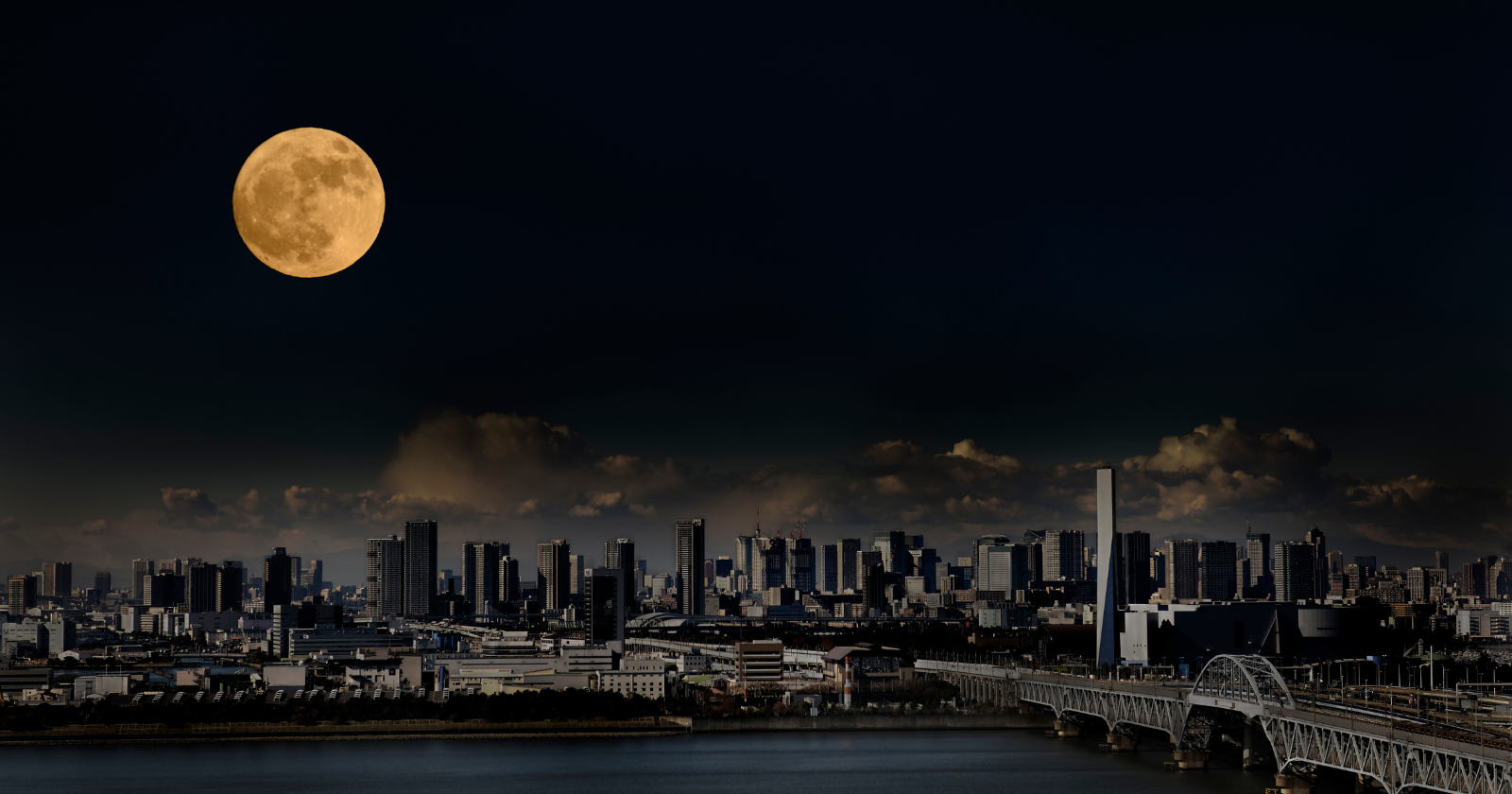
You’re driving home in the early evening when you see it. A huge full Moon is hanging just above the rooftops, glowing orange, looking almost close enough to touch. A few hours later, high in the night sky, it looks like an ordinary small white disc.
The Moon hasn’t changed size. It hasn’t moved closer, either. In fact, when it’s sitting on the horizon, it’s a little farther away from you. The giant Moon is happening inside your head.
Farther, not closer
The geometry is simple. When the Moon is directly overhead, you’re on the side of Earth facing it. When it’s on the horizon, you’re viewing it from the side of the planet, so you’re roughly one Earth radius, about 6,400 kilometers, farther from it.
That makes the horizon Moon about 1.5 percent farther away and very slightly smaller in the sky than when it’s overhead. Earth’s atmosphere also bends the light from the horizon Moon, squashing it a little from top to bottom.
So if anything, the rising Moon should look slightly smaller and flatter. Yet most people see it as dramatically larger, often by around 50 percent.
Proving it’s an illusion
You can test this yourself. Take a photo of the rising Moon, then another a few hours later when it’s high in the sky, using the same zoom setting. In the photos, both Moons will be almost exactly the same size.
Another trick is to hold a small object, like a pea or an aspirin tablet, at arm’s length next to the rising Moon. Then try again when the Moon is high. The object will cover the Moon about the same amount both times.
Some people even bend over and look at the horizon Moon upside down between their legs. Many find it suddenly shrinks back to a normal size, because the familiar scene around it has been disrupted.
An ancient puzzle
The Moon illusion has puzzled people for thousands of years. The ancient Greek astronomer Ptolemy first tried to blame Earth’s atmosphere, but later suggested it was an illusion of perceived distance.
The 11th-century scholar Ibn al-Haytham, a pioneer of optics, developed the idea further. He argued that the brain sees the sky as a flattened dome, with the horizon seeming much farther away than the sky overhead. By the 17th century, scholars broadly accepted that the effect was psychological, not physical.
How the brain gets fooled
The leading explanation is called the apparent distance theory. The brain doesn’t just measure how big an image is on the back of the eye. It combines that with how far away it thinks the object is.
When the Moon is near the horizon, it sits beyond trees, buildings, hills and miles of landscape. All those cues tell the brain the Moon must be very far away. Since the Moon’s image on the eye is the same size as always, the brain concludes it must be enormous.
High in the sky, there are no distance cues around it. The brain treats the overhead Moon as closer, so the same image seems smaller.
In a 2000 study published in PNAS, neuroscientist Lloyd Kaufman and his son James, a physicist at IBM, tested this with an artificial Moon projected into the sky using a special stereo display. Their results supported the idea that the brain treats the horizon Moon as much farther away, which makes it look bigger.
Not fully solved
There’s a twist. When asked directly, most people say the horizon Moon looks closer, not farther. That seems to contradict the apparent distance theory.
Researchers have offered other explanations. One is size contrast. On the horizon, the Moon is surrounded by small-looking objects like distant houses and trees, which may make it seem larger by comparison, similar to a well-known illusion where a circle looks bigger when surrounded by smaller circles. Up high, it’s surrounded by vast empty sky, which may make it seem smaller.
Even astronauts have reported seeing a version of the illusion from orbit. Many scientists think more than one effect is probably at work, and there’s still no complete agreement.
The best show in the sky
Whatever the full explanation, the illusion is a powerful reminder that seeing isn’t just about your eyes. Your brain constantly interprets what you see, using its best guesses about distance, size and context.
Most of the time, those guesses work well. But on a clear evening when a giant orange Moon rises above the horizon, you’re watching your brain get it beautifully wrong.