
In the spring of 1900, a boat carrying Greek sponge divers was heading home from North Africa when a storm forced it to shelter near the small island of Antikythera, between mainland Greece and Crete. While waiting for the weather to clear, the divers went down to look for sponges.
One diver came back up shaken, describing a seabed scattered with bodies and horses. What he had actually seen were bronze and marble statues. The divers had found a Roman-era shipwreck, and hidden among its cargo was one of the most extraordinary objects to survive from the ancient world.
Treasure on the seabed
The wreck lay about 45 to 55 metres down, a dangerous depth for divers in heavy suits breathing air pumped from the surface. Working with the Greek government, the sponge divers spent months recovering bronze and marble statues, glassware, pottery and coins. One diver died and others were injured during the work.
The ship had probably sunk in the first century BC, around 60 to 70 BC, while carrying luxury goods, possibly towards Rome. Most of the treasures went to the National Archaeological Museum in Athens, where attention focused on the beautiful statues.
A lump of corroded bronze
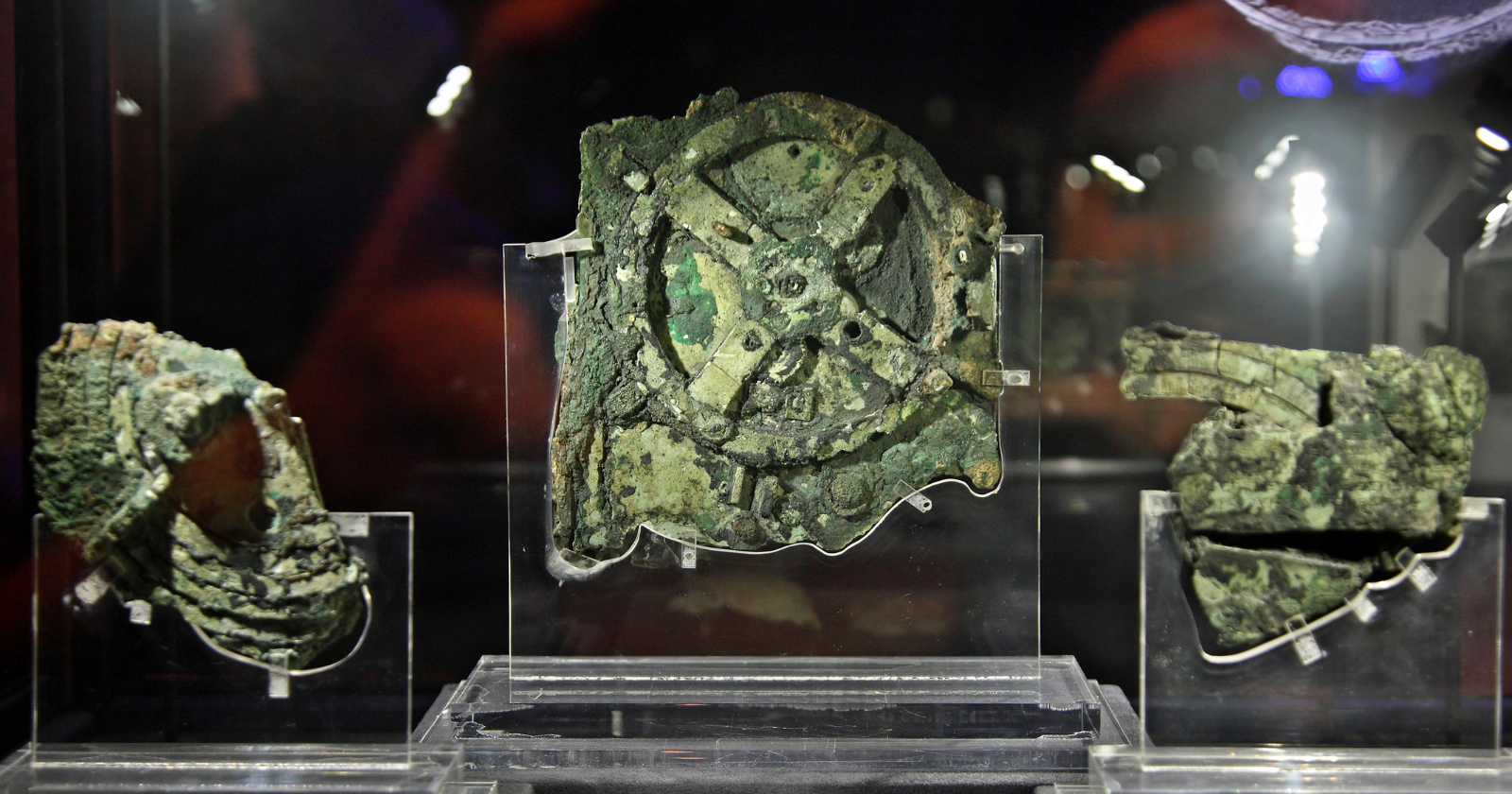
Among the finds was a shapeless lump of corroded bronze and wood. For months, it attracted little interest. Then, in 1902, archaeologist Valerios Stais noticed something unusual: a gear wheel embedded in one of the pieces.
The object turned out to be the remains of a mechanical device roughly the size of a shoebox, originally housed in a wooden case. Today, it survives in 82 fragments, representing only about a third of the original machine. Inside them are 30 surviving bronze gears, some with teeth just over a millimetre long.
Unlocking its secrets
For decades, scientists struggled to understand the device. The breakthrough came in the 2000s, when the Antikythera Mechanism Research Project used high-resolution X-ray scans to look inside the fragments. In 2006, the team, led by mathematician Tony Freeth, published its findings in Nature.
The scans revealed hidden gears and thousands of tiny inscriptions, effectively a user’s manual engraved on the device. They showed that the mechanism was an astronomical calculator. By turning a hand crank, a user could track the positions of the Sun and Moon, the phases of the Moon and the dates of important events, including the Olympic Games.
Predicting eclipses
One of the mechanism’s most remarkable features was a dial on the back that predicted eclipses. It was based on a cycle known to ancient Babylonian astronomers, called the Saros, which lasts about 18 years. Eclipses tend to repeat after each Saros cycle.
The dial was divided into 223 months, with symbols showing when solar and lunar eclipses were expected, and in some cases the time of day and other details. A further dial tracked a longer 54-year cycle, allowing the user to predict eclipses decades ahead.
A model of the heavens
In 2021, Freeth and a team at University College London published a reconstruction of the device’s front display in Scientific Reports. They suggested it showed the Sun, Moon and the five planets known at the time, Mercury, Venus, Mars, Jupiter and Saturn, moving around the Earth in a series of rings.
Because only a third of the mechanism survives, parts of this reconstruction are educated guesses. Some researchers have also questioned how well the device worked. A study in 2025 by physicists in Argentina suggested that small errors in the shape of the gear teeth may have caused the mechanism to jam often, though others argue the evidence is too uncertain to be sure.
Nothing like it for a thousand years
What makes the Antikythera Mechanism so astonishing is that nothing comparable is known from the ancient world. Gear-driven devices of similar complexity don’t appear again until the astronomical clocks of medieval Europe, more than a thousand years later.
Ancient writers, including the Roman orator Cicero, mention bronze globes and devices that showed the movements of the heavens, some linked to the scientist Archimedes. The Antikythera Mechanism suggests these descriptions were not exaggerations. It remains on display in Athens today, a small, battered machine that shows how far ancient Greek science and engineering had travelled more than 2,000 years ago.