
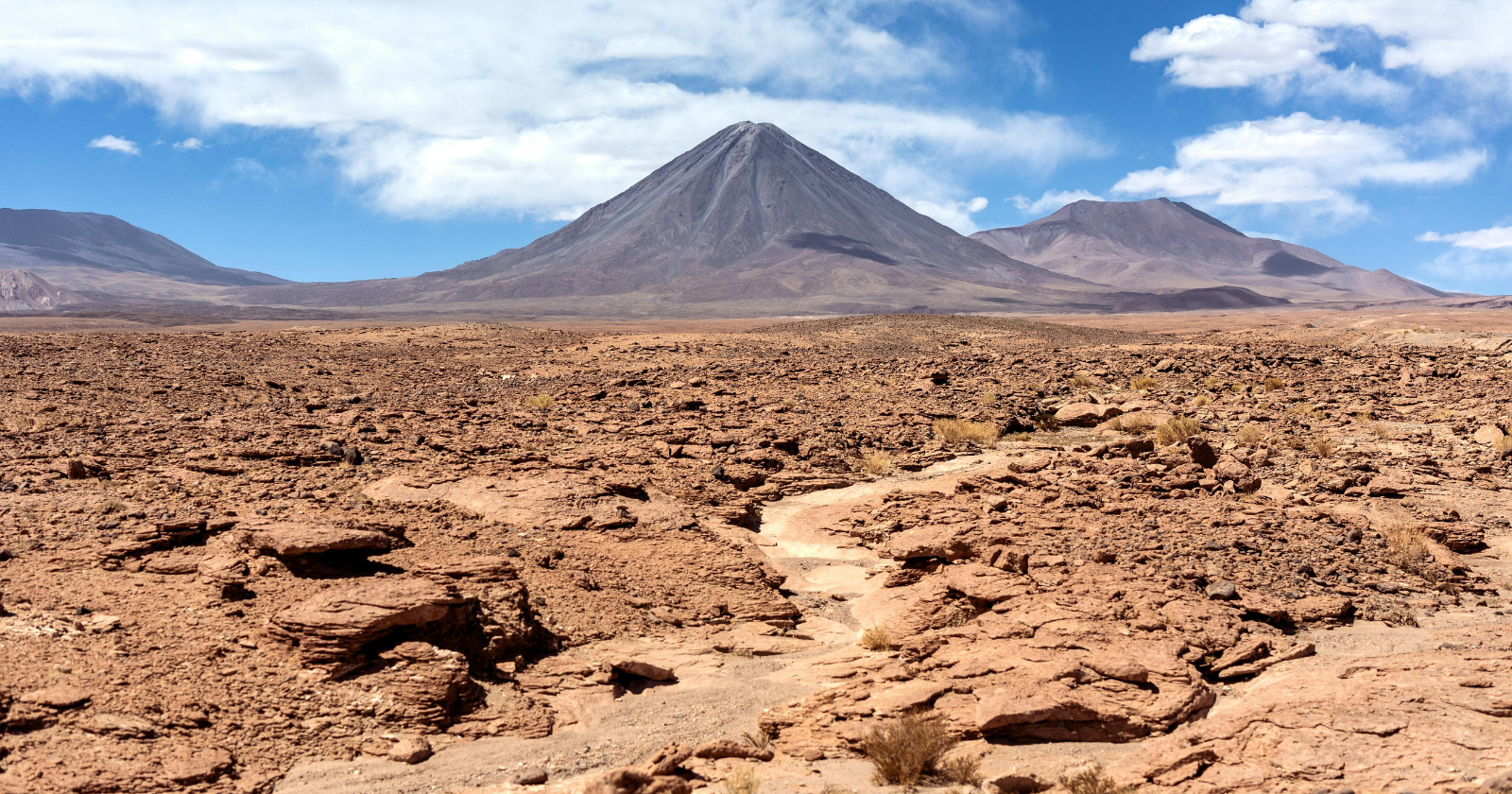
In the heart of northern Chile, between the Andes and the Pacific coast, lies a landscape of bare brown hills and cracked, salt-crusted ground. There are no plants, no insects and no birds. In some places, years can pass without a single shower of rain.
For scientists hoping to find life on Mars, this emptiness is exactly the point. Parts of the Atacama Desert are so dry and barren that they’re one of the closest things on Earth to the Martian surface.
The driest place on Earth
The Atacama stretches about 1,000 kilometres along Chile’s Pacific coast. It’s among the oldest deserts on Earth, having been dry for millions of years. Its core is shielded from moisture on both sides: by the Andes to the east, and by coastal mountains and a cold ocean current to the west.
This creates what scientists call a double rain shadow. In the driest parts, near an area called Yungay, researchers once recorded just one small rainfall in four years. NASA scientist Chris McKay has estimated that the core of the desert receives meaningful rain only about once a decade.
Echoes of Viking
In 1976, NASA’s two Viking landers became the first spacecraft to search for life on Mars. They scooped up Martian soil and ran experiments designed to detect microbes, such as adding nutrients and looking for signs that something was consuming them.
The results were puzzling. One experiment gave a reaction that at first looked like life, but the landers found no organic molecules in the soil, the carbon-based building blocks of living things. Most scientists concluded that the soil was lifeless and that chemical reactions, not microbes, explained the results.
Running the tests in the Atacama
In 2003, a team led by Rafael Navarro-González of the National Autonomous University of Mexico, with McKay and others, published the results of Viking-style tests on Atacama soil in the journal Science.
In the driest part of the desert, they found organic material only at trace levels, below what Viking’s instruments could have detected. Attempts to grow bacteria from the soil produced extremely low numbers, and two samples tested for DNA yielded none. One co-author said it was the only place he’d collected soil where nothing at all grew back in the lab. Like Viking, the team also saw chemical reactions that broke down organic material without any living thing involved.
McKay summed it up simply: if Viking had landed in the Atacama, it would have found nothing either. That suggested Viking’s negative results didn’t necessarily mean Mars was lifeless, only that the instruments weren’t sensitive enough.
A testing ground for Mars rovers
These Mars-like conditions have made the Atacama a favourite site for testing space technology. Over the past two decades, NASA-funded teams have driven prototype rovers across the desert, testing how they navigate rough ground, drill into soil and search for signs of life with little help from people.
The desert also helps scientists design better life-detection instruments. If a device can find faint traces of life in the Atacama’s driest soils, it has a better chance of spotting it on Mars.
Life finds a way
Later research has shown that even the Atacama isn’t completely lifeless. In a 2018 study, Dirk Schulze-Makuch and colleagues found that rare rainfalls could briefly wake up microbes in the soil, which became active before going dormant again as the ground dried out.
A 2023 study led by Armando Azua-Bustos found microbes living below the surface in an ancient riverbed in the Atacama. The team found that some of the instruments sent to Mars would struggle to detect them, which suggests that even small amounts of life could be missed.
What the Atacama teaches us about Mars
The Atacama has helped scientists understand both the limits of life on Earth and the challenge of finding it elsewhere. It shows that life can survive in extremely harsh conditions, but also that it can be very hard to detect.
That’s an important lesson as NASA and other agencies plan future missions to Mars. In a desert where almost nothing seems to grow, scientists are still learning how to look, so that if life ever did exist on the Red Planet, they’ll recognise it when they find it.