
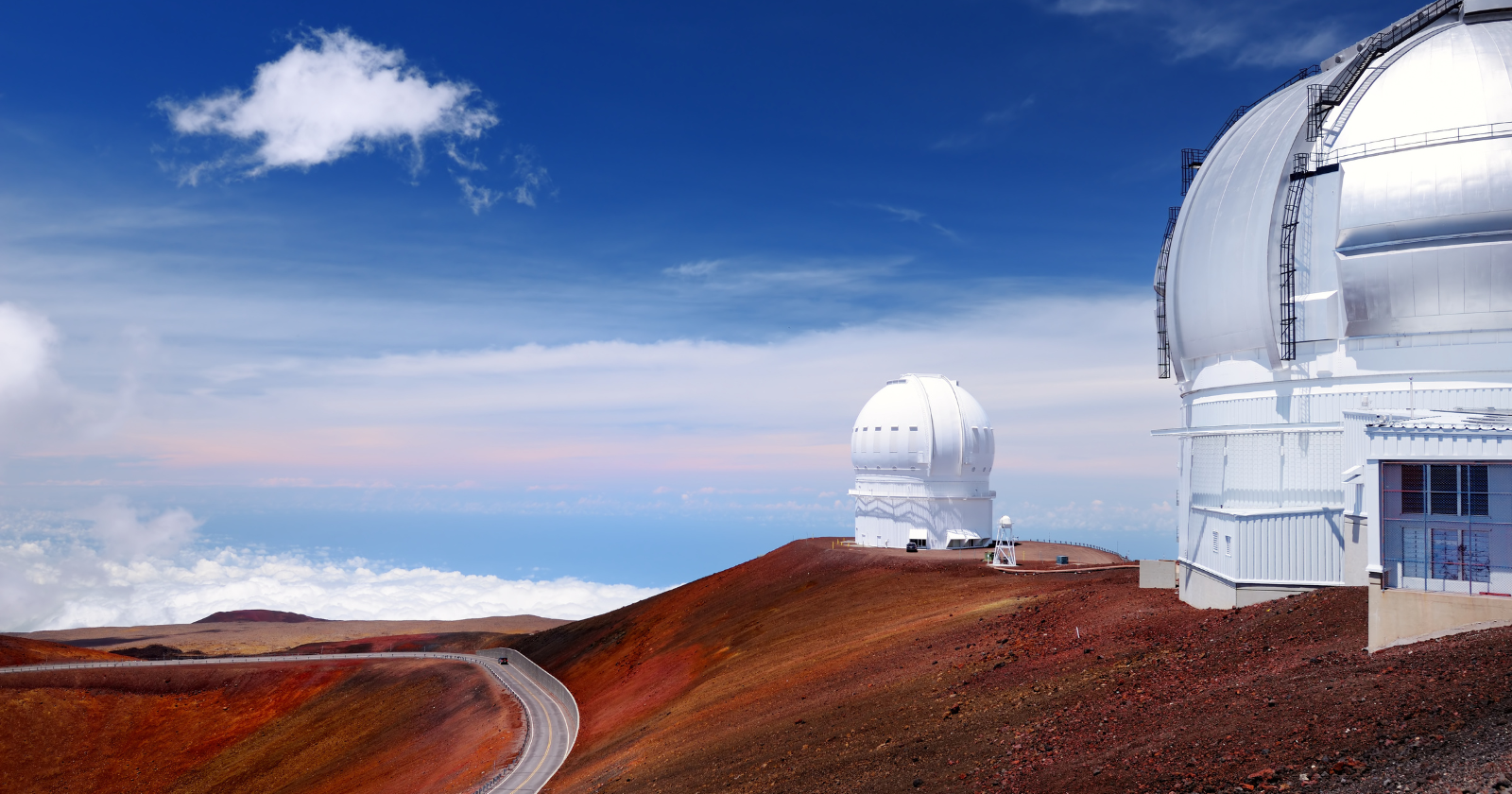
Drive up the slopes of Mauna Kea on Hawaii’s Big Island, and the landscape changes from tropical forest to bare, reddish volcanic cinders. By the time you reach the summit, more than 4,200 metres up, the air is thin and cold, and you may be standing above the clouds.
At sunset, the white and silver domes along the summit ridge open one by one. Inside are some of the most powerful telescopes on Earth, pointed at a sky so clear and steady that astronomers from around the world compete for time here.
Taller than Everest
Measured from sea level, Mauna Kea’s summit stands about 4,207 metres high, less than half the height of Mount Everest. But most of the mountain is hidden underwater. Its base sits on the floor of the Pacific Ocean, around 6,000 metres below the surface.
Measured from base to summit, Mauna Kea rises about 10,200 metres, well over a kilometre more than Everest’s 8,849 metres above sea level. That makes it the tallest mountain on Earth by that measure, though geologists note that its enormous weight has pressed down the ocean floor beneath it, which complicates the comparison.
Above much of the atmosphere
Mauna Kea’s height is what makes it so valuable to astronomers. At the summit, air pressure is only about 60 percent of that at sea level, meaning roughly 40 percent of the atmosphere lies below. Even more importantly, the summit sits above most of the water vapour in the air.
Water vapour absorbs infrared light, which astronomers use to study cool objects such as forming stars and distant galaxies. With so little of it overhead, Mauna Kea gives telescopes a much clearer view in the infrared than lower sites.
Calm, clear skies
Height isn’t the only advantage. Mauna Kea sits in the middle of the Pacific, far from large cities, and Hawaii’s lighting rules help keep the skies dark. The summit is often above a layer of cloud that blocks moisture and light from below.
The air flowing over the mountain from the open ocean is also unusually smooth. That reduces the twinkling caused by turbulence, which blurs images in telescopes. The result is some of the sharpest views of the sky anywhere on Earth.
A summit full of telescopes
Astronomers began building on Mauna Kea in the 1960s and 1970s. Over the following decades, the summit became home to telescopes from the United States, the United Kingdom, Canada, France, Japan, Taiwan and other countries. At their peak, there were 13 observatories on the mountain.
They include the twin Keck telescopes, each with a mirror 10 metres across, Japan’s Subaru Telescope and the Gemini North telescope. Discoveries made here have helped reveal planets around other stars, the giant black hole at the centre of our galaxy and how fast the universe is expanding.
A sacred mountain
For many Native Hawaiians, Mauna Kea is a sacred place, associated with ancestors and the gods. Some have long objected to the number of telescopes on the summit, and in 2019, protests stopped work on the planned Thirty Meter Telescope, which would be one of the largest optical telescopes in the world.
In 2022, Hawaii’s legislature created a new authority, including Native Hawaiian representatives, to share management of the mountain. Since then, the number of telescopes has begun to fall. Two observatories were removed in 2024, and the UK Infrared Telescope ended its science operations in September 2026, ahead of its planned removal. The future of the Thirty Meter Telescope remains uncertain.
A changing summit
Mauna Kea remains one of the most important astronomy sites in the world, but its future looks different from its past. Fewer telescopes are likely to stand on the summit in the years ahead, and the mountain’s management now aims to balance scientific research with cultural and environmental protection.
For astronomers, the reasons for being there are unchanged. Few places on Earth offer such a high, dry, dark and steady view of the universe. And for visitors who make the journey, watching the domes open beneath a sky full of stars is a reminder of why this remote volcano became one of humanity’s windows on the cosmos.