
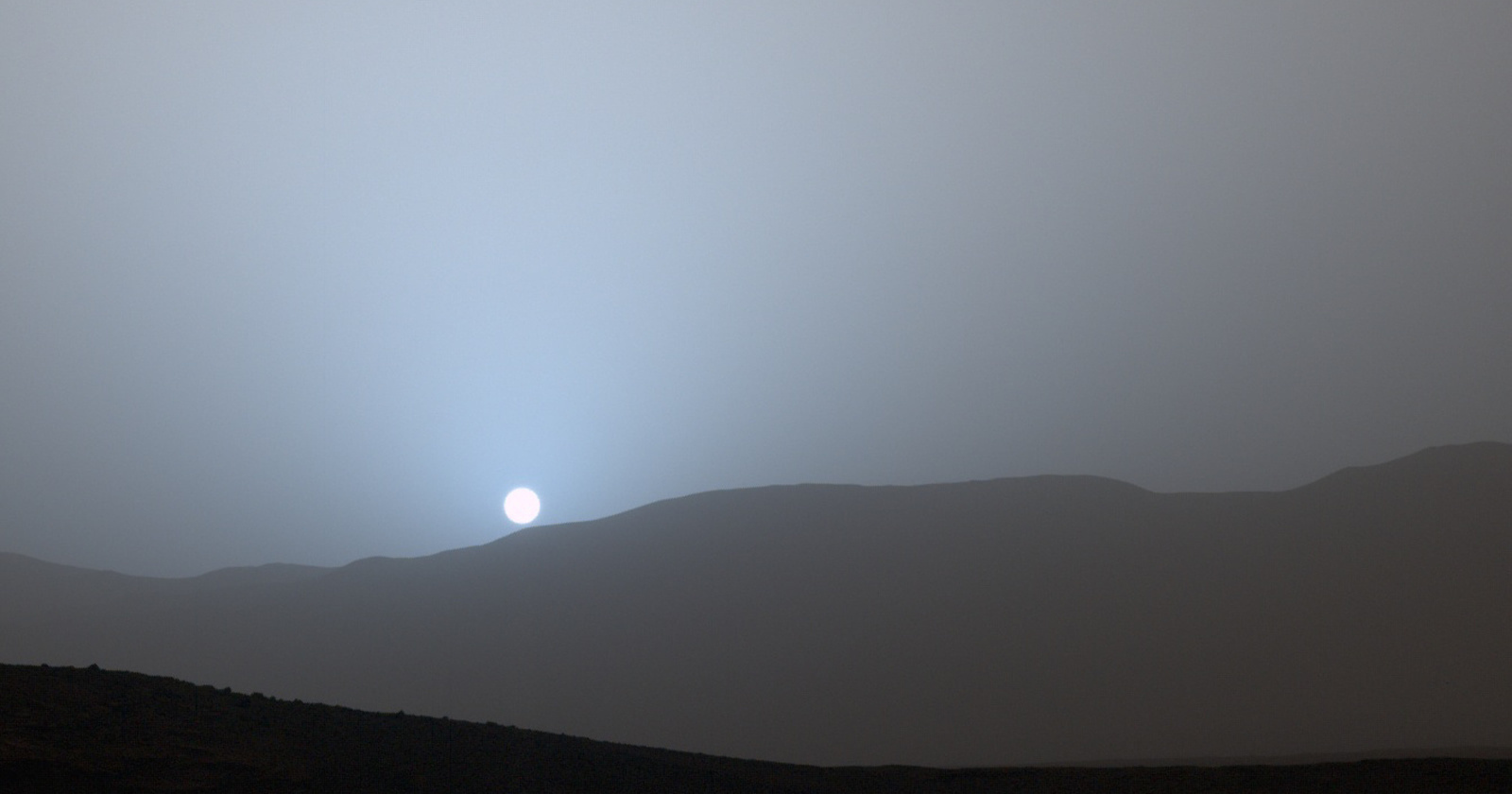
On the evening of April 15, 2015, NASA's Curiosity rover paused in Gale Crater and pointed its mast camera west. It was the rover's 956th Martian day, and the first time it had recorded a sunset in color. The Sun was a small, pale disk, about two-thirds the size it appears from Earth. The sky immediately around it was blue. Farther out, the color faded back into the same dusty butterscotch that hangs over Mars all day.
Nothing in the picture is a special effect. It is what Martian evenings do, on a quiet night between dust storms, with just enough fine dust still floating high in the air.
Why the daytime sky looks like butterscotch
On Earth, the daytime sky is blue because nitrogen and oxygen molecules scatter short wavelengths in every direction. Mars has a much thinner atmosphere, only about 1 percent as dense as Earth's, and it is loaded with something else: a haze of iron-oxide dust that never quite settles. That dust, not the gas, does most of the scattering.
The grains have a typical radius of about 1.5 micrometers, close to the wavelength of visible light, a figure measured from the sky by NASA's Spirit and Opportunity rovers. They absorb some of the blue, and they toss the remaining reds and yellows across the sky. Look up at noon and the color is a hazy tan, often described as butterscotch or caramel, from the zenith down to the horizon. It is the same fine rust that tints the ground underfoot toward those same browns.
Why the blue appears at sundown
Sunset changes the geometry. Light from the Sun now takes a long, slanting path through the dusty air, so it meets far more grains on the way to the horizon. Those grains have a particular habit: they scatter blue light mostly forward, along the direction it was already traveling.
"The colors come from the fact that the very fine dust is the right size so that blue light penetrates the atmosphere slightly more efficiently," said Mark Lemmon, then a Curiosity science-team member at Texas A&M University, after the 2015 images came down. "When the blue light scatters off the dust, it stays closer to the direction of the sun than light of other colors does. The rest of the sky is yellow to orange."
A 2014 study in the journal Applied Optics reached the same conclusion with formal scattering theory. The blue glow is not a simple case of blue light being stripped out of the beam, the way Earth's sunsets go red. It is near-forward scattering by those micron-sized grains.
The same halo appears at sunrise. NASA's InSight lander photographed it at about 5:30 a.m. local time in April 2019.
A smaller Sun, and a long twilight
Mars orbits about 50 percent farther from the Sun than Earth does, which is why the disk looks so modest. As it nears the horizon, it also dims quickly, the dust eating into the beam.
Then the light lingers. After the Sun disappears, a twilight glow can stay visible, growing fainter, for up to two hours. High-altitude dust scatters sunlight around to the night side of the planet. On Earth, a dusk that long usually means volcanic ash still hanging high in the air. On Mars, that dust is just part of the weather.
Not every sunset looks the same
The show depends on how much dust is in the air. When the atmosphere is clearer than usual, the blue halo is weaker. NASA's Perseverance rover photographed a sunset from Jezero Crater on November 9, 2021, that looked almost muted for that reason. During a dust storm, the Sun can fade into a brown haze long before it reaches the ridge line, and the colors shift again.
The color pattern was already clear in 1997, when Mars Pathfinder's camera caught a sunset on Sol 24 with a band of blue tight around the Sun and the familiar rusty sky farther out. The team noted that the blue was not ice cloud. It was the dust itself.
What a person would actually see
Rover pictures are processed. NASA calibrates and white-balances many of the published sunset images to remove camera artifacts and to approximate what a human eye might see. That is still an approximation. Curiosity's Mastcam, which took the 2015 picture, sees color much as people do, though it is a little less sensitive to blue. Other cameras, and other filter combinations, can push the rust in the rest of the sky too far. A well-known 2005 sunset from the Spirit rover is one example: the blue glow near the Sun would be visible in person, NASA says, but the redness farther away is stronger in the image than it would look in ordinary daylight.
If you ever stand there, the reliable part is the pattern, not a single exact shade. All day, a butterscotch sky. At the edges of the day, a blue lantern around a smaller Sun. And then a long, dusty dusk that takes its time going out.