
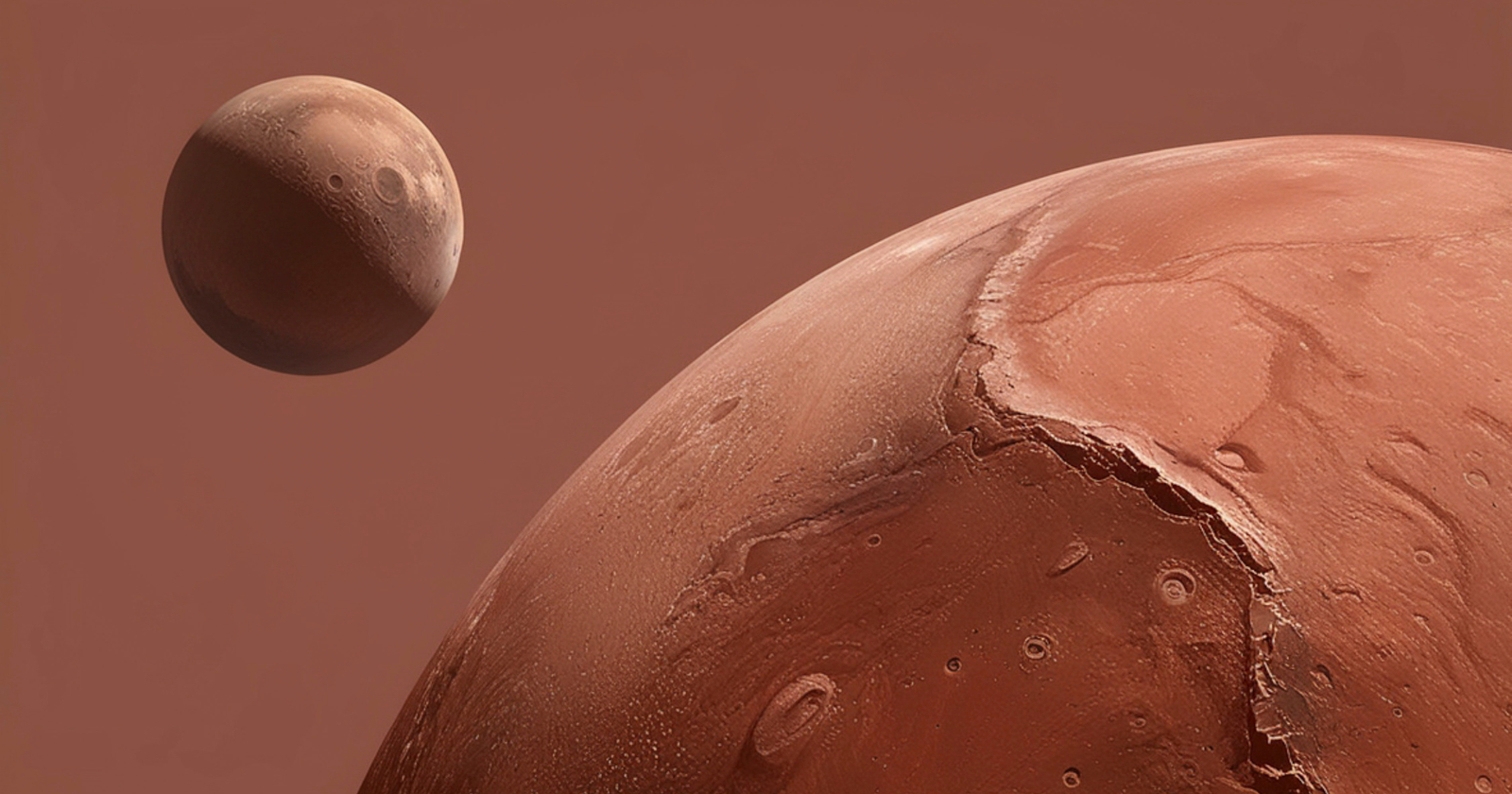
Stand on the Martian equator and the larger of the planet's two moons behaves very oddly. Phobos rises in the west, crosses the sky in a few hours and sets in the east. Then it comes round and does it again.
It is moving faster than the ground beneath it turns, and that speed will be the end of it. Mars is drawing Phobos in by about two metres every hundred years, and NASA expects the moon to be pulled apart in 30 to 50 million years. When that happens, Mars will probably gain something no rocky planet in the solar system has today: a ring.
A moon that outruns its planet
Phobos is a lumpy, potato-shaped body roughly 20 kilometres across. It orbits only about 6,000 kilometres above the surface, closer to its planet than any other moon in the solar system. It completes a lap in about seven and a half hours, while Mars takes just over 24 hours to spin once.
That mismatch is the problem. Phobos's gravity raises a slight tidal bulge on Mars, but because the planet turns more slowly than the moon orbits, the bulge lags behind. It pulls back on Phobos, draining its orbital energy, so the moon sinks a little lower every year.
Our own Moon sits on the other side of that line. It orbits more slowly than Earth spins, so the same kind of tidal tug pushes it outwards by a few centimetres a year. Phobos is moving the opposite way at a similar pace, and tides grow sharply stronger as a moon gets closer, so the squeeze only tightens.
Stretch marks on a potato
Phobos already looks like it is under strain. Its surface is scored with long, shallow, roughly parallel grooves. For decades they were blamed on the impact that dug Stickney, a crater about 10 kilometres wide that came close to shattering the moon.
In 2015, Terry Hurford of NASA's Goddard Space Flight Center and his colleagues offered a different reading. Their modelling showed that the grooves behave like stretch marks, produced by Mars's tides pulling on a moon that cannot hold its shape. "We think that Phobos has already started to fail," Hurford said.
Some grooves also look younger than others. That is what you would expect if the cracking is still going on, rather than a scar left by a single ancient blow.
Torn apart, not smashed
Scientists have long known Phobos faces one of two endings. It could plunge into Mars more or less intact, or it could break up while still in orbit. Which one happens depends mostly on how strong the moon is.
Benjamin Black and Tushar Mittal, then at the University of California, Berkeley, tried to estimate that strength. They compared Phobos's density with models of how damaged rock behaves, and used simulations of the Stickney impact to work out how much punishment the moon has already survived. Their 2015 study in Nature Geoscience concluded that much of Phobos is weak, heavily fractured material.
On their numbers, tides would scatter the weakest parts of Phobos in 20 to 40 million years, a little sooner than NASA's broader estimate. The break-up itself could take only days to weeks. Black compared it to pulling apart a granola bar, with crumbs and chunks scattering everywhere.
Not every piece would turn to dust. Larger, tougher fragments could survive the shredding and later spiral down into Mars, striking the surface at shallow angles and low speeds.
What a Martian ring would look like
The rest of the rubble would spread into a band around the planet. Black and Mittal estimate the ring could last anywhere from one million to 100 million years before its material rains down on Mars's equatorial region. At first, they suggest, it would hold a mass density comparable to Saturn's rings.
It would not look like Saturn's, though. Saturn's rings are mostly bright water ice, while Phobos is made of dark material that reflects little sunlight. A Martian ring might be hard to pick out from Earth with a small telescope.
From the Martian surface, the clearest sign might be the ring's shadow falling across the ground. Every giant planet in the solar system already has rings. Mars would be the first rocky world to join them.
A spacecraft already on its way
There is a deeper puzzle hiding behind all this: nobody knows where Phobos came from. One idea says it is a captured asteroid. Another says it gathered together from debris thrown into orbit when something huge hit Mars.
Japan has sent a spacecraft to find out. JAXA's Martian Moons eXploration mission launched on an H3 rocket from Tanegashima on 20 October 2026. It is due to reach Mars orbit in 2027, and a German-French rover called Idefix is scheduled to land on Phobos in 2029. The spacecraft will then bring at least 10 grams of the moon's surface back to Earth in 2031.
If that sample shows Phobos really is reassembled Martian debris, the moon's story will have an odd symmetry. It would have been born from a ring of rubble around Mars, and it is destined to become one again.