
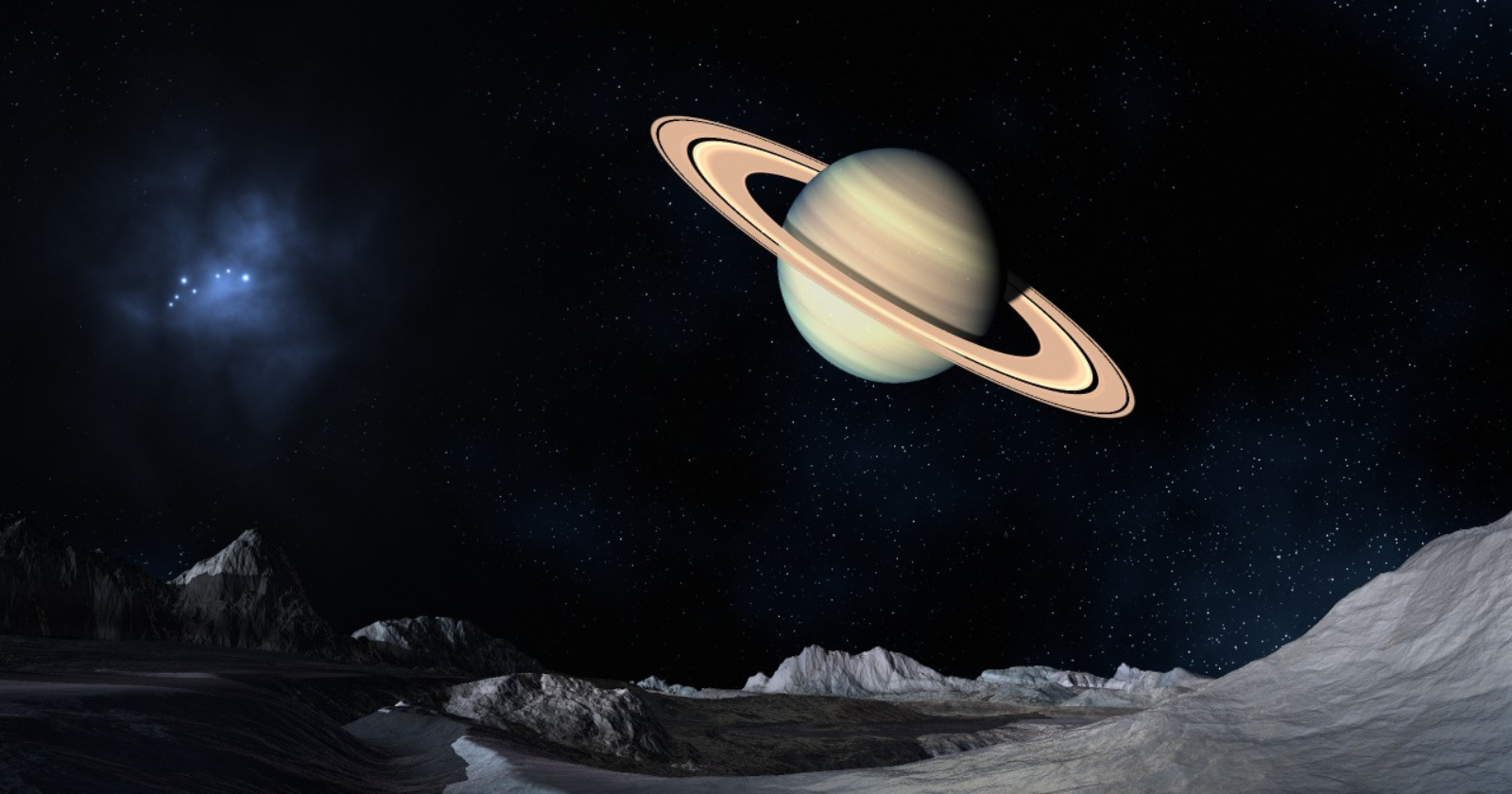
Saturn is an absolute giant. It holds 95 times as much matter as Earth, and you could fit more than 760 Earths inside it.
Yet pound for pound, it is the lightest planet in the solar system. Its average density is about 0.69 grams per cubic centimetre, roughly two-thirds that of water. That is the source of a famous claim: drop Saturn into a big enough ocean, and it would float.
The numbers behind that claim are real. What it says about the planet is more interesting than the bathtub.
How a planet ends up lighter than water
Density is simply mass divided by volume. Saturn has a lot of mass, but it is spread through an enormous volume. According to NASA's Saturn fact sheet, its volume is about 764 times Earth's, while its mass is only 95 times as great.
The reason is what it is made of. Saturn is mostly hydrogen and helium, the two lightest elements in the universe. Its atmosphere is about 96% hydrogen, with most of the rest helium.
For comparison, Earth, built from rock and iron, is about five and a half times as dense as water. Even Jupiter, the other gas giant, is about a third denser than water, because its far greater mass squeezes its hydrogen much harder.
Saturn spins fast too, once every 10 and a half hours or so. That rapid spin flings its equator outwards, making it the most visibly squashed planet. It is about 10% wider at the equator than from pole to pole.
Not light all the way through
An average can hide a lot. Saturn is not a uniform ball of gas, so it doesn't have the same low density everywhere.
Near the cloud tops, the gas is thin. Deeper down, the weight of everything above crushes hydrogen into a liquid. Deeper still, under millions of times Earth's atmospheric pressure, hydrogen is thought to behave like a liquid metal that conducts electricity, generating Saturn's magnetic field.
At the centre lies something much denser than water. For decades, textbooks showed a neat, compact core of rock and ice. The real picture turned out to be stranger.
A fuzzy heart, found in the rings
NASA's Cassini spacecraft orbited Saturn from 2004 to 2017. Among its measurements were tiny ripples in Saturn's innermost bright ring, the C ring. Some of those ripples are not caused by moons. They are caused by Saturn itself.
The planet is constantly vibrating, and those vibrations slightly shift its gravity field, which in turn nudges ring particles into spiral patterns. Caltech astronomers Christopher Mankovich and Jim Fuller used those patterns as a kind of seismograph.
In a 2021 paper in Nature Astronomy, they reported that Saturn's core is not a hard ball at all. It is a diffuse, slushy region of ice, rock and metallic fluids that extends across about 60% of the planet's radius. It holds roughly 17 Earth masses of heavy material, mixed gradually with hydrogen and helium rather than separated by a sharp boundary.
Mankovich compared it to parts of Earth's oceans, where water gets saltier the deeper you go.
So would it actually float?
On paper, yes. A ball of water the size of Saturn would weigh about 8.3 × 10²⁶ kilograms. Saturn weighs about 5.7 × 10²⁶. So in an idealised world, where Saturn was a solid, sealed shell, about 69% of it would sit below the waterline and the rest would bob above.
In reality, it falls apart quickly. To hold Saturn, you would need more water than the planet itself contains. That much water would form a planet of its own, with crushing gravity and pressures so high that the water deep inside would not stay liquid.
Saturn also has no surface to float on. Its outer layers would mix with the water's surface or spread into a new atmosphere, while its dense, fuzzy interior would sink towards the middle. Rather than floating, the two would merge into one strange, layered world.
That's why scientists treat the floating Saturn as a thought experiment, not a description of anything that could happen. It's a vivid way of making a single number stick.
A planet still full of surprises
Saturn keeps adding to its record. As of mid-2026, it had 293 confirmed moons, far more than any other planet. Most are small, irregular objects only a few kilometres across.
No new spacecraft is due to orbit Saturn soon. NASA's Dragonfly mission is planned to fly a nuclear-powered rotorcraft through the hazy air of Titan, Saturn's largest moon, in the 2030s. It will study the moon, not the planet.
For now, the best map of Saturn's insides still comes from Cassini's last years, and from a ring system that, as Mankovich put it, lets us watch the planet ring like a bell.