
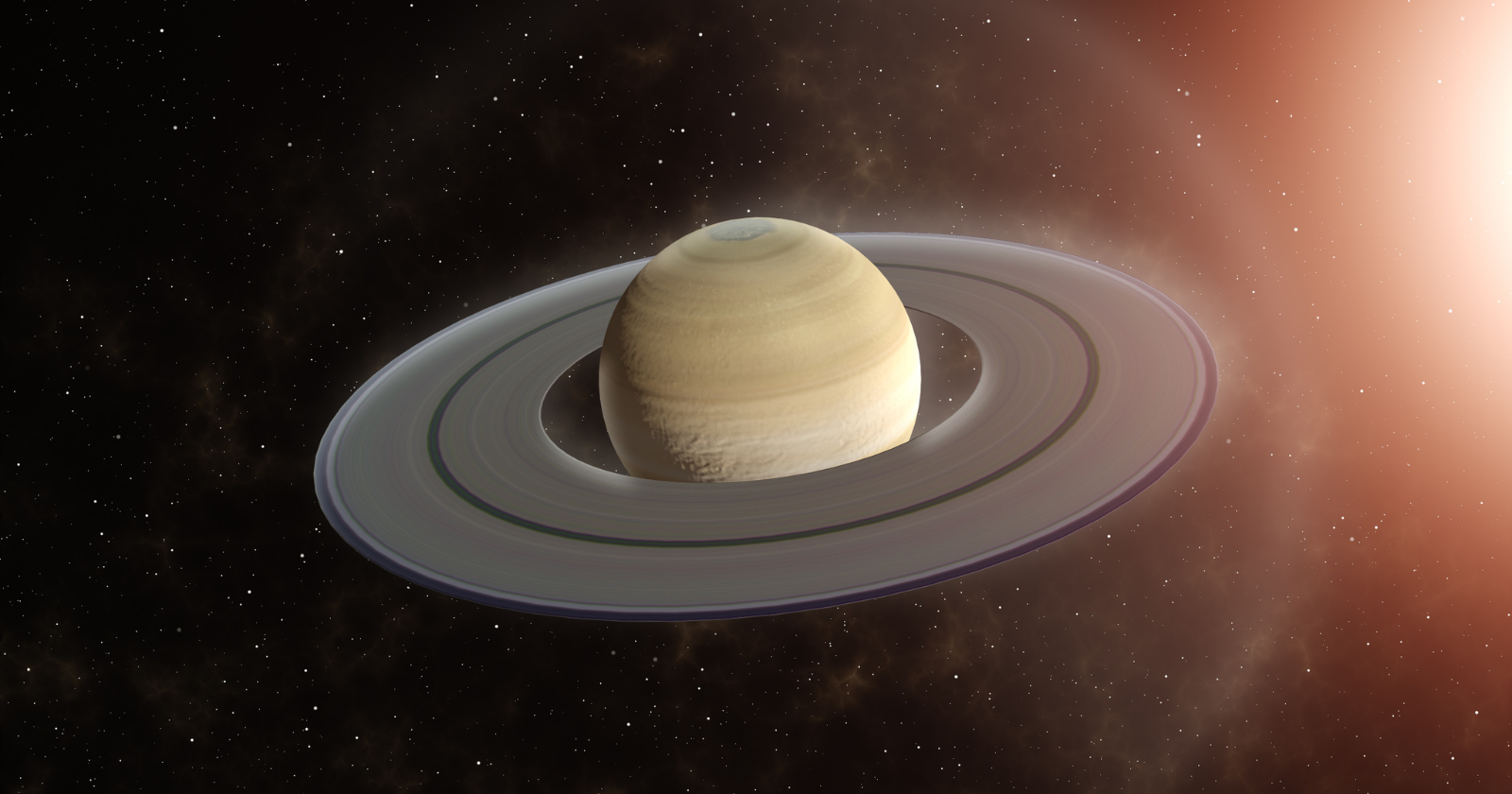
In 1610, Galileo Galilei turned one of the first telescopes towards Saturn and saw something odd. The planet seemed to have two companions, one on each side, like handles on a jug.
Two years later, they were gone.
Galileo never worked out what had happened. The answer, as astronomers found decades later, was that he had been looking at a ring system almost unimaginably wide and astonishingly thin, and in 1612 Earth had lined up with its edge.
The same thing happened again in 2025.
A planet that nods at us
Saturn's rings circle its equator, and the whole planet is tilted by nearly 27 degrees. That tilt stays pointed in the same direction in space as Saturn makes its slow 29-year journey around the Sun.
So from Earth, we see the rings from different angles over the years. For part of Saturn's orbit we look down on their northern face. For another part, we look up at their southern face. Twice in every Saturnian year, roughly every 13 to 15 years, Earth passes through the plane of the rings and sees them exactly edge-on.
Astronomers call this a ring plane crossing. The rings themselves do not move or tilt. Only our viewpoint changes.
Vast, and thinner than you can imagine
From edge to edge, Saturn's main rings span about 282,000 kilometres, roughly three-quarters of the way from Earth to the Moon.
Yet they are extraordinarily thin. Across most of the main rings, they are thought to be only about 10 metres to a kilometre thick, and in many places closer to the low end. They are made of countless chunks of ice and rock, from fine dust to pieces the size of a house.
To get a feel for those proportions, shrink the rings to the width of a football pitch. A 10-metre-thick section would then be about a twentieth of the width of a human hair.
Seen edge-on from more than a billion kilometres away, a layer that thin reflects almost no sunlight towards us. Through all but the largest telescopes, the rings shrink to a faint line or vanish altogether.
March 2025: the crossing nobody could see
Earth passed through Saturn's ring plane on 23 March 2025, at about 16:04 GMT. Headlines announced that the rings had disappeared.
In practice, as Space.com warned at the time, almost no one could see it. Saturn had passed behind the Sun from our point of view on 12 March, so during the crossing it sat low in the dawn sky, lost in the Sun's glare.
The geometry stayed awkward for weeks. After the crossing, Earth was looking at the side of the rings the Sun was not lighting, so they stayed dark and hard to see. That only changed after 6 May 2025, Saturn's equinox, when the Sun shone exactly along the ring plane and then began to light the side facing us.
November 2025: the view that worked
The better chance came later. After opening to a tilt of only about 3.6 degrees in July, the rings slowly closed again. On 23 November 2025, as Sky & Telescope noted, they reached their narrowest angle of the year, just 0.37 degrees from edge-on.
This time Saturn was well placed in the evening sky. Through backyard telescopes it looked strangely bare, with the rings reduced to a hair-thin line of light across the planet and a thin shadow band on its cloud tops.
Edge-on rings are not just a curiosity. With their glare reduced, it becomes easier to spot faint moons close to the planet. When Earth crossed the ring plane in 1995, the Hubble Space Telescope took advantage of the view to search for them.
And during Saturn's 2009 equinox, NASA's Cassini spacecraft watched the low Sun cast long shadows across the rings, revealing ripples and clumps that rose well above the ring plane.
When the rings come back
The rings are now opening out again. Year by year they will look wider through a telescope, reaching their greatest tilt towards Earth around 2032.
Then the cycle reverses. The next ring plane crossings will come in a cluster: Earth will pass through the ring plane on 15 October 2038, and twice more in 2039. Unlike 2025, those crossings should be much easier to observe.
When they come, Saturn will once again look the way it did to Galileo in 1612: a planet that seems to have lost its rings, even though they never went anywhere.