
In the 1440s, most people in Korea couldn’t read or write. Official writing used Chinese characters, which took years of study to master and didn’t fit the sounds of the Korean language well. Reading was largely a privilege of the educated elite.
King Sejong, the fourth king of the Joseon dynasty, decided to change that. In 1443, he unveiled a new alphabet designed so that ordinary people could learn it quickly. Unusually, it came with a detailed explanation of how and why every letter was designed.
A king who wanted his people to read
Sejong ruled Korea from 1418 to 1450 and is remembered as one of its greatest monarchs. He supported science, astronomy, music and farming, and encouraged inventions such as rain gauges and water clocks.
He was troubled that his subjects couldn’t write down their own words. In the preface to the new script, he explained that common people had things they wanted to say but no way to put them in writing. He wanted a system that a clever person could learn in a morning, and even a slower learner in about ten days.
Letters shaped like the mouth
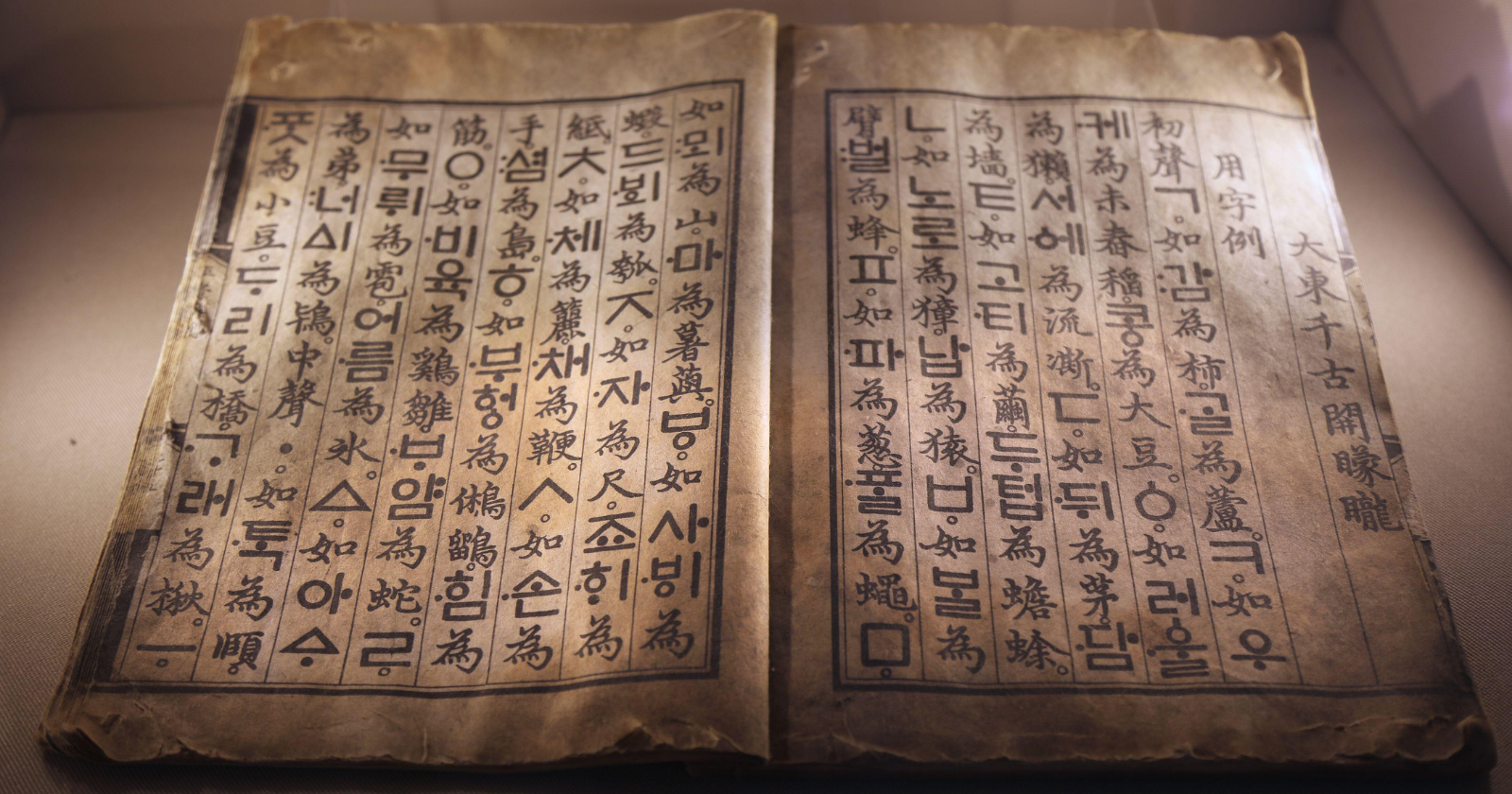
The new alphabet was published in 1446 in a document called Hunminjeongeum, meaning “the correct sounds for the instruction of the people”. A companion text, the Hunminjeongeum Haerye, written by scholars at Sejong’s court, explained the design in detail.
The basic consonants were drawn to resemble the parts of the mouth used to make each sound. The letter ㄱ (g/k) shows the back of the tongue rising to block the throat. ㄴ (n) shows the tip of the tongue touching the ridge behind the upper teeth. ㅁ (m) represents the shape of the closed lips, ㅅ (s) a tooth, and ㅇ the round opening of the throat.
A system that builds on itself
Other consonants were made by adding strokes to these basic shapes, to show sounds that were stronger or more aspirated. For example, adding a stroke to ㄱ makes ㅋ (k), a sharper, breathier version of the same sound. That means letters for related sounds look related, which makes the system easy to learn.
The vowels were based on three symbols with philosophical meaning: a dot for heaven, a horizontal line for earth and a vertical line for humans. Combining them created the other vowels. Letters are grouped into blocks that form syllables, so a written word looks tidy and compact, much like Chinese characters, even though it’s built from an alphabet.
Resistance from the elite
Not everyone welcomed the new script. Some scholars at court, including an official named Choe Manri, argued against it, fearing it would undermine Chinese learning and Korea’s ties to Chinese culture.
For centuries, Hangul was looked down on by many in the upper classes and was often associated with women, children and commoners. At one point in the early 16th century, King Yeonsangun even banned its use after it was used in posters criticising him. Chinese characters remained the language of government and scholarship for a long time.
A national symbol
By the late 19th and early 20th centuries, Hangul became a symbol of Korean identity, especially during the period of Japanese rule, when the Korean language was suppressed. After independence in 1945, it became the main writing system in both North and South Korea.
Today, South Korea celebrates Hangul Day every 9 October, and North Korea marks its own day in January. In 1997, UNESCO added the Hunminjeongeum Haerye to its Memory of the World Register, recognising it as a unique document in human history.
Why linguists admire it
Linguists often praise Hangul as one of the most logical writing systems ever designed. Other scripts have known creators, such as the Armenian alphabet and the Cherokee syllabary. But few came with a surviving explanation, written at the time, of how the letters were designed to match the sounds of speech.
More than five centuries after Sejong’s announcement, Hangul is used by around 80 million people. A king’s wish that his people could write their own words turned into one of the most carefully designed alphabets in the world.