
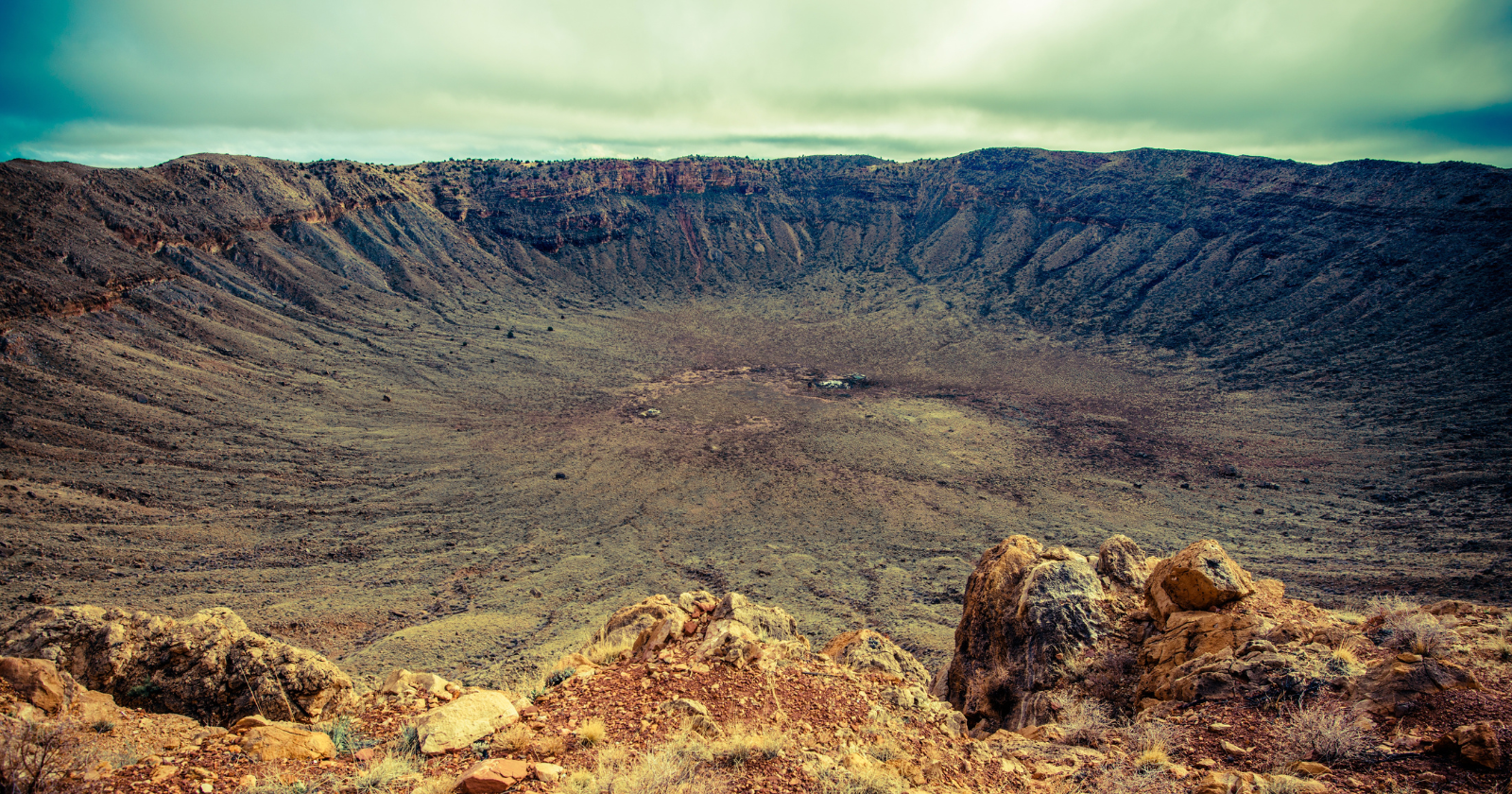
In the high desert of northern Arizona, about 40 miles east of Flagstaff, the flat ground suddenly drops away into an enormous bowl. Its rim rises above the plain, and its walls fall more than 500 feet to a dusty floor.
In the 1960s, men who would later walk on the Moon scrambled down those walls carrying rock hammers and sample bags. Before Neil Armstrong and Buzz Aldrin ever stepped onto the lunar surface, they learned to read a crater here.
A hole made in seconds
Meteor Crater is about 1.2 kilometres, or three-quarters of a mile, across. It was formed around 50,000 years ago when an iron-rich asteroid, probably around 50 metres wide, slammed into the desert at tens of thousands of kilometres per hour.
The impact released energy equivalent to millions of tonnes of explosives. It blasted out millions of tonnes of rock, flipped layers of rock over at the rim and scattered fragments of iron across the surrounding plain. Thanks to the dry climate, it is one of the best-preserved impact craters on Earth.
Proving it came from space
For decades, scientists argued about how the crater formed. Many thought it was volcanic. In the early 1900s, mining engineer Daniel Barringer insisted a giant iron meteorite had made it and spent years drilling in search of the buried mass, which he never found. The crater is still owned by his family today.
The question was finally settled in 1960, when geologist Eugene Shoemaker and colleagues found coesite, a form of quartz created only under extreme pressure, at the crater. That proved it had been formed by a violent impact. Shoemaker’s work helped show that many craters on the Moon were made the same way.
Gene Shoemaker’s dream
Shoemaker had long dreamed of studying the Moon himself, and he became one of the driving forces behind teaching geology to astronauts. In 1963, he moved the US Geological Survey’s astrogeology branch to Flagstaff, close to Meteor Crater, the Grand Canyon and volcanic landscapes.
Soon, groups of astronauts were coming to northern Arizona for geology training. Shoemaker led Armstrong and Aldrin on hikes at Meteor Crater, teaching them how impact craters form and how to recognise the rocks they create.
Learning to read a crater
Inside the crater, astronauts learned to recognise the features they would later see on the Moon: overturned layers of rock at the rim, broken and shattered fragments, and debris thrown out by the impact. They practised describing what they saw, picking useful samples and working as field geologists.
The training wasn’t always comfortable. According to a story passed down by guides at the crater, Aldrin tore his spacesuit on sharp rocks in a layer nicknamed the “tear-pants formation,” prompting changes to the design.
Not the only training ground
Meteor Crater was one of many places astronauts trained. In northern Arizona alone, they hiked the Grand Canyon, studied lunar maps at Lowell Observatory and worked in volcanic cinder fields near Flagstaff. There, the Geological Survey used explosives to blast hundreds of craters, recreating parts of the Moon’s Sea of Tranquility, where Apollo 11 would land.
Astronauts also trained in Hawaii, Iceland, Canada and elsewhere. Each site taught different lessons, from volcanic rocks to the effects of huge impacts. Together, they turned test pilots into field geologists who could make smart choices on the Moon with limited time.
A legacy that continues
The training paid off. Astronauts returned from the Moon with carefully chosen samples that are still being studied today. Every astronaut who walked on the Moon trained in northern Arizona, except Harrison Schmitt, who was already a professional geologist.
Meteor Crater is now a popular visitor attraction, with a museum, viewing platforms and an exhibit on astronaut training. NASA’s new generation of astronauts, preparing for the Artemis missions, still train in northern Arizona’s volcanic fields. Half a century after Apollo, the desert around Flagstaff is once again helping prepare people to walk on the Moon.