
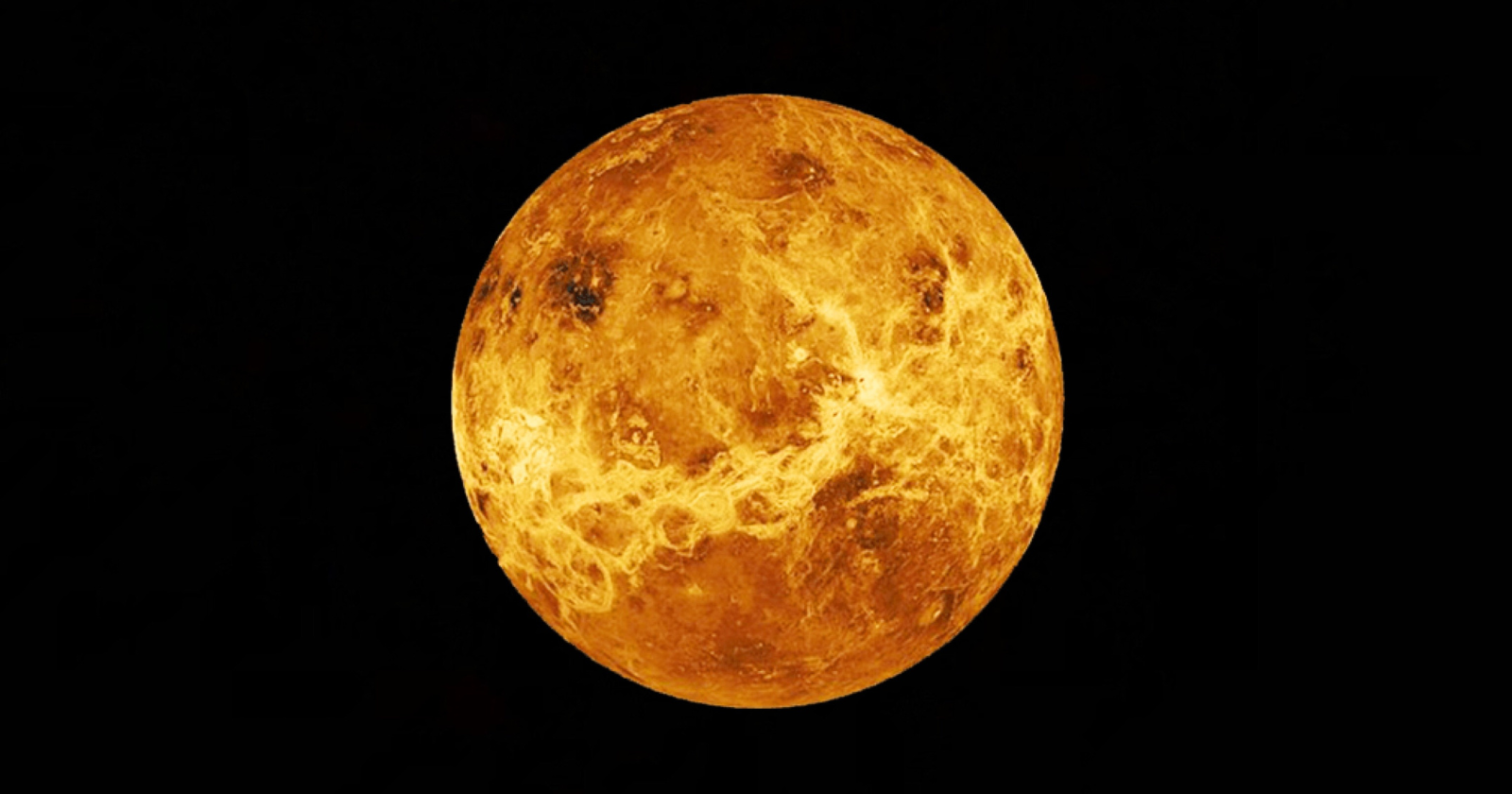
On the morning of 22 October 1975, a small metal sphere drifted down through the thick yellow clouds of Venus. It slowed itself with parachutes and a large disc that acted as an air brake, then hit the ground at about 7 metres per second.
Within minutes, it began sending back something no one had ever seen before: a picture taken on the surface of another planet. The view showed flat, broken slabs of rock stretching into the haze. The spacecraft was the Soviet Union’s Venera 9 lander.
The most hostile planet in the solar system
Venus is often called Earth’s twin, because it’s almost the same size. But its surface is one of the most hostile places known. Its thick atmosphere is mostly carbon dioxide, which traps heat in a runaway greenhouse effect.
Venera 9 measured a surface temperature of about 485°C, hot enough to melt lead and hotter than most pizza ovens. The air pressure was around 90 times that at sea level on Earth, similar to being nearly a kilometre underwater. Earlier Soviet probes had been crushed or overheated before reaching the ground or soon after.
Built like a deep-sea submarine
To survive, Venera 9’s lander was built like a heavily insulated pressure vessel. It was cooled down before it entered the atmosphere, so it started its descent as cold as possible and could absorb heat for longer.
The lander was carried to Venus by an orbiter, which went into orbit around the planet on 20 October 1975, becoming the first spacecraft to orbit Venus. The orbiter’s job was to receive the lander’s signals and relay them back to Earth.
The first picture
Venera 9 touched down at 05:13 Universal Time on 22 October, near a volcanic upland region. It carried two cameras designed to sweep across the landscape, but only one worked; a lens cover on the other failed to come off.
The working camera slowly scanned the scene, transmitting a black-and-white panoramic image line by line. It showed angular rocks around 30 to 40 centimetres across, sitting on a slope, with a clear view of the ground stretching away. The light was much brighter than scientists had expected, similar to a cloudy summer day on Earth.
Fifty-three minutes on Venus
The lander sent data for 53 minutes after landing. Then the signal stopped. But Venera 9 didn’t fall silent because it had been overwhelmed by the heat. The orbiter relaying its signals had simply moved out of radio range.
Nobody knows how long the lander kept working after contact was lost. Its instruments may have continued running for a while, with no one able to hear them. Three days later, its twin, Venera 10, landed about 2,000 kilometres away and sent back pictures for 65 minutes, until its own orbiter also moved out of range.
What the pictures revealed
The images settled a long-running question. Some scientists had expected the surface to be covered in fine dust, or eroded smooth by the dense atmosphere. Instead, Venera 9 showed sharp-edged rocks, suggesting the surface was geologically young or still being shaped.
The lander also measured the density of the rocks beneath it, finding values similar to basalt, the type of volcanic rock common on Earth. Its other instruments recorded the composition of the atmosphere and the structure of the clouds.
A record that still stands
Venera 9’s achievement came less than a year before NASA’s Viking 1 sent back the first clear images from the surface of Mars in 1976. Later Venera landers went further. In 1982, Venera 13 sent back the first colour images from Venus and recorded sounds on another planet for the first time.
Half a century later, the Soviet Venera and Vega landers remain the only spacecraft to have photographed the surface of Venus. NASA and the European Space Agency are planning new missions to the planet in the 2030s. Until then, the best views we have of its surface still come from a handful of hardy machines built in the 1970s, beginning with Venera 9’s grainy black-and-white picture.