
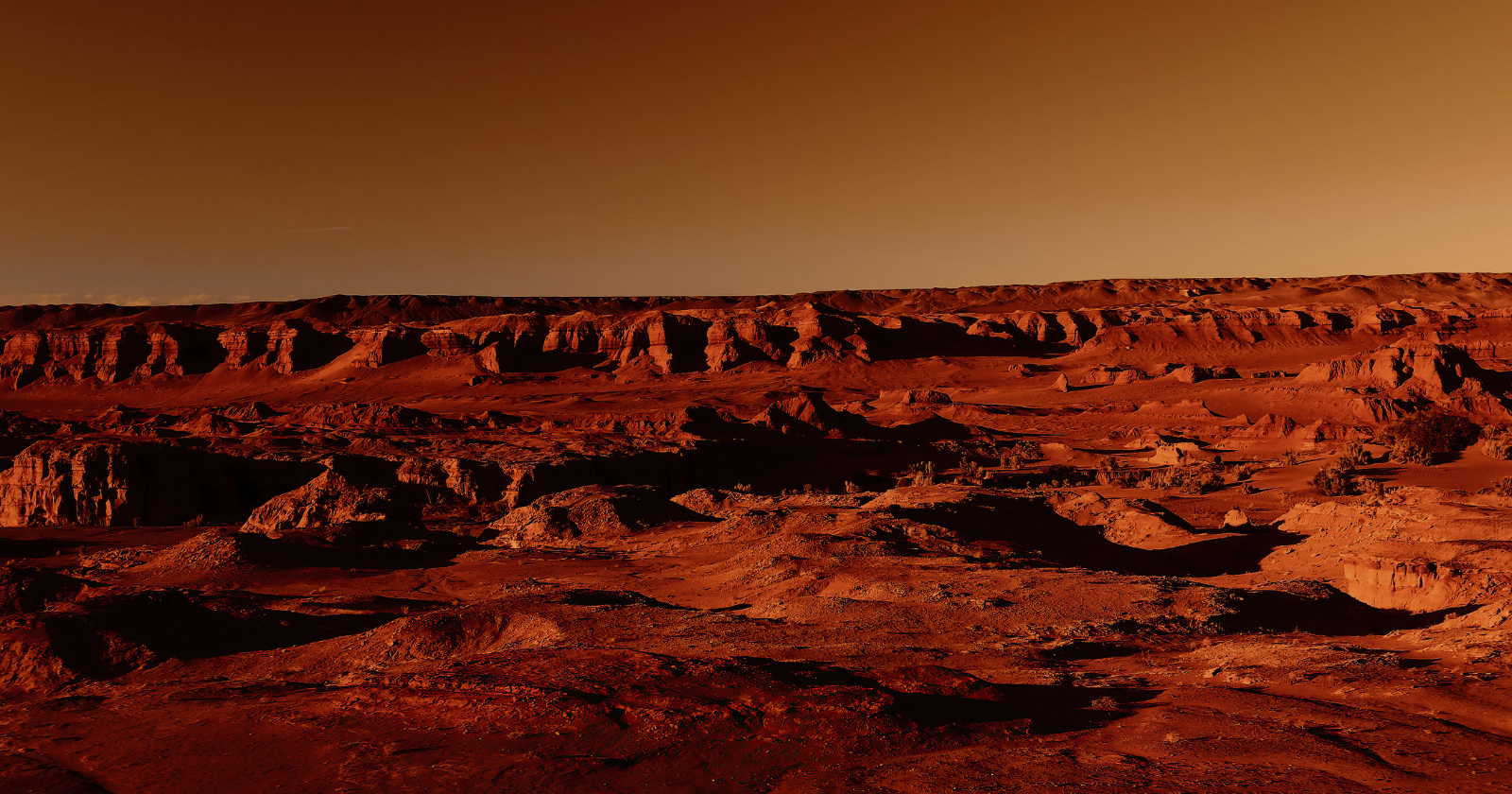
Picture yourself standing in Gale Crater on Mars. The ground stretches away toward a tall mountain in the distance. You might expect a world painted bright red, like the planet looks in the night sky.
Instead, you’d see something more muted. The rocks and soil around your boots would be mostly shades of tan, brown and butterscotch, with patches of darker gray. The sky above would be a hazy caramel color. Mars is red from a distance, but up close it’s a planet of browns.
Red from far away
For thousands of years, people have called Mars red. Babylonian astronomers noted its color, and the Romans named it after their god of war, linked to blood and battle.
From Earth, the planet really does look reddish-orange. That’s because we’re seeing light reflected off a planet-wide layer of fine dust. Spacecraft orbiting Mars also see a reddish-brown world, though most dramatic orbital images are color-enhanced to bring out details, and don’t show the true beige-to-brown tones Mars actually has.
A world dusted in rust
The red tint comes from iron. Mars has a lot of it in its rocks, and over billions of years, much of that iron reacted with water or oxygen to form iron oxides, the same family of compounds that makes rust on Earth.
Over time, the rusty material broke down into extremely fine dust, much finer than ordinary sand. Martian winds and planet-wide dust storms have spread it everywhere. It settles on rocks, sand dunes and spacecraft, and some always hangs in the thin atmosphere.
Because the dust layer is so thin, it tints the landscape rather than coloring it completely. Mix a little reddish dust with brown and gray rocks and you get the butterscotch and caramel colors rovers see on the ground.
What’s under the dust
Scrape away that coating, and Mars looks very different. Much of the planet’s bedrock is basalt, a dark volcanic rock similar to what forms islands like Hawaii and Iceland.
When NASA’s Curiosity rover first drilled into a Martian rock in 2013, the powder that came out was gray, not red. Rover wheels have also churned up surprisingly pale soils in places, showing that the reddish layer is often only skin deep.
A sky the color of caramel
The dust also changes the sky. On Earth, tiny gas molecules scatter blue light, making our daytime sky blue. On Mars, the atmosphere is far thinner, and fine dust particles do most of the scattering.
That dust gives the Martian daytime sky a hazy, butterscotch or pinkish-tan color. At sunset, the effect flips. Dust scatters blue light forward, toward the setting Sun, creating a blue glow around it. Rovers have photographed these eerie blue Martian sunsets many times.
A new twist on why Mars is red
Scientists long believed the main iron oxide in Martian dust was hematite, a mineral that can form under dry conditions over very long periods. That suggested Mars rusted slowly, after its early wet period had ended.
A 2025 study published in Nature Communications challenged that idea. A team led by Adomas Valantinas of Brown University created replica Martian dust in the lab, using data from NASA and European Space Agency orbiters and rovers to match its chemistry and properties.
They found that the best match was a mix of basalt and ferrihydrite, an iron oxide that contains water and forms quickly in cool water. If they’re right, Mars rusted much earlier, while water still existed on its surface. That could matter for understanding whether the planet was ever habitable.
The team says the idea still needs confirmation. Samples collected by NASA’s Perseverance rover, some of which include dust, could settle the question if they’re ever brought back to Earth.
Still the Red Planet
None of this means Mars needs a new nickname. From Earth, and from orbit, it really does glow reddish-orange. As Valantinas put it, Mars is still the Red Planet. What has changed is our understanding of why.
But if humans ever walk on Mars, they may be surprised by the view. The famous red will be there in the dust on their boots, but the landscape around them will look more like a vast desert in shades of brown, under a sky the color of caramel.