
On 5 March 1982 the Soviet lander Venera 14 came down on a basaltic plain near the eastern flank of Phoebe Regio on Venus. It kept working for at least 57 minutes, against a planned lifespan of 32, in a temperature of about 465 °C and a pressure about 94 times that at sea level on Earth.
One of its experiments, though, never touched Venus at all.
The wrong target
The lander's cameras looked out through quartz windows that were protected during the descent by lens covers. After touchdown the covers popped off, as designed, so the cameras could photograph the ground.
Venera 14 also carried a soil probe meant to press into the surface and measure how compressible the Venusian soil was. By bad luck, a lens cap came to rest at the exact spot where the probe was due to go in. The probe did its job, and measured the compressibility of the lens cap instead.
What it did measure
The rest of the lander's instruments fared better. An X-ray fluorescence spectrometer analysed surface samples and found rock similar to the tholeiitic basalts of Earth's ocean floors. Microphones on board recorded the sound of the atmosphere, and later analysis of those recordings put the average wind speed at the surface at between 0.3 and 0.5 metres per second.
The lander could not talk to Earth directly. Its signals went up to the spacecraft that had carried it, which flew past Venus and relayed the data home before continuing into orbit around the Sun.
A pair of probes
Venera 14 was the twin of Venera 13, which was launched 45 years ago today, on 30 October 1981. Venera 14 followed five days later, on 4 November, and after a four-month cruise landed about 950 km south-west of its sibling.
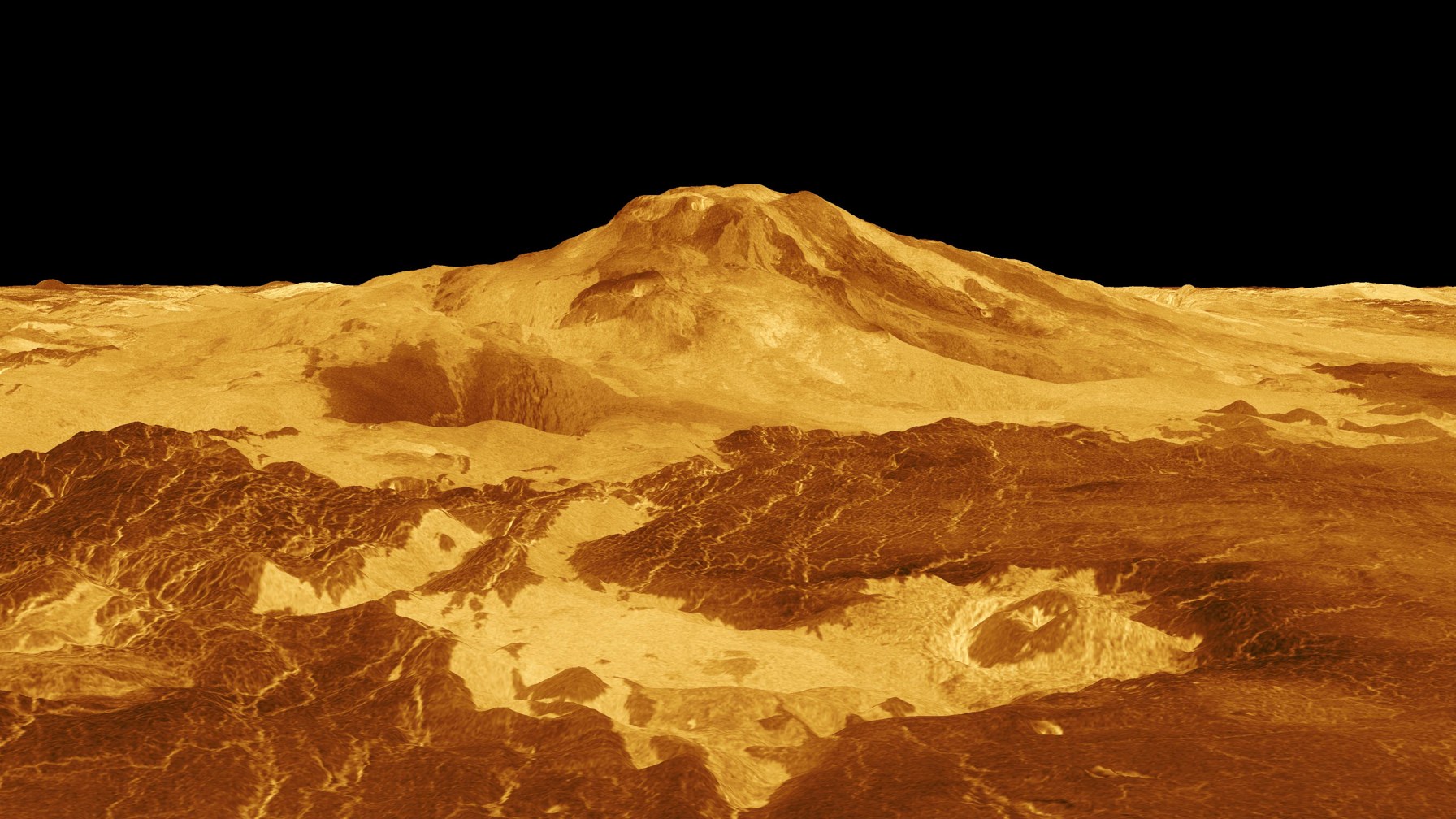
Featured image: Magellan radar 3D perspective view of Maat Mons on Venus, not the Venera 14 landing site. NASA/JPL, public domain.