
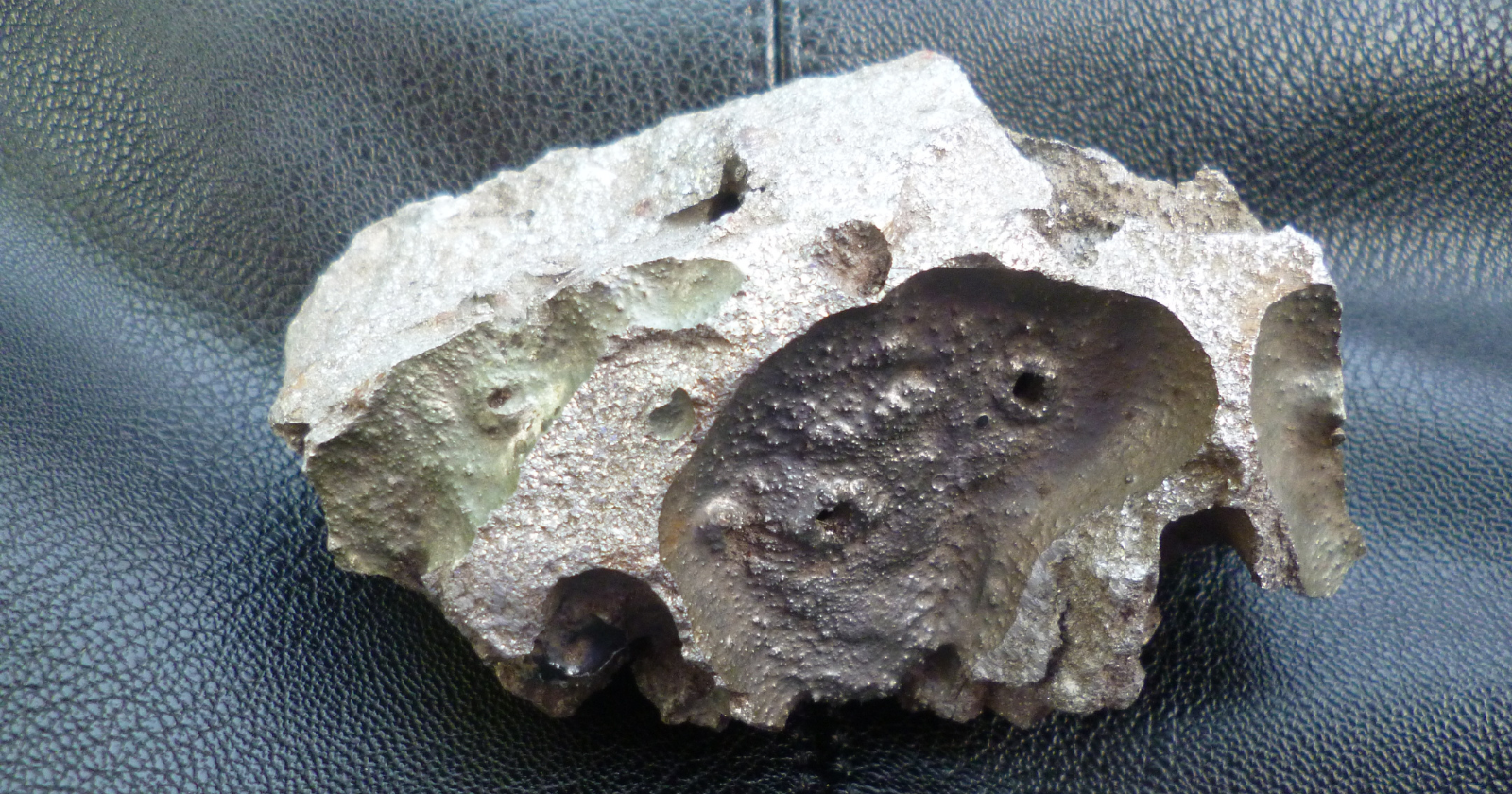
On a farm in Edmore, Michigan, a dark, heavy lump of rock sat at the bottom of a barn door for decades, holding it open. Its owner sometimes sent it to school with his kids for show-and-tell. Nobody thought much more about it.
Then, in 2018, he finally decided to find out what it really was. The answer surprised even the scientist who examined it.
A rock that came with the farm
David Mazurek bought the farm in Edmore, about 30 miles southwest of Mount Pleasant, in 1988. The rock came with it.
According to the farmer who sold him the property, the rock had fallen from the sky in the 1930s. One night, the farmer and his father heard a loud boom and went out to look. The next morning, they found a crater and dug out a warm, heavy rock. As geologist Mona Sirbescu later recalled, the family’s story was that it was collected right after they witnessed the big boom.
The family used it as a doorstop. When Mazurek bought the farm, the farmer told him it was a meteorite and that he could keep it. For the next 30 years, it kept doing the same job.
Inspired by a fireball
What changed his mind was a meteor. On January 16, 2018, a bright fireball streaked across the sky over southeast Michigan, and meteorite hunters soon found fragments near the town of Hamburg. News stories reported that small pieces were selling for thousands of dollars.
Mazurek began to wonder what his doorstop might be worth. That year, he took it to Central Michigan University to have it examined.
“Something special”
Mona Sirbescu, a geology faculty member at Central Michigan University, had spent 18 years telling people that their suspected meteorites were just ordinary rocks. This time was different.
“I could tell right away that this was something special,” she said. She later called it the most valuable specimen she had ever held, both in money and in scientific terms.
Testing showed the rock was an iron meteorite, made of about 88.5 percent iron and 11.5 percent nickel. At about 22.5 pounds, it was the sixth-largest meteorite ever recorded in Michigan.
Confirmed by the Smithsonian
To be sure, Sirbescu sent small slices to the Smithsonian Institution in Washington. Experts there confirmed it was a meteorite, and a sample also went to a meteorite specialist at the University of California, Los Angeles, for further analysis.
The meteorite was officially named the Edmore meteorite, after the town where it fell. Based on its size and type, it was valued at around $100,000.
Several buyers showed interest, including the Smithsonian and a mineral museum in Maine. Mazurek promised to give 10 percent of the sale price to Central Michigan University to support students studying earth and atmospheric sciences.
A new home
The Edmore meteorite did find a permanent home, though not for the full estimated value. Michigan State University’s Abrams Planetarium bought it through a donor for $75,000, and it went on display there in the fall of 2019.
Why iron meteorites are special
Most meteorites that reach Earth are stony, made mostly of rock. Iron meteorites like the Edmore meteorite are much rarer, making up only about 5 percent of observed falls.
They’re thought to come from the metal cores of ancient asteroids that were broken apart by collisions early in the history of the solar system. That makes them valuable to scientists studying how planets formed.
They’re also valuable to collectors. Iron meteorites are heavy, durable and often have striking patterns when cut, polished and etched.
Could you have one too?
Most suspected meteorites turn out to be ordinary rocks, sometimes called “meteorwrongs.” Real meteorites are usually much heavier than they look, often attract a magnet and may have a thin dark crust from melting as they passed through the atmosphere.
If you think you’ve found one, a university geology department or natural history museum may be able to help. And if you’ve had an unusually heavy rock propping open a door for years, it might be worth asking.