
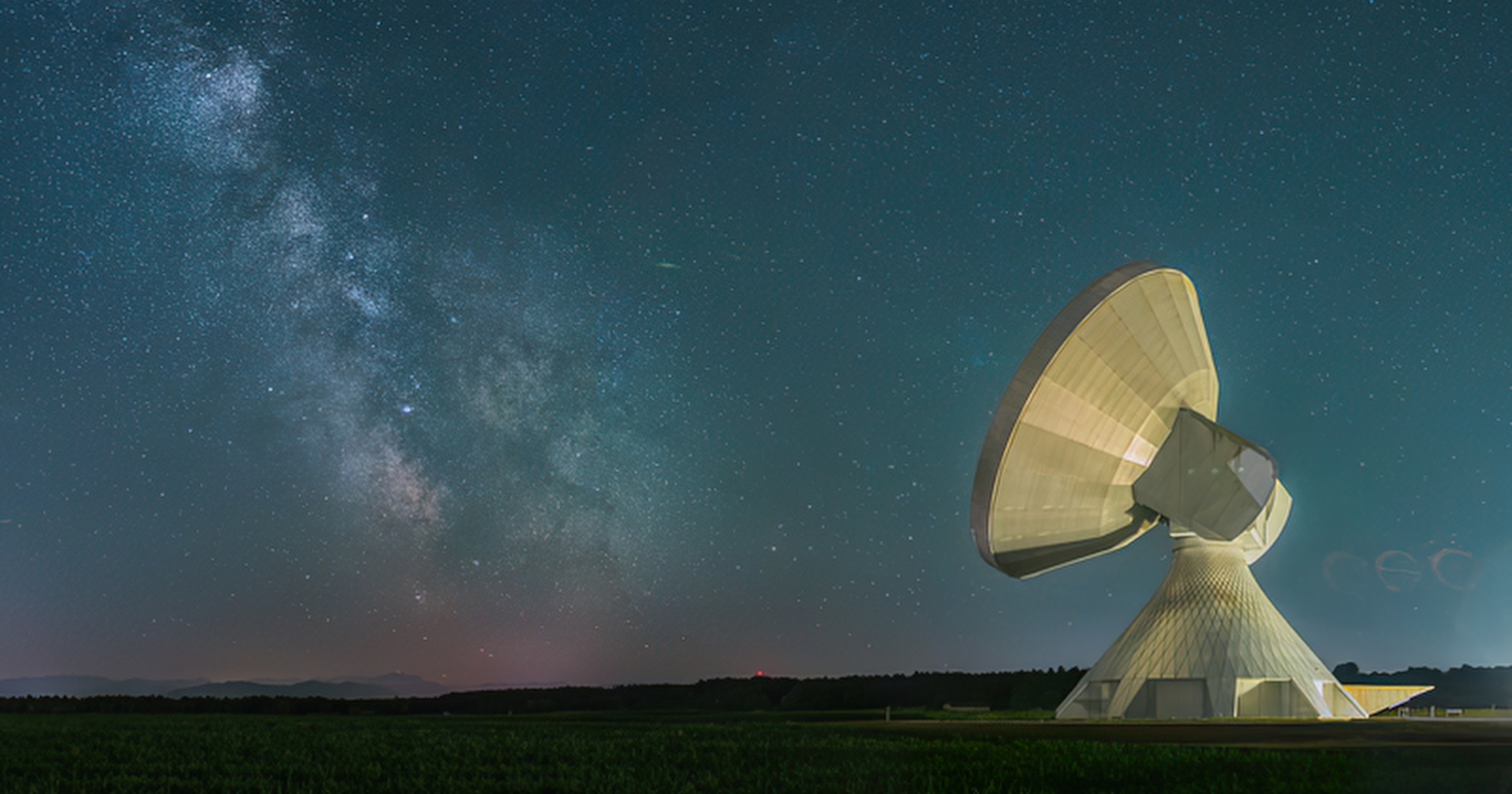
In a valley outside Canberra, surrounded by hills and grazing kangaroos, a giant white dish slowly turns toward a patch of southern sky. It’s listening for a signal so faint it took almost a day to arrive.
The dish is called Deep Space Station 43. Its target is Voyager 2, a spacecraft launched almost half a century ago. And for the past few decades, it’s been the only antenna on Earth able to tell Voyager 2 what to do.
A grand tour of the planets
Voyager 2 launched on August 20, 1977, about two weeks before its twin, Voyager 1. It was designed to last about five years.
Instead, it became one of the most successful missions in history. Voyager 2 flew past Jupiter in 1979 and Saturn in 1981. Then it went on to become the only spacecraft ever to visit Uranus, in 1986, and Neptune, in 1989. Almost everything we’ve seen up close of those two ice giants comes from Voyager 2’s brief flybys.
In November 2018, Voyager 2 became the second human-made object to cross into interstellar space, the region beyond the bubble of solar wind that surrounds our Sun.
Why it headed south
The planets all orbit the Sun in roughly the same flat plane. For most of its journey, Voyager 2 traveled within that plane.
That changed at Neptune. Mission planners wanted Voyager 2 to pass close to Neptune’s north pole and then fly by its large moon, Triton. Neptune’s gravity bent the spacecraft’s path sharply downward, sending it heading south of the plane of the planets.
Voyager 2 has been traveling in that direction ever since. Today, it’s so far south that it doesn’t have a line of sight with radio antennas in the Northern Hemisphere.
One dish to call it
NASA’s Deep Space Network has three main sites spaced around the world: Goldstone in California, Madrid in Spain, and Canberra in Australia. Together, they’re meant to keep at least one site in contact with distant spacecraft as Earth rotates.
But Goldstone and Madrid are in the Northern Hemisphere, so they can’t see Voyager 2. That leaves Canberra.
Several smaller dishes at Canberra can work together to receive Voyager 2’s weak signal. But only Deep Space Station 43, a 70-meter (230-foot) antenna, has a transmitter powerful enough and set to the right frequency to send it commands. The dish was first built in 1972 and enlarged to 70 meters in 1987, partly to help capture Voyager 2’s data from Neptune.
Seven months of silence
That single point of contact has made for some nervous moments. In March 2020, DSS-43 went offline for major repairs and upgrades, much of it work that hadn’t been done in decades.
For seven months, Voyager 2 could still send data home, but engineers couldn’t send it any commands. On October 29, 2020, the upgraded dish sent a test signal, and Voyager 2 confirmed it had received it. The spacecraft was then about 11.6 billion miles from Earth.
There was another scare in July 2023, when a mistaken command turned Voyager 2’s antenna 2 degrees away from Earth. DSS-43 sent a powerful “shout” in the spacecraft’s direction, and it worked. Voyager 2 turned back, and contact was restored in early August.
A conversation that takes almost two days
Voyager 2 is now more than 13 billion miles away. At that distance, a radio signal traveling at the speed of light takes about 20 hours to reach it, so sending a command and hearing back takes nearly two days.
The signal reaching Earth is incredibly weak. It’s transmitted with about the power of a refrigerator light bulb, and by the time it arrives, it’s spread across an enormous area.
Running on borrowed time
Voyager 2 runs on a nuclear power source that produces less electricity every year. Engineers have gradually switched off heaters, systems and science instruments to keep it going.
In 2026, NASA announced that Voyager 2 had enough power to keep its three remaining science instruments running for about another year. Eventually, though, the power will run too low, and the spacecraft will fall silent.
Even then, its journey won’t end. Voyager 2 will keep coasting through the galaxy for millions of years. For now, though, every message humanity sends it still goes out through a single dish in the Australian countryside.