
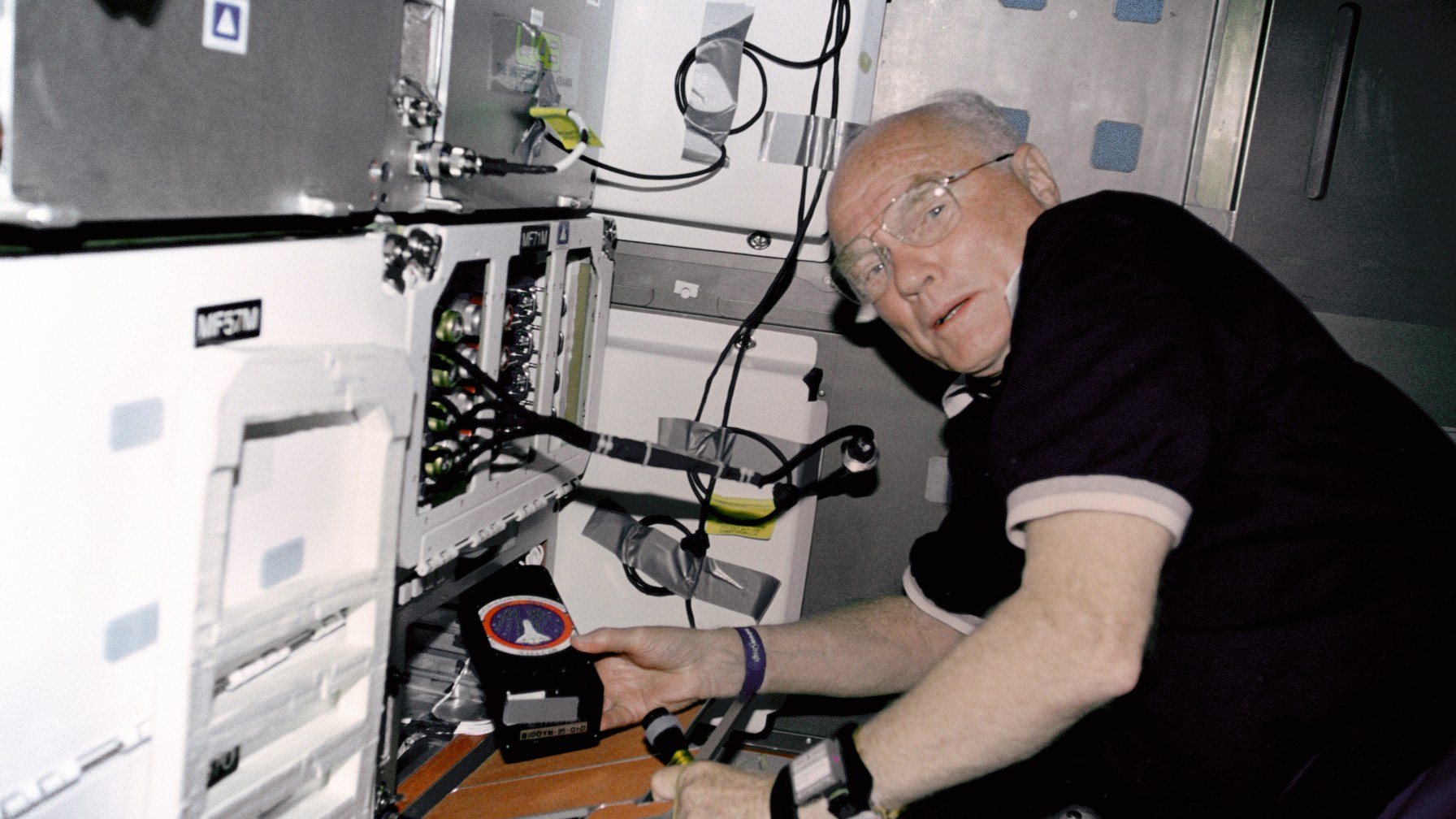
Twenty-eight years ago today, on 29 October 1998, the Space Shuttle Discovery lifted off from Kennedy Space Center in Florida on mission STS-95. Among its seven crew was John Glenn, a 77-year-old serving US senator from Ohio. He was the oldest person ever to fly in space, and he remains the oldest person to have reached Earth orbit.
Glenn had first flown 36 years earlier. On 20 February 1962 he rode the Mercury capsule Friendship 7 from Cape Canaveral and circled the Earth three times, becoming the first American to orbit the planet. With STS-95 he became the only person to fly on both a Mercury spacecraft and the Space Shuttle.
A test subject on purpose
NASA did not send Glenn as a passenger. A large part of the mission was given over to life-sciences experiments in a Spacehab module carried in Discovery's payload bay, and Glenn was a subject for studies of how spaceflight affects an older body. Weightlessness produces changes that resemble ageing, including loss of bone and muscle and disturbed sleep, and researchers wanted to compare his responses with those of younger astronauts. The crew also deployed and retrieved the Spartan free-flying solar observatory and tested equipment for a later Hubble Space Telescope servicing mission.
The flight carried another first: Pedro Duque of the European Space Agency became the first Spaniard in space. Discovery landed back at Kennedy on 7 November after just under nine days.
A president on the roof
President Bill Clinton and Hillary Clinton watched the launch from the roof of the Launch Control Center. Clinton became the only sitting US president to see a Space Shuttle launch in person.
A record that still stands
Glenn's age record for any spaceflight lasted 23 years. In July 2021 Wally Funk, then 82, flew on Blue Origin's New Shepard. William Shatner, 90, followed in October 2021, and Ed Dwight, a former US Air Force test pilot once in line for astronaut training, flew in May 2024 aged 90 and a few months older than Shatner. All three flights were suborbital: they crossed the edge of space and came straight back down. None of them went into orbit, so Glenn's record for that still stands.
Glenn died on 8 December 2016, aged 95. He was the last surviving member of the Mercury Seven.
Featured image: John Glenn working on an experiment on Discovery's middeck during STS-95. NASA, public domain.