
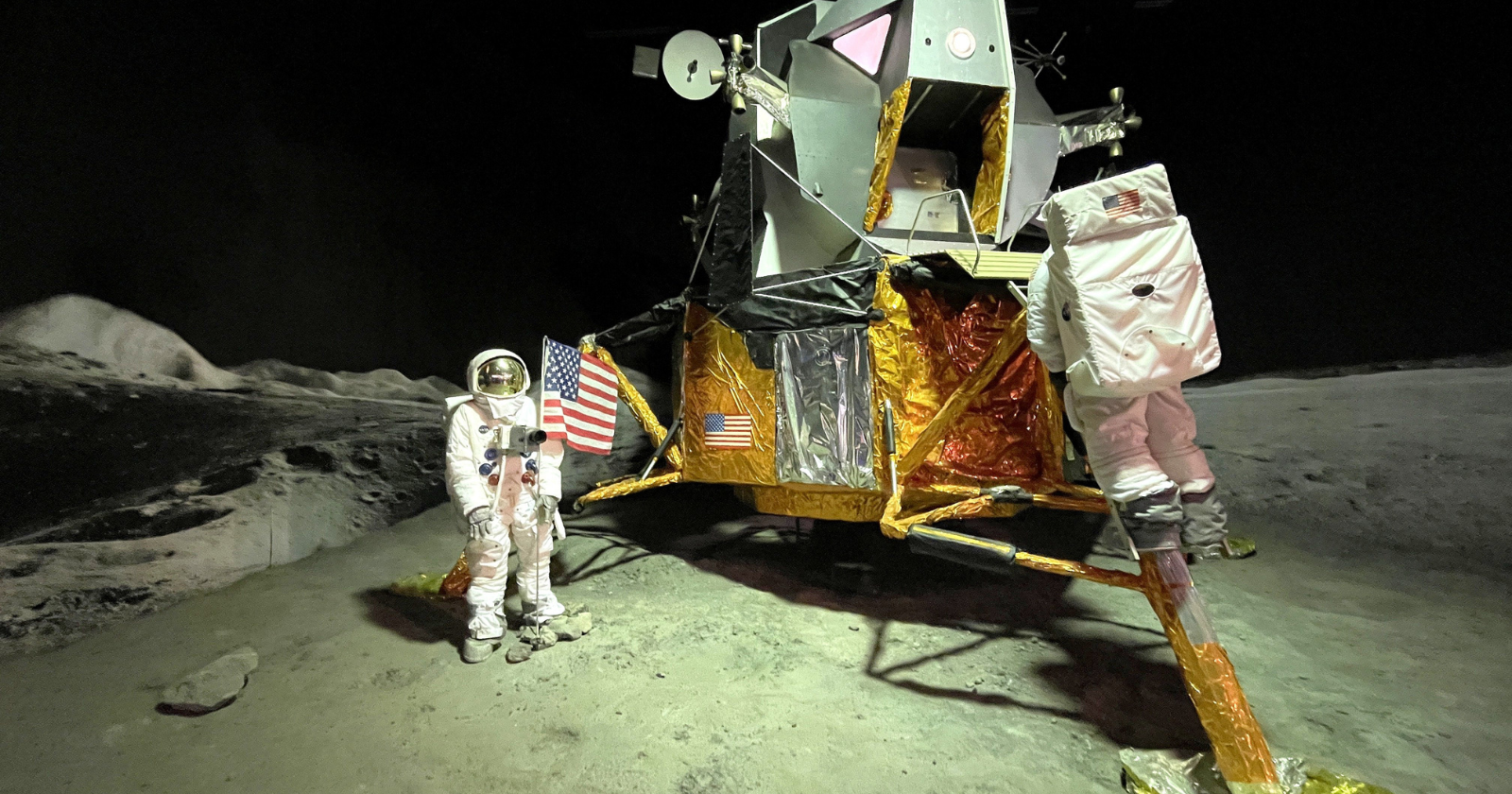
On July 21, 1969, near the end of their two and a half hours on the Moon, Neil Armstrong asked Buzz Aldrin whether he had remembered the small bag in his sleeve pocket. Aldrin pulled it out and tossed it onto the lunar dust near the landing module.
Inside was a disc of silicon about 1.5 inches across. To the naked eye, it looked almost blank, with a few tiny dots. But under a microscope, those dots held messages from kings, queens, presidents and prime ministers around the world.
A last-minute idea
The plan came together in a rush. Only in June 1969, about a month before launch, did the US State Department authorize NASA to collect goodwill messages from world leaders to leave on the Moon.
There was no email or fax in the modern sense. Diplomats around the world scrambled to reach heads of state, explain the request and get a reply back to Washington in time. Requests went out to more than 100 leaders.
In the end, 73 countries sent messages that made it onto the disc. Some replies, including Sri Lanka’s, arrived too late to be included.
Writing smaller than a pinhead
NASA turned to the Sprague Electric Company of Massachusetts, a regular supplier that already made thousands of electronic parts for the Apollo spacecraft. Sprague had to work out how to fit dozens of letters, many in different languages and scripts, onto one small disc.
The solution came from the technology used to make computer chips. According to NASA’s 1969 press release, each message was photographed and reduced 200 times. The tiny image was transferred to glass, and ultraviolet light was shone through it onto a light-sensitive coating on the silicon disc, which was then etched.
Each message ended up much smaller than the head of a pin, about 1 millimeter across. On the disc, each one appears as a barely visible dot. Reading them requires a microscope.
What it says
Around the edge of the disc are the words “From Planet Earth” and “July 1969.” At the top is the inscription “Goodwill messages from around the world brought to the Moon by the astronauts of Apollo 11.”
The disc also carries statements from four American presidents, Dwight Eisenhower, John F. Kennedy, Lyndon Johnson and Richard Nixon. It lists the leaders of Congress and members of the congressional committees responsible for NASA, along with the space agency’s top officials.
The international messages vary widely. Many leaders wrote about peace, science and the shared achievement of humanity. Some quoted scripture or poetry. Pope Paul VI’s message included verses from Psalm 8, which reflects on human beings’ place among the heavens.
A race against the clock
Sprague delivered a finished disc about a week before launch. Then more messages came in, and NASA wanted them added. The company made a new version, and the final disc was ready just days before Apollo 11 lifted off on July 16, 1969.
Silicon was a good choice for the Moon. It’s stable and doesn’t corrode, and it should withstand the extreme temperature swings between lunar day and night far better than many other materials.
Left with other tributes
The disc wasn’t alone in that small bag. Aldrin also left an Apollo 1 mission patch honoring the three astronauts who died in a fire during a 1967 launch rehearsal. There were medals commemorating Soviet cosmonauts Yuri Gagarin and Vladimir Komarov, who had also died. A small gold olive branch pin, a symbol of peace, was included too.
Those items join the better-known plaque attached to the lunar module’s leg, which reads in part, “We came in peace for all mankind.”
Still sitting at Tranquility Base
As far as anyone knows, the disc is still lying in the gray dust where Aldrin left it, more than 57 years later. With no wind, rain or erosion on the Moon, it could survive there for a very long time, although harsh sunlight, temperature swings and tiny micrometeorites may slowly wear away the surface over many centuries.
Most people who know about Apollo 11 remember the flag and the footprints. Far fewer know that, lying nearby, is a disc carrying the words of dozens of the world’s leaders, written smaller than a grain of sand and meant for anyone who might one day find it.