
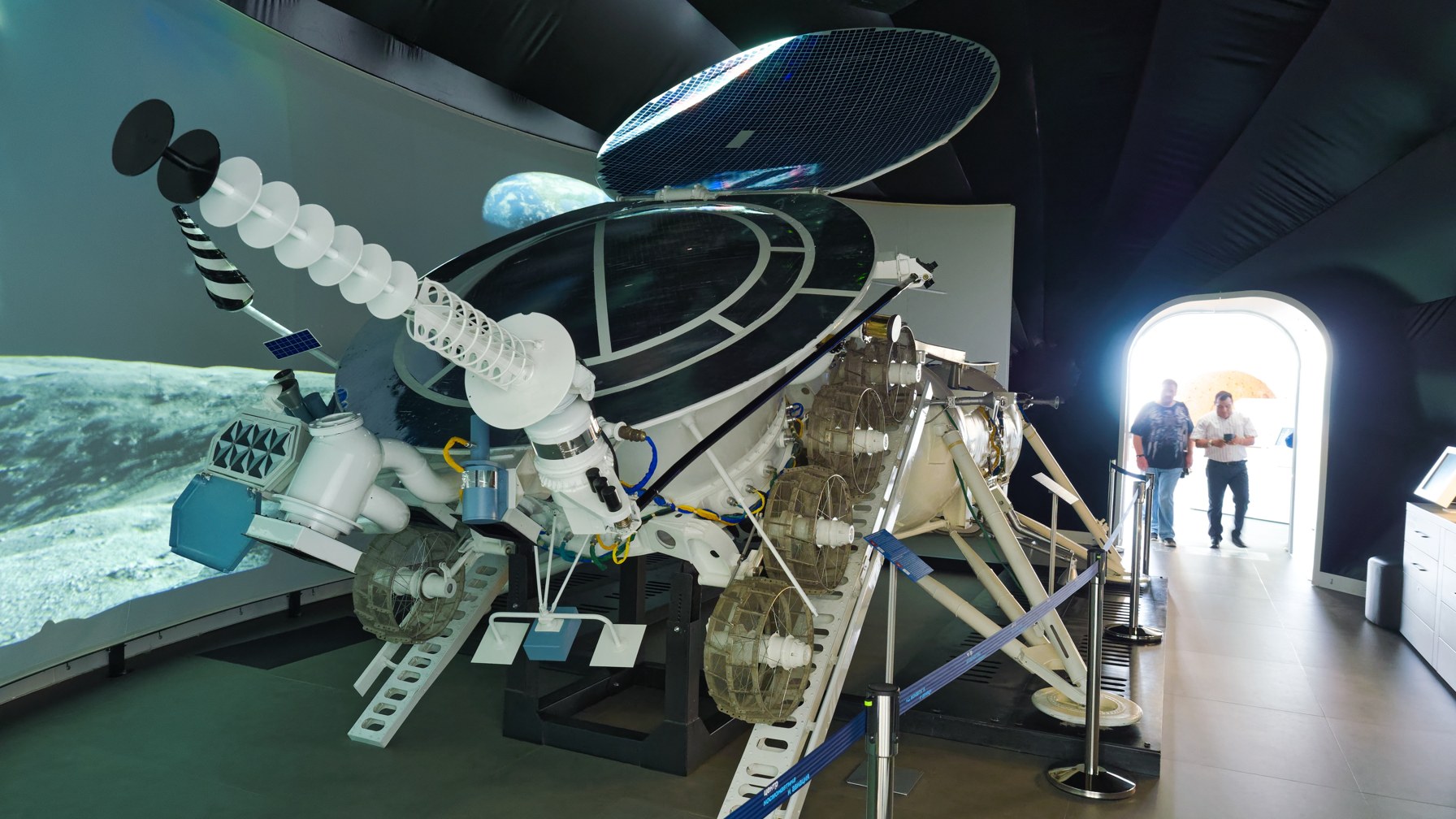
In December 1993 Sotheby's in New York held an auction of Soviet space hardware. One lot was unusual: the buyer would not be able to collect it. Lunokhod 2, a Soviet robotic rover, and the Luna 21 lander that carried it, had been sitting on the Moon for almost 21 years.
The Lavochkin Association, the bureau that built the craft, sold ownership of both for $68,500. The buyer was Richard Garriott, the computer game developer behind the Ultima series and the son of Skylab astronaut Owen Garriott. Sotheby's own catalogue got the lot wrong: it listed lot 68A as Luna 17 and Lunokhod 1, the earlier rover. The vehicle Garriott bought was Lunokhod 2.
What he bought
Luna 21 landed in Le Monnier crater, on the eastern edge of Mare Serenitatis, on 15 January 1973. The rover it carried weighed 840 kg, stood about 1.35 metres tall and ran on eight wheels, each with its own electric motor, suspension and brake. A team on Earth drove it in near real time from television pictures, at one or two kilometres an hour.
It worked for about four months. In that time it sent back more than 80,000 television pictures and 86 panoramic images and carried out mechanical tests of the lunar soil and laser ranging measurements. Contact ended in May 1973.
Soviet controllers originally put its distance at 37 km, based on wheel turns. After images from NASA's Lunar Reconnaissance Orbiter became available, researchers at the Moscow State University of Geodesy and Cartography revised that to about 42 km. Russian and American teams later settled on 39 km. That stood as the record for driving on another world until 27 July 2014, when NASA's Opportunity rover passed it on Mars.
Lost, then found
For decades nobody knew exactly where on the Moon the rover had stopped. In March 2010 a researcher at the University of Western Ontario said he had found it in Lunar Reconnaissance Orbiter images, but the spot turned out to be a mark in its tracks made when it turned around. The orbiter's camera team identified the rover's real position in March 2012. Lunokhod 2 still carries a laser reflector, and observatories continue to bounce lasers off it; its position is known to within a metre.
"I am not a government"
Garriott spoke about the purchase in a 2001 interview with Computer Games Magazine. "I am now the world's only private owner of an object on a foreign celestial body," he said. He added that international treaties bar governments from claiming territory beyond Earth, "I am not a government", and, in the voice of his Ultima character, claimed the Moon "in the name of Lord British".
The joke has a serious edge. The 1967 Outer Space Treaty forbids nations from claiming the Moon, but says nothing that stops a manufacturer selling a vehicle it built. Garriott owns the rover, not the ground under it. He saw his purchase for the first time in 2010, through the orbiter's images, 17 years after he paid for it.
Garriott later went to space himself, flying to the International Space Station as a paying visitor in 2008. Lunokhod 2 has not moved since 1973.