
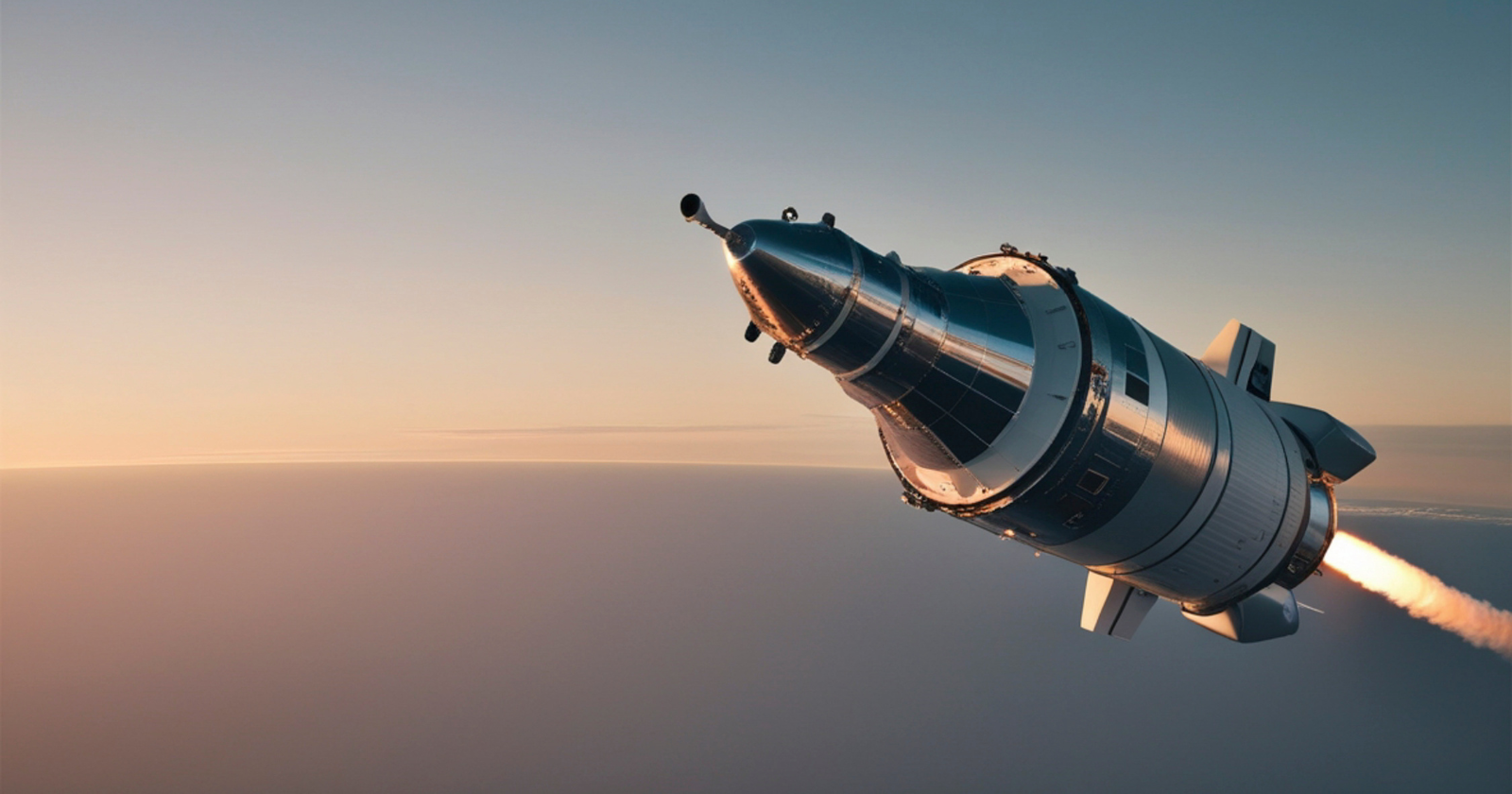
Picture a calm stretch of the Pacific off the California coast. A tugboat pulls something enormous through the water, a steel cylinder nearly as long as two football fields. Crews open valves at one end, and seawater pours into tanks at its base. Slowly, the giant tips upward until it’s floating vertically, its nose high above the waves.
Then its engine ignites, and the largest rocket ever designed rises straight out of the sea.
That was the plan for Sea Dragon. It never flew, but serious people thought it could.
The engineer who wanted to make rockets cheap
Robert Truax was a US Navy officer and rocket engineer who had worked on early American missiles, including the Thor and the submarine-launched Polaris. By 1962, he was at Aerojet, a major American rocket engine maker.
Truax had a simple idea that went against much of the industry. Most rockets were built like precision instruments, as light and efficient as possible, using expensive materials and complicated machinery. Truax thought that approach made spaceflight far too costly.
His alternative later became known as the “big dumb booster.” Build rockets big, simple and sturdy, accept some extra weight, and save money by cutting complexity.
A rocket the size of a skyscraper
Sea Dragon was Truax’s most extreme version of that idea. The design called for a two-stage rocket about 150 meters (490 feet) tall and 23 meters (75 feet) wide, weighing around 18,000 metric tons when fueled.
It was designed to lift about 550 metric tons into low Earth orbit. That’s more than the entire International Space Station in a single launch, and several times what the Saturn V could carry.
The first stage would have used a single gigantic engine producing around 80 million pounds of thrust, roughly ten times the thrust of the Saturn V at liftoff.
Built like a ship
The key to Sea Dragon’s low cost was how it would be made. Instead of being built in an aerospace factory, it would be constructed in a shipyard, from steel plate about 8 millimeters thick, using techniques similar to building a ship’s hull or a submarine.
The engines were also kept simple. Most large rockets use turbopumps, high-speed spinning machines that force fuel into the engine. Sea Dragon would have used a pressure-fed system instead, pushing fuel and oxidizer out of the tanks with high-pressure gas. That required thick, heavy tank walls, but removed some of the most expensive and failure-prone parts of a rocket.
Launching from the sea
A rocket that big would have needed a gigantic launch pad. Truax’s solution was to skip the pad entirely.
After being built and loaded with payload and kerosene fuel at a coastal facility, Sea Dragon would be towed out to sea horizontally. At the launch site, ballast tanks at the bottom would be filled with water, tipping the rocket upright so it floated like a giant buoy, with only the top section above the surface.
Once fully fueled with liquid oxygen, it would launch directly from the water. The ocean would absorb much of the sound and heat that would damage a land-based launch pad. Truax had already experimented with firing smaller rockets from the water to test the concept.
The first stage was designed to fall back into the ocean after use, where it could be recovered and potentially reused.
“Within their capabilities”
The idea wasn’t just a sketch on a napkin. Aerojet produced a detailed study under a NASA contract, and Todd Shipyards, a major American shipbuilder, examined whether it could build the rocket. It concluded construction was within its capabilities.
NASA also had the design reviewed by TRW, an aerospace company, which broadly supported Aerojet’s engineering and cost estimates. Aerojet even considered buying a stretch of coastline between Santa Barbara and Vandenberg Air Force Base as a possible base of operations.
Why it never flew
Sea Dragon faced bad timing. NASA was already committed to the Saturn V for the Apollo Moon landings, with established contractors, launch pads and political backing. There was no mission that needed a rocket able to lift 550 tons at once.
As NASA’s budget tightened in the mid-1960s and its office for long-term future projects wound down, Sea Dragon was shelved. It remained a concept study, not a rocket that was ever built or tested.
Truax kept building unusual rockets. In 1974, he designed the steam-powered Skycycle X-2 that daredevil Evel Knievel rode in his failed attempt to jump Idaho’s Snake River Canyon.
A dream that keeps resurfacing
Sea Dragon has never quite disappeared. It appeared in the alternate-history TV series For All Mankind, and space enthusiasts still debate whether it could have worked.
Some of its ideas did come true. Sea Launch fired rockets from a floating platform in the Pacific starting in 1999, and SpaceX has shown that reusing rocket stages can cut costs. Today’s largest rocket, SpaceX’s Starship, is aiming for heavy payloads at low cost, and even it would be smaller than Sea Dragon.