
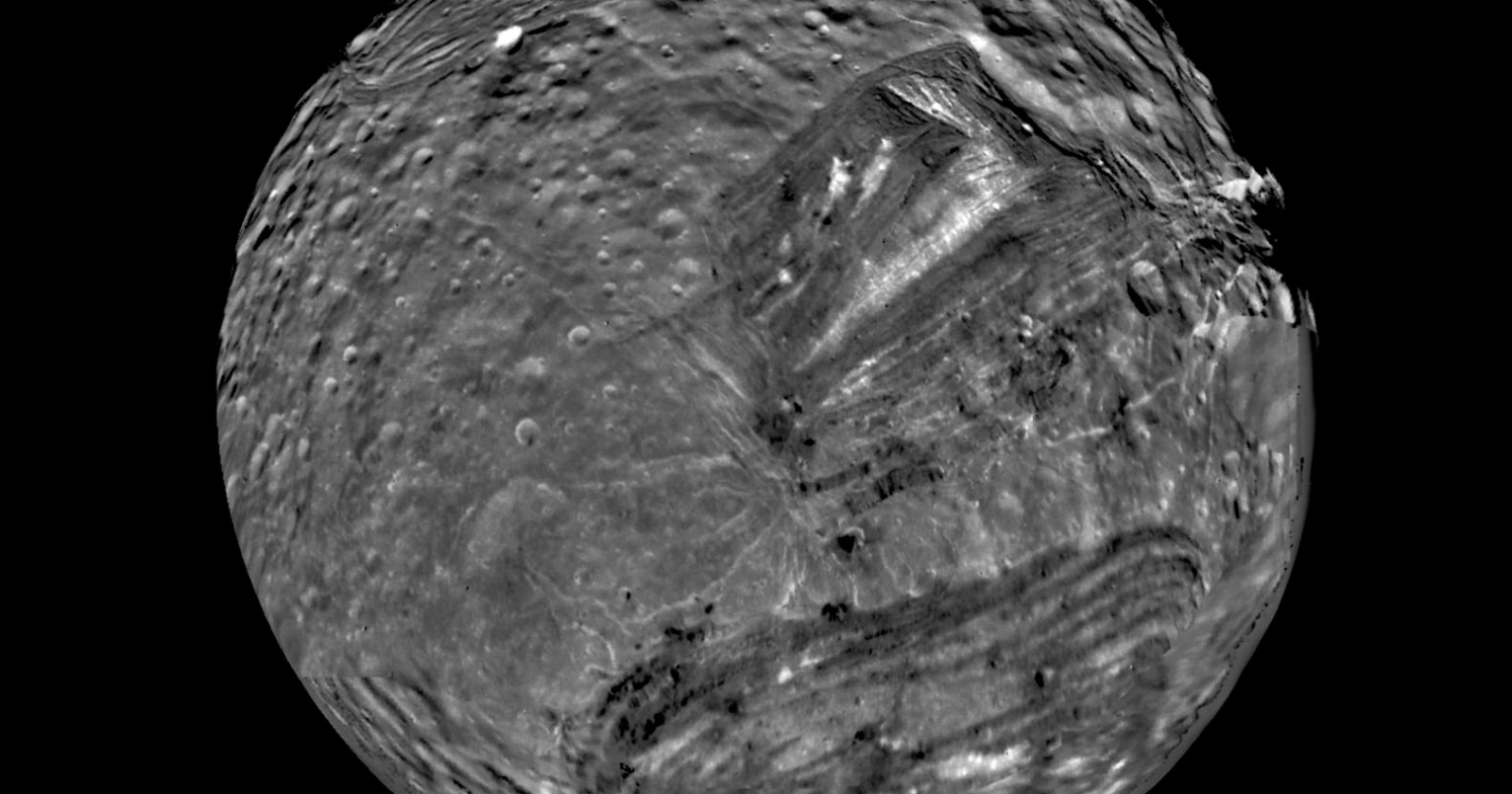
In January 1986, Voyager 2 raced past Uranus and its moons, snapping photos as it went. One of the images it sent back from the small moon Miranda showed a strange, bright wall of ice running along its surface.
That wall, now called Verona Rupes, is often described as the tallest known cliff in the solar system. It’s also the setting for one of planetary science’s favorite thought experiments: what would happen if you jumped off?
A small, strange moon
Miranda is the smallest and innermost of Uranus’s five major moons. It’s only about 470 kilometers (290 miles) across, small enough to fit inside the state of Texas.
Before Voyager 2, scientists expected it to be a dull, cratered ball of ice. Instead, the images revealed one of the most bizarre surfaces in the solar system. Miranda looks like a patchwork, with old cratered regions sitting next to huge oval and chevron-shaped zones of grooves and ridges.
Running along the edge of one of these regions is Verona Rupes, named after the Italian city where Shakespeare set Romeo and Juliet. Uranus’s moons are named after characters from Shakespeare and Alexander Pope, and Miranda herself comes from The Tempest.
How tall is it, really?
Verona Rupes is enormous, but its exact height is uncertain. Voyager 2 photographed it only once, from an angle, at a single moment during its fast flyby. Measuring height from that one image is tricky.
The original estimates put the cliff at 5 to 10 kilometers high, or roughly 3 to 6 miles. Later studies that accounted for the viewing angle suggested a range of about 5 to 15 kilometers. Some popular accounts, including NASA’s Astronomy Picture of the Day, have cited a figure as high as 20 kilometers.
Even at the low end, the cliff dwarfs anything on Earth. The Grand Canyon is about 1.8 kilometers deep at its deepest point. Verona Rupes could be several times that.
The long way down
Now for the fun part. Miranda’s gravity is extremely weak, about 0.079 meters per second squared, or less than 1 percent of Earth’s. On Miranda, a 70-kilogram person would weigh about as much as a bag of sugar does on Earth.
That changes everything about falling. If the cliff is about 10 kilometers high, a simple calculation gives a fall time of around eight minutes. By the time you reached the bottom, you’d be traveling at roughly 40 meters per second, about 90 miles per hour. That’s like driving fast on a highway.
The answer depends on which height estimate you use. At 5 kilometers, the fall would take about six minutes and end at around 56 mph. At 20 kilometers, it would last about 12 minutes, with a landing speed of around 120 mph. That higher figure is the one behind NASA’s often-quoted “12 minutes at racecar speed.”
Could you survive it?
On Earth, a fall from a height of 10 kilometers would reach terminal velocity, a speed where air resistance stops you from accelerating further. On Miranda, there’s no atmosphere, so you would keep speeding up the whole way down.
Still, landing at highway speed is far gentler than hitting the ground after a skydive without a parachute. NASA’s APOD has suggested that the fall might be survivable with proper airbag protection.
There’s a catch. Verona Rupes probably isn’t a perfectly vertical wall. Its slope is likely steep but not sheer, so a real jumper might bounce and slide down the face rather than falling straight through empty space. And you’d need a spacesuit. Miranda’s surface temperature is around minus 187 degrees Celsius.
How did it form?
Nobody knows for sure how Verona Rupes formed. It may be a giant fault, created when the moon’s icy crust cracked and shifted. It may be linked to a huge impact, or to the strange geological activity that created Miranda’s patchwork surface.
One old idea was that Miranda was smashed apart by a collision and reassembled in a jumble. A more popular explanation today is that tidal forces from Uranus once heated the moon’s interior, causing warm ice to rise and reshape the surface. Some researchers have even suggested Miranda may once have had a hidden ocean beneath its crust.
Waiting for a second look
Voyager 2 remains the only spacecraft ever to visit Uranus and its moons. Much of Miranda’s surface has never been photographed at all, because the southern hemisphere was facing the Sun during the flyby.
That could change. In 2022, the US planetary science community named a Uranus orbiter and probe as its top priority for NASA’s next flagship mission. If it flies, it may finally pin down how tall Verona Rupes really is, and give a better answer to how long that fall would take.