TKS VA s/n 008
Spacecraft · Russia
Original archive entry. The text, images and links below are kept as they were written.
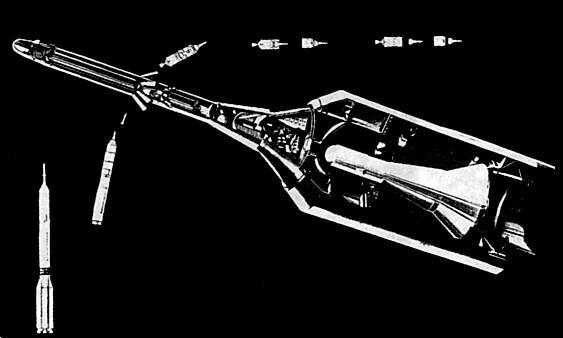
Configuration of the 82LB72 LVI dual-VA capsule test configuration. Externally the test configuration was identical with an all-up TKS ferry. The second VA, housed within the fairing, had no launch escape system and could not be rescued in the case of a launch vehicle failure.
Planned manned single-orbit flight aboard the TKS space capsule during a series of two-TKS-launched-by-one-Proton flight tests. Flown unmanned due to inability to demonstrate two consecutive failure-free launches.
On 20 April 1979 LVI-4 VA (VA s/n 103 and s/n 008) was awaiting launch. The booster ignited, but then shut down on the pad. This triggered the launch escape system, which pulled the top capsule away from the booster. The parachute system failed and the capsule crashed to the ground. The lower capsule remained in the rocket. The top capsule was to have been manned, but the inability to demonstrate two consecutive failure-free launches of the Proton/TKS-VA combination made that (luckily) impossible.
Related
- Country
- Russia
Chronology
1 event
1979 April 20
Launch Site: Baikonur. Launch Complex: Baikonur LC81/24.- TKS VA s/n 008 - .
Payload: TKS VA s/n 008. Mass: 4,250 kg (9,360 lb). Nation: Russia.
Program: Almaz.
Class: Manned.
Type: Manned spacecraft. Flight: TKS VA s/n 008.
Spacecraft Bus: TKS.
Spacecraft: TKS VA .
On 20 April 1979 LVI-4 VA (VA s/n 103 and s/n 008) was awaiting launch. The booster ignited, but then shut down on the pad. This triggered the launch escape system, which pulled the top capsule away from the booster. The parachute system failed and the capsule crashed to the ground. The lower capsule remained in the rocket. The top capsule was to have been manned, but the inability to demonstrate two consecutive failure-free launches of the Proton/TKS-VA combination made that (luckily) impossible.