
In the summer of 1967, a young graduate student at the University of Cambridge was working her way through endless rolls of paper. Each day, a radio telescope she had helped build produced around 100 feet of chart, covered in wiggly lines traced by a pen.
Jocelyn Bell’s job was to check every inch by hand. Among the noise, she noticed something strange: a small patch of what she called “scruff,” taking up only a fraction of an inch. It didn’t look like anything she’d seen before. It would change astronomy.
Building a telescope by hand
Bell was a 24-year-old PhD student from Northern Ireland, working under radio astronomer Antony Hewish. Together with other students, she spent two years helping build a huge radio telescope in a field outside Cambridge.
It wasn’t a dish. It was more than 2,000 posts strung with about 120 miles of wire, covering four and a half acres. It was designed to study quasars, distant objects that flicker as their radio signals pass through gas from the Sun. Bell ran the telescope and analyzed its output, which meant reading miles of chart paper.
The mysterious signal
When Bell looked closer at her strange patch of scruff, she found it kept coming back at the same position in the sky. In November 1967, using a faster chart recorder, she discovered it was a series of sharp pulses, repeating about every 1.3 seconds with astonishing regularity.
Nothing natural was known to behave like that. For a while, the team half-jokingly labeled the source LGM-1, short for “Little Green Men,” because they briefly wondered whether it could be an artificial signal from another civilization.
Not aliens, but something just as strange
Soon after, Bell found a second similar signal in a different part of the sky, then more. Since it was unlikely that several alien civilizations were signaling Earth at once, the team concluded they had found a new kind of natural object.
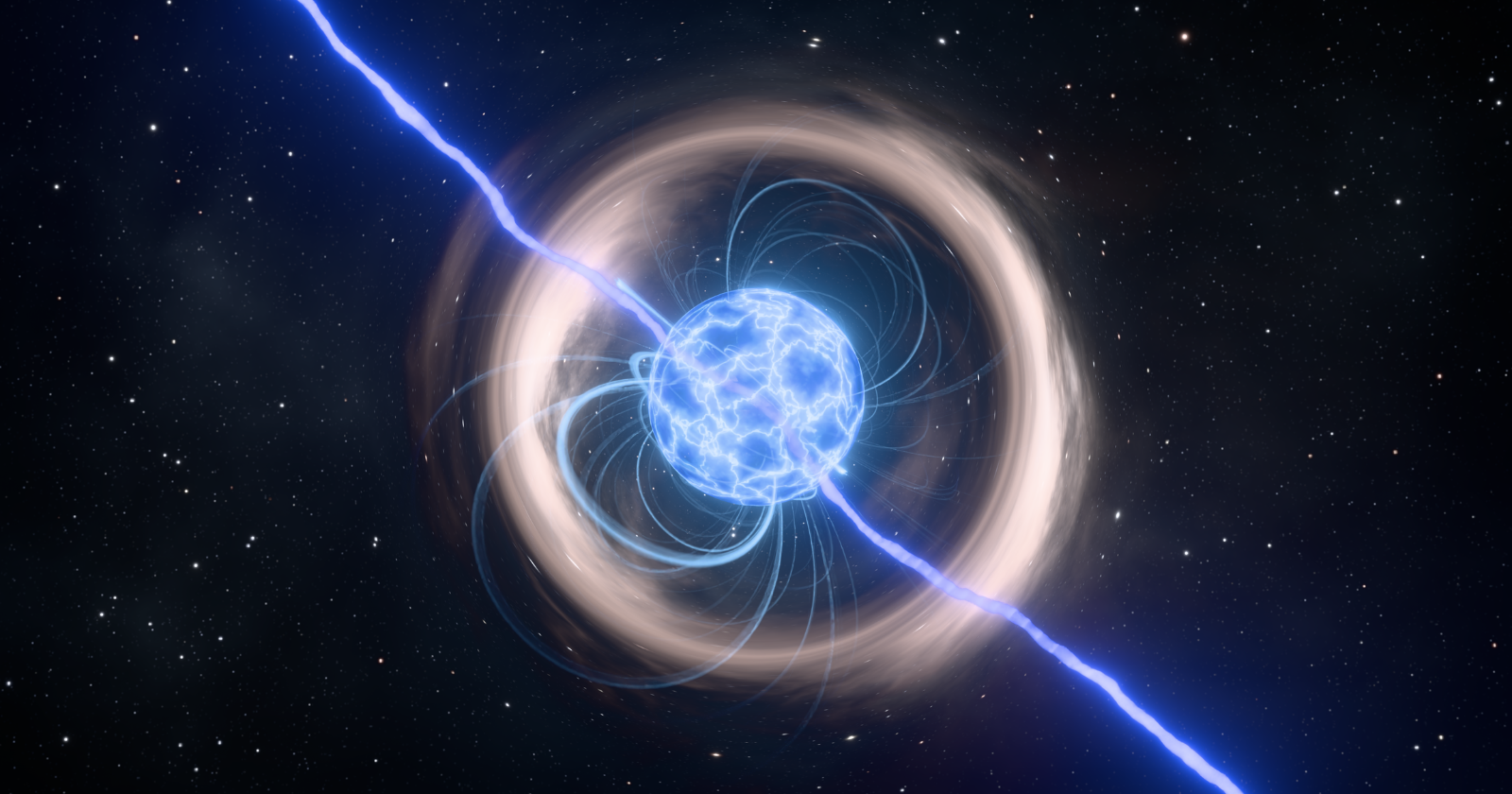
They published their discovery in the journal Nature in February 1968. The objects were named pulsars. Astronomers soon realized they were rapidly spinning neutron stars, the collapsed cores of exploded stars, so dense that a teaspoon of their material would weigh billions of tons. They sweep beams of radio waves across space like lighthouses.
The Nobel Prize controversy
In 1974, the Nobel Prize in Physics was awarded to Antony Hewish, for his role in the discovery of pulsars, and to Martin Ryle, for developing new radio astronomy techniques. Bell, who had first noticed the signal and identified it as something new, was not included.
The decision caused controversy. Some prominent astronomers, including Fred Hoyle, criticized it publicly. Bell herself was gracious, saying that Nobel Prizes traditionally went to senior researchers who led projects, rather than students. But many saw it as an example of how young scientists, and particularly women, have been overlooked.
Recognition later in life
Bell, who became Jocelyn Bell Burnell after she married, went on to a distinguished career in astronomy. She became a professor, president of the Royal Astronomical Society and the Institute of Physics, and was made a Dame in 2007.
In 2018, she received the Special Breakthrough Prize in Fundamental Physics, worth $3 million. She gave all of the money away to create a fund helping students from underrepresented groups, including women, ethnic minorities and refugees, train as physicists.
Why pulsars matter
Pulsars have become one of the most useful tools in astronomy. Their extraordinarily regular signals act like cosmic clocks. They’ve provided evidence for gravitational waves and helped test Einstein’s theory of general relativity.
In 1992, the first planets ever confirmed outside our solar system were found orbiting a pulsar. And the two Voyager spacecraft carry maps showing Earth’s position relative to 14 pulsars, so anyone who finds them could, in theory, locate our home.