
The light that reached two teams of astronomers in 2011 had set out when the universe was a small fraction of its current age. It came from a distant galaxy whose centre shone with almost unimaginable power.
When the astronomers analysed that light, they found something remarkable hidden in it: the signature of water. Not a lake or an ocean, but a vast cloud of water vapour, the largest and most distant reservoir of water ever found.
A monster in the early universe
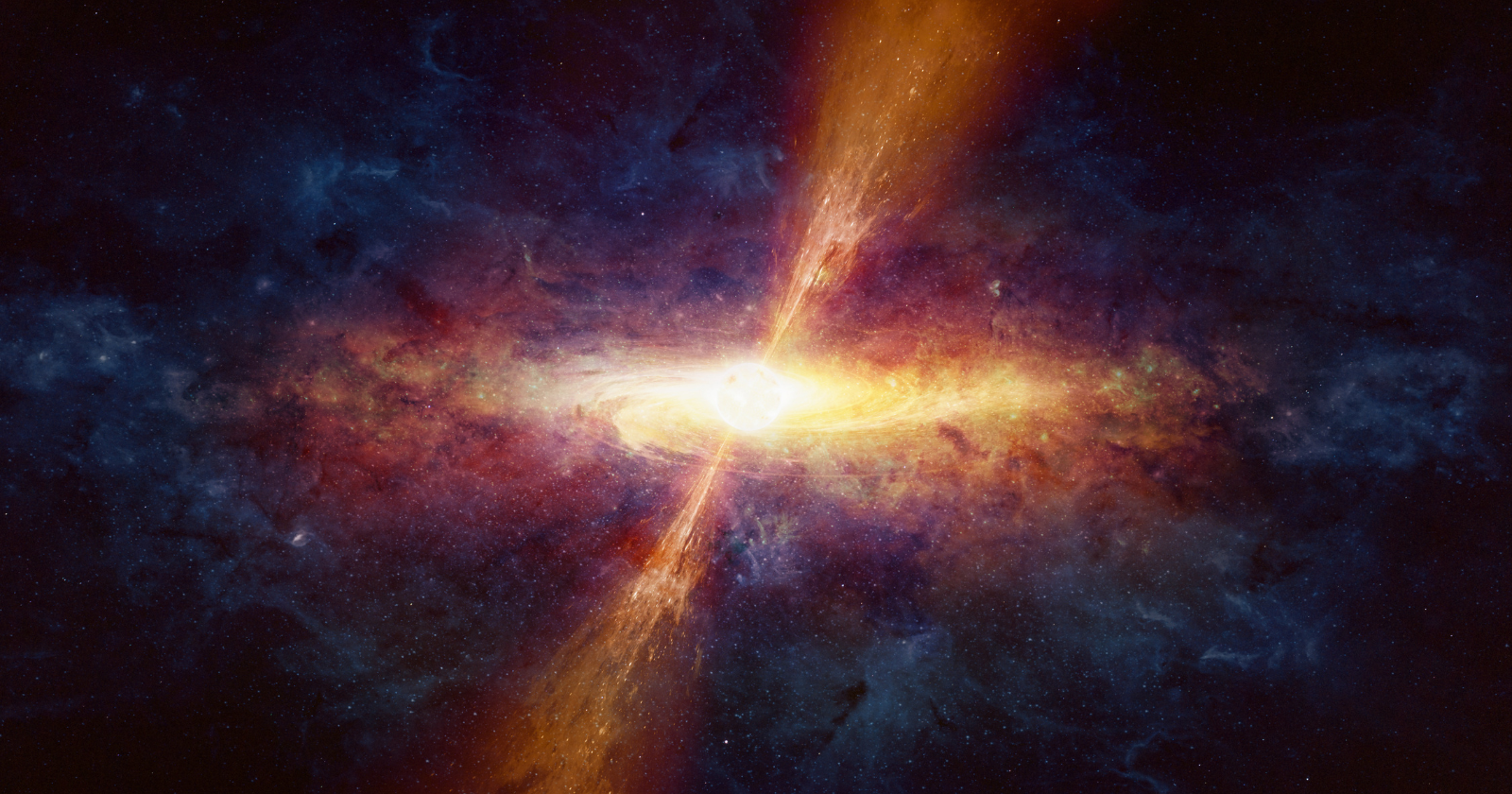
The water surrounds a quasar called APM 08279+5255. A quasar is the brilliant centre of a galaxy powered by a supermassive black hole. As gas and dust spiral into the black hole, they heat up and glow, releasing enormous amounts of energy.
This black hole is about 20 billion times more massive than the Sun. The quasar it powers gives off as much energy as a thousand trillion Suns, making it one of the most luminous objects known.
Seeing back in time
The quasar’s light took around 12 billion years to reach Earth. That means astronomers see it as it was when the universe was only about 1.6 billion years old, less than an eighth of its current age.
Finding such a huge store of water so early in cosmic history showed that water was already widespread in the young universe. The ingredients for water, hydrogen and oxygen, had been produced in the earliest generations of stars and spread through space.
How much water?
The reservoir contains at least 140 trillion times as much water as all of Earth’s oceans combined. That’s about 4,000 times more water vapour than exists in the whole of our own galaxy, the Milky Way, most of which is frozen as ice.
The vapour is spread across hundreds of light-years around the black hole. It’s extremely thin and cold by everyday standards, at around –53°C, yet that’s still five times warmer and many times denser than typical gas in galaxies like ours. Radiation from the quasar keeps the gas warmer than usual.
Two telescopes, one discovery
Two separate research teams made the discovery, using telescopes designed to detect light at millimetre and submillimetre wavelengths, beyond what our eyes can see. Matt Bradford of NASA’s Jet Propulsion Laboratory led a team using an instrument called Z-Spec at the Caltech Submillimeter Observatory on Mauna Kea in Hawaii, which published its findings in The Astrophysical Journal Letters.
A second team, led by Dariusz Lis of Caltech, used the Plateau de Bure Interferometer in the French Alps to measure water in the same quasar, confirming the discovery. Together, they detected several spectral lines of water vapour, the chemical fingerprints that showed it was there.
Fuel for a growing black hole
The water isn’t just a curiosity. It shows that the gas around the quasar is rich and warm, and that there’s plenty of material available to feed the black hole.
The astronomers estimated that the black hole is surrounded by enough gas to keep growing until it’s about six times larger. Some of that gas may also form new stars, or be blown out of the galaxy by the quasar’s powerful radiation.
Water across the cosmos
Water is one of the most common molecules in the universe. It has been found in comets, on moons in our solar system, in the atmospheres of distant planets and in clouds where stars are forming.
The discovery around APM 08279+5255 showed it was already abundant when the universe was young. Twelve billion years ago, long before Earth or the Sun existed, a vast cloud of water was swirling around a giant black hole, an early sign that water has been part of the universe’s story from the start.