
In 1980, millions of people tuned in to the first episode of a new television series called Cosmos. Its host, astronomer Carl Sagan, stood on a rocky shore and spoke about the universe with a mix of wonder and plain-spoken science.
Near the start of that episode, he said something that has been quoted ever since: that the cosmos is within us, that we are made of star-stuff, and that we are a way for the universe to know itself.
It sounds like poetry. But almost every word of it is backed by science.
Who was Carl Sagan?
Carl Sagan was an American astronomer and planetary scientist at Cornell University. He worked on some of NASA’s most important robotic missions, including the Mariner probes, the Viking landers that touched down on Mars in 1976, and the Voyager spacecraft.
He was also one of the most gifted science communicators of the 20th century. Cosmos became one of the most widely watched series in public television history. The original line is slightly different from the version usually quoted: Sagan said the cosmos is “also” within us, and that we are “a way for the cosmos to know itself.”
What “star-stuff” really means
Shortly after the Big Bang, the universe contained almost nothing but hydrogen and helium, the two lightest elements. The heavier elements that make up our bodies and our planet didn’t exist yet.
Those elements were forged inside stars. Deep in their cores, stars fuse lighter elements into heavier ones, creating carbon, nitrogen, oxygen and more. When massive stars die, often in huge explosions called supernovae, they scatter these elements into space.
Over billions of years, that material mixed into new clouds of gas and dust, which formed new stars, planets and eventually us. The carbon in your cells, the oxygen you breathe and the iron in your blood were once part of stars that lived and died before the Sun was born.
Holding star-stuff in your hand
Scientists have even found pieces of those ancient stars. Some meteorites contain tiny grains of dust that formed around dying stars before our solar system existed. In the Murchison meteorite, which fell in Australia in 1969, some of these grains are about 7 billion years old, older than the Sun itself.
NASA’s OSIRIS-REx mission, which brought samples from the asteroid Bennu back to Earth in 2023, found similar presolar grains. They’re direct, physical proof of Sagan’s point: the material around us, and inside us, began in stars.
From words to spacecraft
Sagan didn’t just talk about our place in the cosmos. He helped send messages into it. He led the team that created the Voyager Golden Records, gold-plated discs carrying sounds, music, greetings and images from Earth. Both Voyager spacecraft are now in interstellar space, still carrying them.
In 1990, Sagan also persuaded NASA to turn Voyager 1’s camera back toward home for one last look. The result was the Pale Blue Dot, a photo showing Earth as a tiny speck of light from about 3.7 billion miles away. Few images capture his idea better: a small world, made of star-stuff, looking back at itself from deep space.
The universe knowing itself
The last line of the quote is the most philosophical. For most of cosmic history, the universe had no way to observe itself. Stars burned, galaxies formed and planets cooled, but nothing was there to notice.
Then, on at least one small planet, matter arranged itself into creatures who built telescopes, launched spacecraft and asked where they came from. Every space mission, from Voyager to the James Webb Space Telescope, is part of that story. When we study the stars, the universe is in a sense studying itself, through us.
See it for yourself
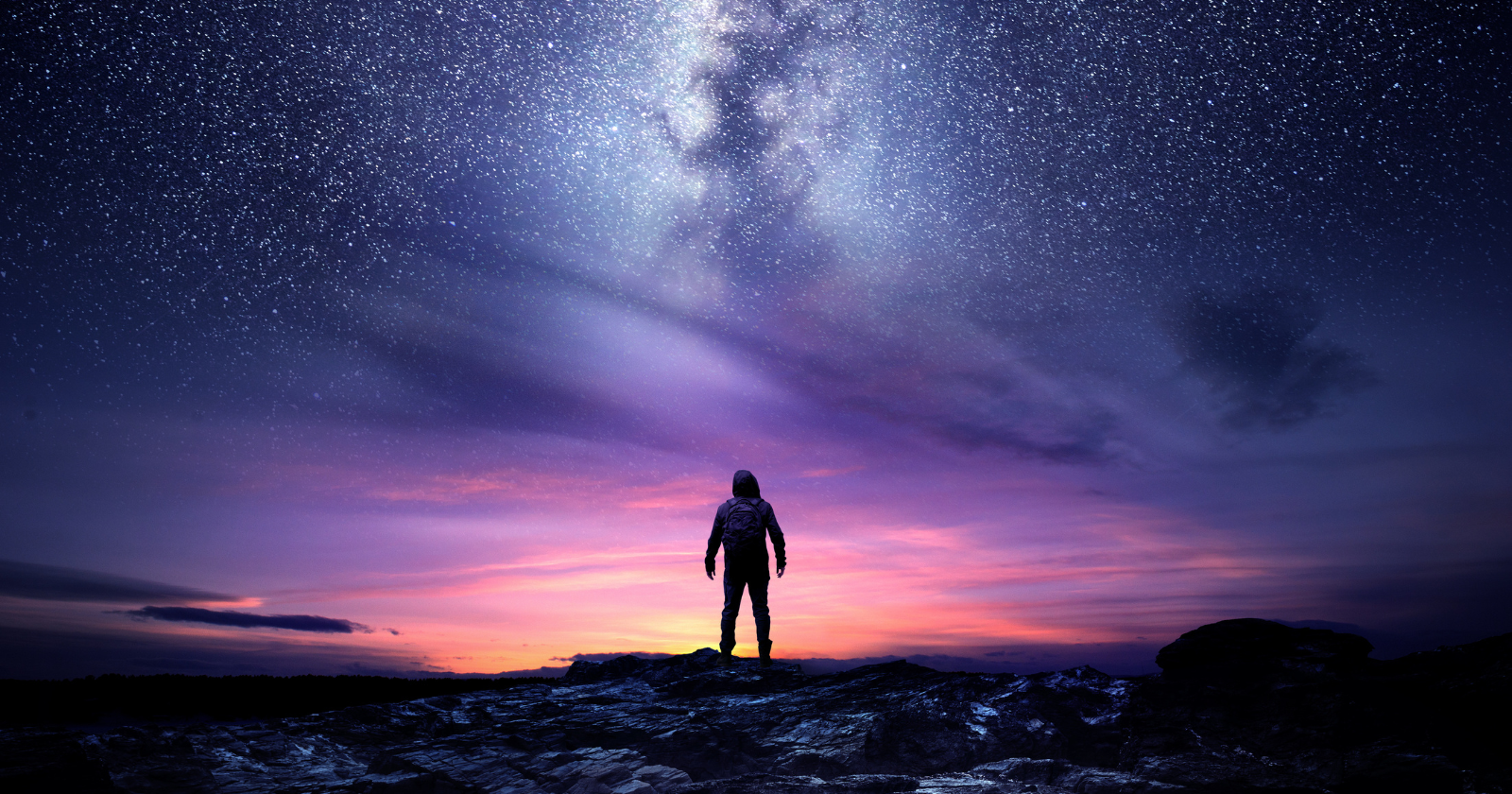
You don’t need a telescope to connect with this idea. On a clear night, step outside somewhere dark and look up for a few minutes. Remember that the light you’re seeing left those stars long ago, and that the atoms in your body share their origins.
You can also look at the Pale Blue Dot image on NASA’s website, or explore the Voyager Golden Record online. Both are reminders that the most remarkable thing about the universe may be that it produced us, able to wonder about it.