
In 1920, on a farm called Hoba West in what is now northern Namibia, Jacobus Hermanus Brits was ploughing a field behind an ox. Suddenly, there was a loud metallic scraping sound, and the plough stopped dead.
Something hard was buried just below the surface. When Brits and others dug around it, they uncovered a huge, flat block of dark metal. It turned out to be the largest known meteorite on Earth, and it’s still lying in the same spot today.
A slab of space metal
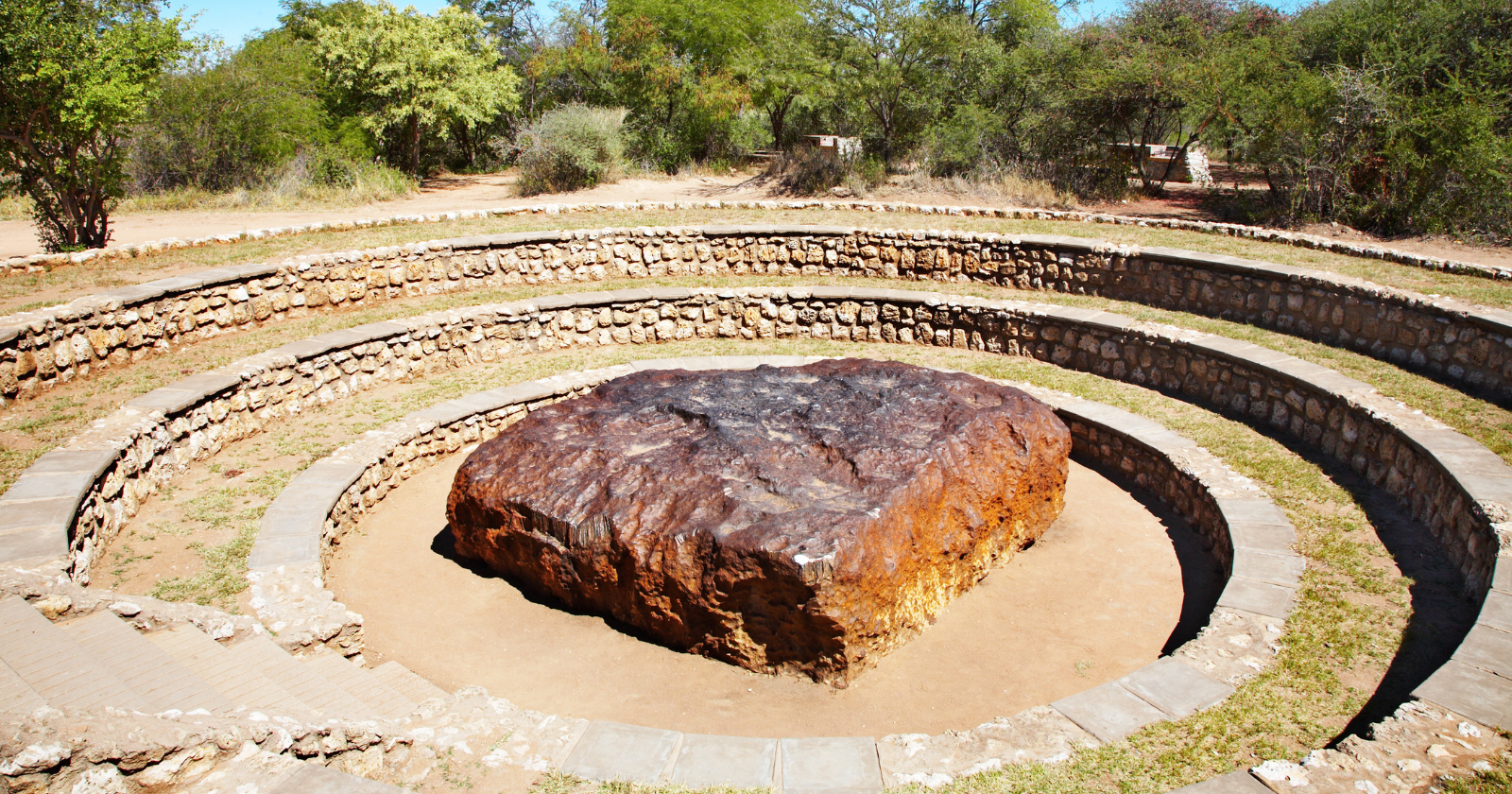
The Hoba meteorite measures about 2.7 metres long and wide and about 0.9 metres thick, roughly the size of a large double bed but far heavier. When it was found, its mass was estimated at about 66 tonnes. Today it’s estimated at around 60 tonnes.
It’s made of about 84% iron and 16% nickel, with traces of other metals such as cobalt. Scientists classify it as an ataxite, a rare type of iron meteorite rich in nickel. Britannica describes it as the largest natural piece of iron known on Earth.
Iron meteorites like Hoba are thought to come from the metal cores of small planet-like bodies that broke apart early in the history of the solar system. That makes Hoba a piece of the inside of another world.
Why it has never been moved
Most large meteorites end up in museums. Hoba never did, for a simple reason: it’s too heavy to move easily.
Over the years, the soil around it was cleared away, so the meteorite now sits exposed in a shallow pit. But the block itself has never been lifted or carried away. It remains on the farm where Brits found it, near the town of Grootfontein.
Its weight has protected it in another way, too. A smaller meteorite might have been sold, cut up or shipped abroad long ago. Hoba stayed put largely because shifting it would have been an enormous undertaking.
A mystery with no crater
One of the strangest things about Hoba is what’s missing. An object this heavy, falling from space at typical speeds, would be expected to blast out a large crater. Yet there is no preserved crater at the site.
Scientists think Hoba fell less than 80,000 years ago, and probably much more slowly than most meteorites. One explanation is its unusual flat shape. As it plunged through the atmosphere, it may have skipped and slowed like a stone on water, losing much of its speed before it hit the ground.
Any small crater that did form may also have worn away over thousands of years, buried under soil and limestone.
Damage and protection
Being left in the open had a downside. Over the decades, visitors and souvenir hunters cut pieces off the meteorite, and saw marks are still visible on its surface. Scientific samples and natural erosion also reduced its mass.
To stop the damage, the government of what was then South West Africa declared Hoba a national monument in 1955, with the farm owner’s permission. In the 1980s, a mining company funded work to protect the site, and a small visitor centre and stone seating area were built around it.
Today, Hoba is a popular stop for travellers in northern Namibia. Unlike most meteorites, visitors are allowed to touch it and even stand on it.
The bigger picture
Meteorites hit Earth every day, but most are small, and many fall into oceans or remote places where no one finds them. Large iron meteorites are rarer, and ones as big as Hoba are exceptional.
The next-largest known meteorites, such as the Cape York meteorite from Greenland and El Chaco from Argentina, are much smaller. Hoba remains in a class of its own.
It’s also a reminder of something that’s easy to forget. Pieces of other worlds are scattered across Earth’s surface, and sometimes they’re hiding just under a farmer’s field.