
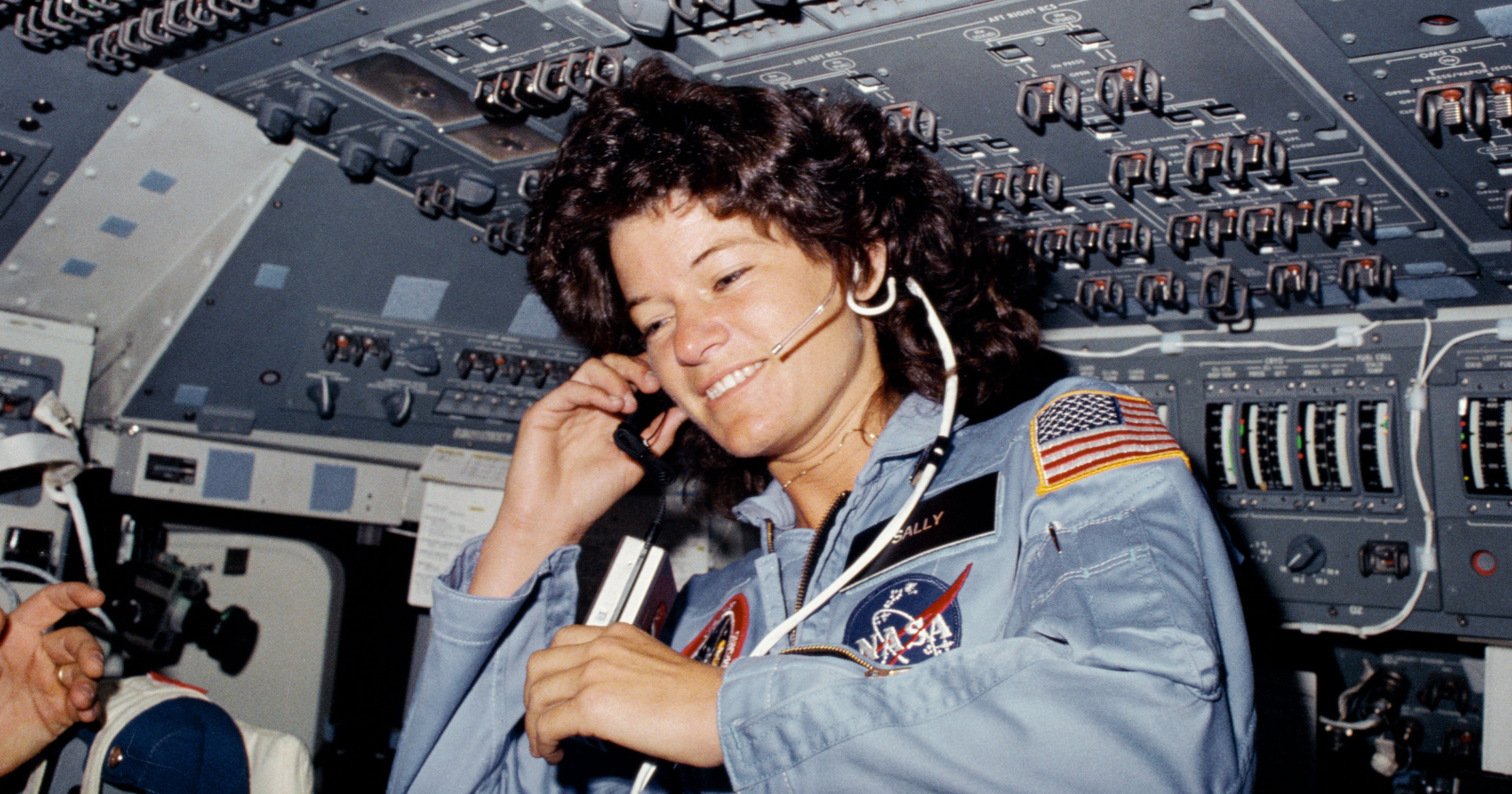
In the early 1980s, NASA was preparing for something it had never done before: sending an American woman into space. Engineers had spent two decades designing spacecraft, suits and supplies for men. Now they had to think about what a woman might need.
So they asked Sally Ride, the astrophysicist chosen to make that first flight. According to Ride’s own account, one of their questions was whether 100 tampons would be the right number for a week in orbit.
A history-making astronaut
Sally Ride was a physicist from California who joined NASA in 1978, part of the first group of astronauts to include women. Six women were selected in that class, out of thousands of applicants.
On June 18, 1983, Ride launched aboard the space shuttle Challenger on mission STS-7. She was 32, and she became the first American woman and, at the time, the youngest American to reach space. During the six-day flight, she operated the shuttle’s robotic arm to deploy and retrieve a satellite.
The Soviet Union had already sent two women into space, Valentina Tereshkova in 1963 and Svetlana Savitskaya in 1982. But for NASA, everything about Ride’s flight was new.
“Is 100 the right number?”
Ride told the story in a 2002 interview for NASA’s oral history project. She remembered engineers trying to decide how many tampons to pack for a one-week flight. As she recalled, they asked, “Is 100 the right number?”
Her answer was simple: no, that would not be the right number. The engineers explained they wanted to be safe. Ride told them they could cut that in half with no problem at all.
The tampons were packaged with their strings tied together in a chain, so they wouldn’t float away in weightlessness. It’s one of many small details engineers had to rethink for life in zero gravity.
The makeup kit
Tampons weren’t the only puzzle. In the same interview, Ride recalled that engineers had also decided women astronauts would want makeup, so they designed a special makeup kit for spaceflight.
Ride was amused. She described imagining the discussions among the mostly male engineers about what should go into it. The kit had to be designed so powders and liquids wouldn’t drift around the cabin.
Clueless or careful?
It’s easy to laugh at the 100-tampon question, and many people have. But there’s another way to see it.
Spaceflight planning is built around caution. Engineers routinely pack extra supplies in case a mission is extended, and they had no data on how menstruation might work in weightlessness. Some doctors at the time even worried about whether blood might flow backward in zero gravity.
The engineers also did what good engineers should do. They asked the person who would actually be using the supplies. Their numbers were wildly off, but they were trying to get it right, and Ride and other female astronauts helped correct them.
The questions Ride faced from the press
Ride also faced questions on Earth that male astronauts never heard. Before her flight, reporters asked whether spaceflight might affect her reproductive organs and whether she cried when things went wrong during training. Her biographer, journalist Lynn Sherr, described these questions as among the most clueless moments of the time.
Ride handled them calmly and with humor. She said she wanted to be treated as an astronaut, not as a novelty, and she was frustrated by the attention on her gender rather than her work.
What we’ve learned since
Since Ride’s flight, more than 70 women have flown in space, and NASA has learned a great deal about women’s health in orbit. Menstruation in space turned out to work much as it does on Earth, with no evidence that weightlessness causes dangerous problems.
Today, many female astronauts choose to use hormonal contraceptives to pause their periods during missions, which simplifies hygiene and reduces the supplies they need to carry. That’s a personal choice, made with medical guidance.
Ride flew again in 1984 and later helped investigate both the Challenger and Columbia disasters. She went on to found a company encouraging girls and young women to pursue science. She died in 2012, but her matter-of-fact handling of those early questions helped make space a place where women were expected, not an exception.