
On April 23, 1972, near the end of his third and final moonwalk, Charlie Duke bent down and placed a small photograph on the gray lunar surface. It showed a smiling family sitting on a bench in a Texas backyard: Duke, his wife Dorothy, known as Dotty, and their two young boys, Charles and Tom.
He took a picture of it lying in the dust. Then he climbed back into the lunar module and left it behind. More than 54 years later, as far as anyone knows, it’s still there.
The youngest man to walk on the Moon
Charlie Duke was 36 when Apollo 16 landed in the Moon’s Descartes Highlands on April 20, 1972. He remains the youngest person ever to walk on the lunar surface.
He was already part of space history. During Apollo 11 in 1969, Duke served as the capsule communicator in Mission Control, the voice talking to Neil Armstrong and Buzz Aldrin as they landed. After the touchdown, he famously told them they had a bunch of people on the ground about to turn blue, before everyone started breathing again.
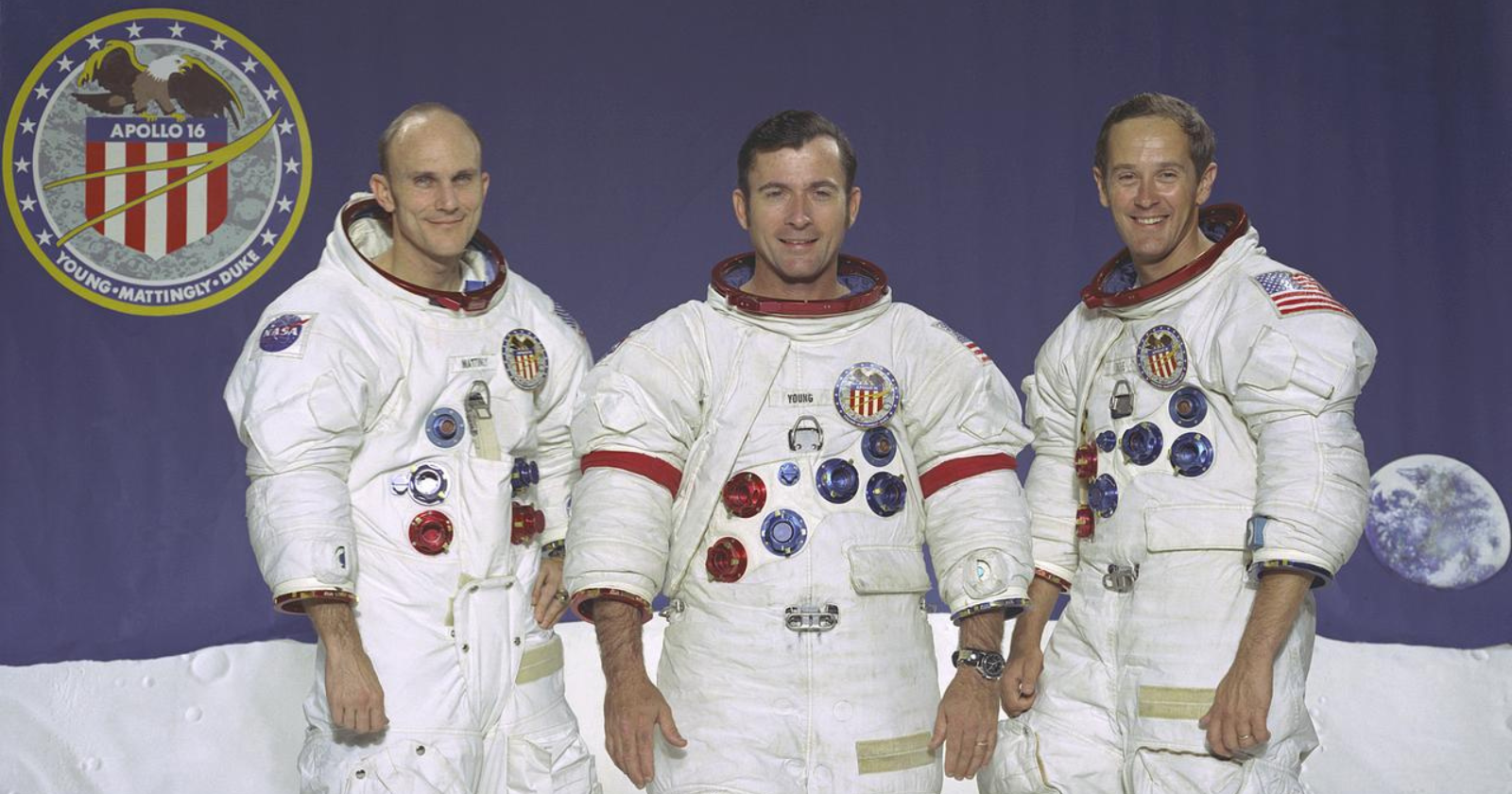
Three years later, he made the journey himself, alongside commander John Young, while Ken Mattingly orbited above in the command module.
Bringing the family along
Training for a Moon mission took up much of Duke’s life. His sons, then around 7 and 5, were fascinated by what their dad was doing but couldn’t come along.
So Duke came up with a way to take them with him. In his autobiography, Moonwalker, he wrote that Dotty and the boys were delighted about having a picture of the Duke family on the Moon. A NASA photographer and friend, Ludy Benjamin, came over to their home and took the family portrait.
On the back, Duke wrote a short message saying the photo showed the family of an astronaut from planet Earth who had landed on the Moon in April 1972. The family signed it, and the photo was sealed in plastic for the journey.
Left in the lunar dust
During the third moonwalk, Duke set the photo down on the surface near the landing site. He photographed it with his Hasselblad camera, and that image, catalogued by NASA as AS16-117-18841, survives in the mission’s archives.
The picture shows the small family portrait resting at an angle on the dusty ground, a startlingly ordinary object in an alien place. It has since become one of the most widely shared images from the Apollo program.
What has happened to it since?
No one has visited the Apollo 16 site since 1972, so nobody knows the photo’s exact condition. But scientists have a good idea of what it has faced.
The Moon has no atmosphere to filter the Sun’s ultraviolet light, which is strong enough to bleach colors and break down plastics over time. Temperatures swing from well over 100 degrees Celsius during the lunar day to far below freezing at night. Tiny meteorites constantly pepper the surface.
The family’s faces have very likely faded to near-white. But with no wind or rain to carry it away, the photo itself is probably still lying where Duke placed it.
One of many personal mementos
Duke’s photo is part of a small collection of personal objects left on the Moon. Apollo 11 left a silicon disc with goodwill messages from world leaders, along with patches and medals honoring astronauts and cosmonauts who had died. Apollo 15 left a small aluminum sculpture called “Fallen Astronaut,” with a plaque listing the names of space explorers who had lost their lives.
What makes Duke’s photo different is how personal it is. It wasn’t a statement from a nation or a tribute to the space program. It was simply a father bringing his family with him to the most remote place any person had ever been.
Why it still resonates
Duke has said in interviews that he wanted his sons to feel part of the mission, and the photo did exactly that. Decades later, it continues to connect with people who have never been anywhere near a rocket.
Part of the appeal is the contrast. Apollo was an enormous technical project involving hundreds of thousands of people and billions of dollars. Yet one of its most memorable images is a small family snapshot, the kind that sits on mantelpieces in homes all over the world.
Somewhere in the Descartes Highlands, the family of an astronaut from planet Earth is still there, under a black sky, waiting for whoever comes next.