
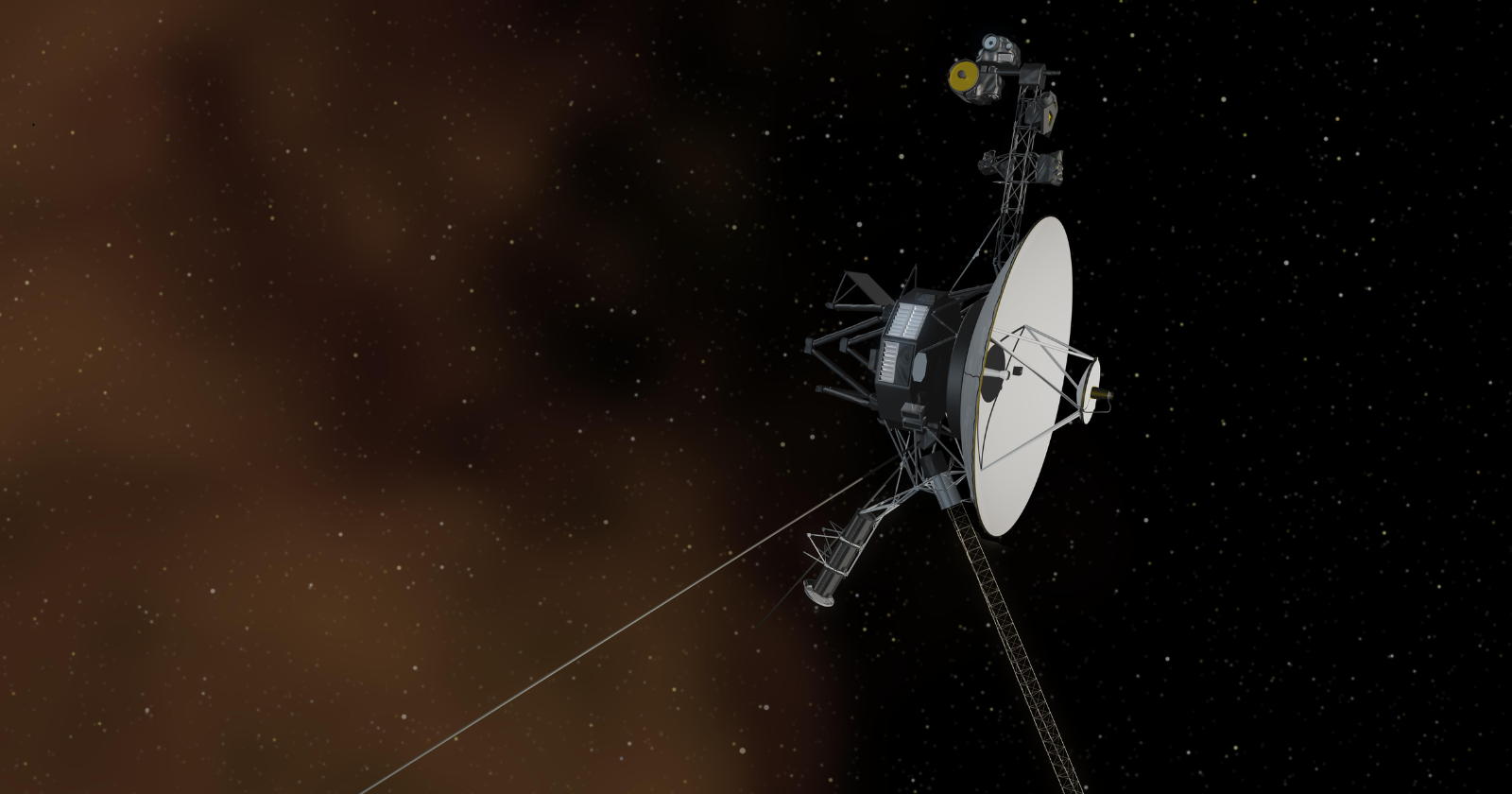
In the early hours of November 18, 2026, a small spacecraft far beyond the planets will quietly cross a line no human-made object has crossed before. From that moment, a radio message from Voyager 1, traveling at the speed of light, will take more than a full day to reach Earth.
Voyager 1 has been flying for more than 49 years. It’s running on aging hardware and fading power. And it’s still talking to us.
A day at the speed of light
Light is the fastest thing in the universe. It can circle Earth more than seven times in a second, and it reaches us from the Sun in about eight minutes.
A light-day is the distance light covers in 24 hours, roughly 25.9 billion kilometers, or about 16.1 billion miles. According to NASA, Voyager 1 will reach that distance at 06:16 UTC on November 18, 2026. Getting there took 49 years, two months and 11 days.
After that, every command NASA sends will take more than a day to arrive, and the reply will take more than a day to come back. A simple question and answer will take more than two days.
Built with very little memory
Voyager 1 launched on September 5, 1977, a few weeks after its twin, Voyager 2. By modern standards, its technology is astonishingly basic.
Its onboard computers are commonly described as having around 70 kilobytes of memory in total. A single photo on a modern smartphone often takes up several megabytes, many times more. The spacecraft originally stored data on an eight-track-style tape recorder.
Yet that modest hardware guided Voyager 1 past Jupiter in 1979 and Saturn in 1980, sending back some of the most famous images of the outer planets ever taken.
Out of the solar system
After Saturn, Voyager 1 headed up and out of the plane of the planets. In 1990, it turned its camera back toward home and took the image known as the “Pale Blue Dot,” showing Earth as a tiny speck in a sunbeam.
In August 2012, it became the first spacecraft to enter interstellar space, the region between the stars beyond the bubble of solar wind that surrounds our Sun. Its twin, Voyager 2, followed in 2018.
Voyager 1 is now traveling at about 61,000 kilometers per hour, or roughly 38,000 miles per hour, heading toward the constellation Ophiuchus.
Keeping an old spacecraft alive
Keeping Voyager 1 working has become a delicate balancing act. It runs on a nuclear power source that produces less electricity every year, so engineers have gradually turned off heaters and instruments to save energy. In April 2026, the team switched off another science instrument, the Low-Energy Charged Particle instrument.
The spacecraft has also had serious scares. In late 2023, Voyager 1 began sending back unreadable data. Engineers eventually traced the problem to a faulty memory chip in one of its computers and, working from billions of miles away, moved the affected code to other parts of memory. By 2024, the spacecraft was again returning useful science.
Why the date isn’t simply fixed
The milestone is measured from Earth, and Earth is constantly moving around the Sun. At some times of year, it moves slightly toward Voyager 1, and at others, slightly away.
That’s why different estimates were given over the past year, ranging from November 13 to November 18. NASA has now calculated the official date. After this crossing, Voyager 1 will never return within one light-day of Earth.
Voyager 2, which took a slower route past Uranus and Neptune, isn’t expected to reach a light-day from Earth until around 2035, and may not be operating by then.
How far is a light-day, really?
A light-day sounds enormous, and it is. Voyager 1 is now more than 170 times farther from the Sun than Earth is.
But in cosmic terms, it’s barely a first step. The nearest star beyond the Sun, Proxima Centauri, is more than four light-years away, which is more than 1,500 light-days. Even at its current speed, Voyager 1 would need tens of thousands of years to get anywhere near another star.
A message for the future
Voyager 1 carries a gold-plated record with sounds and images from Earth, including greetings in dozens of languages, music and natural sounds. It was intended as a message for anyone who might one day find the spacecraft.
NASA expects Voyager 1 to run out of power sometime in the early 2030s. When it falls silent, it will keep drifting through the galaxy for millions of years, carrying that record with it.
For now, though, it’s still sending data home, a full day’s journey at the speed of light, from the edge of everything humans have ever reached.